How to Automate Vanta
Vanta automates the evidence. Hundreds of tests run hourly across your connected systems, controls map to SOC 2, ISO 27001 and HIPAA at the same time, and policy acceptance and access reviews are tracked in one place. Chasing the people behind a failing control is still manual, and that is where an agent such as WebRun works.
 Written by
Clara Bennett
Revenue operations
Written by
Clara Bennett
Revenue operations
 Reviewed by
Elliot Nakamura
Platform writer
Reviewed by
Elliot Nakamura
Platform writer
Compliance stopped being a binder and became a dashboard
Security compliance used to be a binder assembled once a year, correct on the day it was signed and stale by February. Vanta is the other model: the state of a company's controls kept current continuously, on a screen anyone can open on a Tuesday.
Underneath are integrations into the cloud accounts, the identity provider, the HR system and the code repositories. Controls tie each framework requirement to the tests, documents, policies and risks that satisfy it, so one control can serve SOC 2, ISO 27001, HIPAA and GDPR at once. A Trust Center publishes the result to the buyers who keep asking.
Two kinds of team live in it: in-house security and compliance people running their own programme, and the vCISO and managed service practices running programmes for many clients through Vanta's MSP partner console.
A failing control is a person who has not replied yet
The tests take care of themselves. The failures are people.
A control goes red because an engineer has not turned a setting on, because a manager has not confirmed who should still reach the production database, or because a policy sits unacknowledged by four new starters. A vendor review needs a report the vendor has not sent. An access review needs eight reviewers to open their list and look at it. A client owes a signed subprocessor agreement and has owed it since the kickoff call.
So somebody spends the week writing the same message in different tones to different people, then going back to see whether it worked. A practice doing this for clients runs that loop across a dozen programmes with different frameworks and audit dates, and fits its own proposals and invoices into the gaps.
Hourly tests watch the systems, not the people
Vanta already removes most of the collecting, and a team should have all of it running before adding anything.
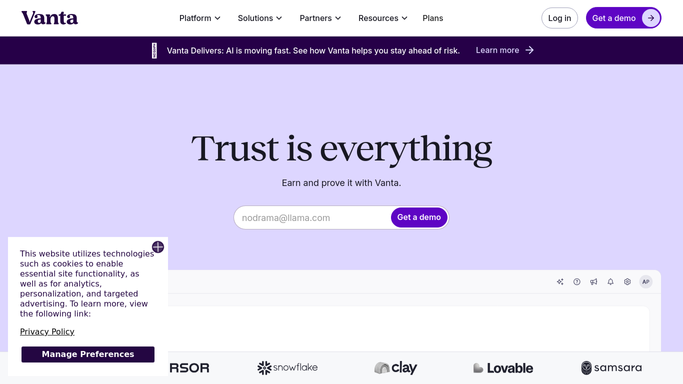
Hundreds of automated tests run hourly across the connected systems, so evidence is continuous instead of a screenshot taken the week before an audit. Policy management ships templates for each framework, a builder to customise them, and acceptance tracked automatically. Access reviews come with their own tests, approval workflows and dashboards for running the round and showing an auditor the result. Questionnaire automation drafts answers to the security questionnaires that arrive with every enterprise deal, and the Report Center turns a programme's state into something a board will read.
That is a great deal of the job, and the half that used to eat entire quarters.
What is left is the part with a human on the other end. A test flips to failing, an issue is raised against an owner, and then the week happens: the reply that never came, the reviewer who opened the list and did nothing, the client waiting on their own vendor. Somebody has to look again until it closes. For a practice billing this work, the retainer, the proposal and the invoice sit elsewhere entirely.
Every date in a compliance programme can be counted down
A programme slips in the days between the tests, not in the tests.
A critical control turning red, read as it happens and put in front of whoever owns that system, with what changed attached, rather than found on Friday. Every certification and audit date across every programme counted down in one list, so a renewal becomes a plan rather than a fortnight of panic.
Controls still waiting on a document turned into a worklist of who owes what, with each reminder written and left for somebody to send. Quarterly access reviews prepared in advance: the reviewers named, a request drafted for each with their list attached, and the slot held in the calendar. A Friday summary per client: pass rate, what opened this week, what closed.
For a practice, the same reading applied to the commercial side. Proposals with no reply after five days. Retainers expiring inside the quarter. Overdue invoices set beside whether that client's programme is still live.
None of that is a compliance opinion. Reading a screen, counting days and drafting a chase are clerical. Whether a control is satisfied, whether evidence is enough and whether a company may claim a certification stay with the people accountable and with the auditor, and nothing here is filed with either.
Nobody needs a security lead to send a reminder
The chasing does not need the most expensive person in the company. It needs somebody who will look again on Thursday.
WebRun is an AI agent that drives a real Chrome browser, signed in the way your team signs in. It opens the dashboard, a client workspace, the calendar or the accounting system, reads what is on the screen, and comes back with a list that has owners and dates on it.
It runs on your schedule inside a private environment of your own. Sessions are not shared between workflows, a workflow can be locked to an explicit list of domains, and a run can be watched and stopped. Nothing is attested, submitted or signed on your behalf, and anything reaching a client, a reviewer or an auditor is drafted and waits for a person.
Each workflow below names what it opens and how often.
Questions people ask
Can it mark a control as passing or sign off an access review?
No. It reads what the dashboard shows, names the reviewer and drafts the request, but a control status and a reviewer approval are attestations. An attestation has to be made by the person answerable for it, and that is the whole point of having one.
Does running this make us compliant, or count as evidence?
Neither. It is a way of doing the chasing on time. It is not a control, not an auditor and not evidence of anything. Your certification still rests on Vanta's tests, your own controls and the opinion of the audit firm you engage.
We run programmes for a dozen clients. Can it keep them separate?
Yes, and that is the situation it suits best. Each workflow is scoped to the accounts and sites you point it at, sessions are not shared between workflows, and one run per client returns one list, so a dozen programmes come back as a dozen reports.
11 ready-made Vanta workflows
Each one names the apps it touches and the exact steps it takes. Open one to read what it will do, then turn it on.

Want one of these running on your own Vanta?
Show WebRun the process once and it will run it on schedule, in your own private browser environment.