How to Automate Azara Healthcare
Azara DRVS automates the reporting a health center is judged on: Patient Visit Planning for the daily huddle, risk stratification across the panel, cohort registries, Automated Patient Outreach and the measure logic behind UDS. Reconciling each health plan's own gap list, on each plan's own portal, stays a manual month.
 Written by
Tom Kessler
Field operations analyst
Written by
Tom Kessler
Field operations analyst
 Reviewed by
Devon Ruiz
Workflow engineer
Reviewed by
Devon Ruiz
Workflow engineer
Azara DRVS sits above the chart, not inside it
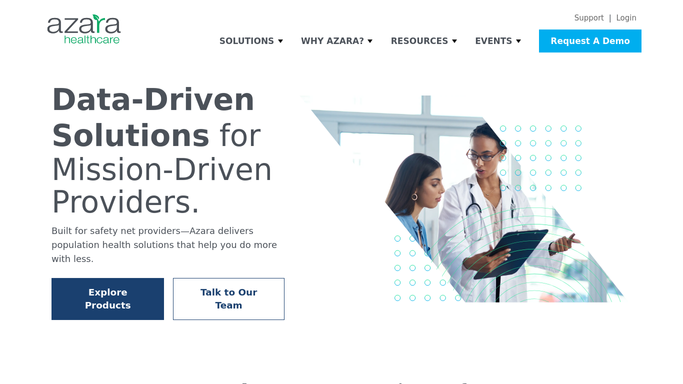
Azara Healthcare makes population health and quality reporting software for the safety net: federally qualified health centers, rural providers, primary care associations and the networks over them. The platform is DRVS, and most people say Azara and DRVS interchangeably.
Azara is not the electronic health record. It sits above one, or above several. A network with four sites on three different EHRs is an ordinary Azara customer, and they bought it because nobody could answer a simple question about the whole organization.
DRVS turns that data into measures, registries, dashboards and worklists. Diabetics whose last A1c came back over nine. Patients overdue for colorectal screening. Cohort registries for hepatitis C, HIV, maternal care and controlled substances. Risk stratification that ranks a panel high, moderate or low using diagnoses, medications, utilization and social determinants.
The people in it are a quality improvement director, a data analyst and a handful of care coordinators, and their year is shaped by two things: UDS reporting to HRSA and whatever the value-based contracts say.
Every health plan sends its own version of your numbers
A health center with five value-based contracts has five sets of quality numbers, and DRVS is one of them.
Each plan runs its own gap list on its own portal, built from its own claims, and none of them match. The plan says a patient is overdue for a mammogram. The mammogram happened at a hospital imaging center in March and the result came back on paper. The health center has the report, the plan does not, and until somebody uploads the proof the contract pays as though it never happened.
So the quality team's month has a shape. Log into each plan's portal, download the gap list, line it up against DRVS, and work out which differences are real gaps and which are the plan not knowing something. Then find the evidence for the second group, which means a specialist's portal, a hospital records site or the state immunization registry. Then upload it, one plan at a time, in whatever format that plan accepts.
And underneath it all the attribution roster, quietly changing, deciding whose numbers these are.
Patient Visit Planning already tells the care team what to ask
Azara automates more of this than most health centers use, and the modules are worth exhausting before anything else.
The Patient Visit Planning report lays out each day's appointments by provider, with a summary of who the patient is and which care gaps are open, so the morning huddle runs off one page. Automated Patient Outreach drives recall and reminder campaigns across whole cohorts. UDS and quality reporting centralize the measure logic and validation the HRSA submission depends on.
Every one of those works on data that reached Azara through a feed somebody negotiated.
That is the honest limit, and it is no criticism of the feeds. A feed exists because two organizations agreed to build one and keep it running. The colonoscopy at the hospital, the shot given at a supermarket pharmacy, the specialist's note, the plan's own quality portal and the federal system UDS is filed in all sit outside that agreement. They are websites with logins, and they will be websites next year too.
A measure can be proved with records from outside the building
A health center's problem is rarely the care. It is proving the care, and the proof sits on sites an analyst has to sign into one at a time.
Each plan's gap list pulled from its portal and set line by line against the DRVS registry, so the differences arrive sorted: genuinely open gaps on one list, evidence the health center is holding on the other. The second list is the money.
Immunizations checked against the state registry, so a child counted as behind in DRVS is either genuinely behind or has a dose recorded somewhere nobody looked. Screening and specialist results chased on the portals holding them, with referrals that never came back kept separate from the ones that did.
Attribution rosters read every month, so a hundred patients appearing in or vanishing from a contract is noticed in time to react. Measure performance tracked week to week against the thresholds that matter, so the December scramble becomes a series of small corrections in November.
The quality team should be improving care, not proving it
Designing an outreach campaign, choosing which measure to push and deciding where a care manager spends the week is skilled work. Downloading eleven gap lists and reconciling them by hand is not, and it uses the same people.
WebRun is an AI agent that works a real Chrome browser, signed in as your staff are. It opens DRVS, each health plan's quality portal, the state registry and the specialist's site, reads what is on screen, and brings back the comparison with the names and differences on it.
It runs on your schedule, and a workflow can be locked to a named list of domains. Gathering and checking runs unattended. Anything that changes a clinical or billing record, submits supplemental data or reaches a patient waits for a qualified person to review and send.
The workflows below are already built, and each one names what it opens.
Questions people ask
Will it upload supplemental data to a health plan?
No. Submitting evidence to a payer changes what a contract pays, so it is assembled and left for a person to send. The reconciliation itself, which is the slow half of the job, is what runs unattended.
Does this replace DRVS or our UDS reporting?
No. DRVS holds the measure logic and the clinical data behind it, and none of that moves. This covers the sites DRVS was never going to reach: each plan's quality portal, the state registry, and the specialist holding a result.
Is patient data safe if something is signing into these portals?
It runs in your own private environment on your schedule, sessions are not shared between tools, and a workflow can be locked to a named list of domains. You can watch a run and stop it at any point.
12 ready-made Azara Healthcare workflows
Each one names the apps it touches and the exact steps it takes. Open one to read what it will do, then turn it on.

Want one of these running on your own Azara Healthcare?
Show WebRun the process once and it will run it on schedule, in your own private browser environment.