How to Automate Artlogic
Artlogic already runs the gallery record: artworks with consignments, loans, provenance and editions, contacts with purchase history and RSVP tracking, invoicing with payment links, websites and the Private Views app. The auction result, the shipper's tracking page and the fair portal sit outside it, which is where an agent like WebRun earns its place.
 Written by
Owen Hartley
Workflow engineer
Written by
Owen Hartley
Workflow engineer
 Reviewed by
Sofia Marchetti
Marketing operations
Reviewed by
Sofia Marchetti
Marketing operations
A gallery's stock is one of everything
Artlogic is the platform a large part of the commercial art world runs on: galleries, artist studios and private collections. It is one company by acquisition as much as by design, having merged in January 2022 with the New York businesses exhibit-E, galleryManager and ArtBase, whose customers are still supported.
What it manages is inventory that behaves unlike any other. There is one of each thing. It has a maker, a date, a medium, dimensions, an edition if it is a print, a condition report, a provenance, and a location that may be a wall, a crate, a fair, a museum on loan or a collector's house on approval. Most of it is not owned by the gallery at all. It is consigned by the artist or an estate, on terms with an end date.
The other half of the business is the contact list, which is the part that is genuinely hard to replace.
The month ends with statements nobody has started
Very little of a gallery's admin is difficult. Almost all of it is remembering.
Consignment terms run out and the work has to go back or be renegotiated. A collector on a payment plan owes the third instalment. A work has been on hold for a client who stopped replying. The crate that left for the fair is somewhere between a warehouse and a booth. A condition report is needed before a loan can go out, and an insurance certificate before that.
Then month end, when somebody sits down and builds a sales statement for each represented artist out of what sold, at what price, less commission, less the shipping that was agreed to be shared. It is arithmetic, it is late, and the artist notices when it is.
The database knows the work, not the world it sells into
Artlogic handles more of this than most galleries use, and it is worth exhausting first.
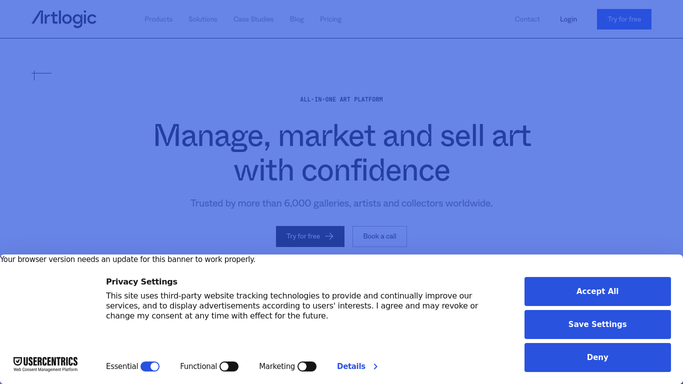
The artwork record carries consignments and loans, provenance and condition reports, prints and editions, shipping and multiple locations, and multiple currencies, so where a work is and on what basis is a lookup. The contacts side holds purchase history, categories and interests, contact narratives, grouped and related contacts, and event and RSVP tracking, which is what turns a mailing list into an invitation list. Invoicing is built in, with online payment links, credit notes, multiple billing entities, tax rate handling and the margin scheme, and Artlogic Pay takes the money. Websites, viewing rooms and online stores build from the same database, and the Private Views app shares a curated selection with a named collector, password protected and set to expire.
What none of it does is look outward. The auction result that reprices an artist, the shipper's tracking page, the fair's exhibitor portal and the artist's own studio inventory sit on other people's websites, and a database only knows what a gallery has typed into it.
An auction result can arrive with your own stock beside it
Picture the outside world arriving in the database on its own.
An auction house's published result for an artist you represent, read the week it happens and set beside the works you hold by that artist at the prices you are asking, so a pricing conversation starts from what the market just did. A crate followed on the shipper's own tracking page, with the arrival date written against the loan or the consignment it belongs to. The fair's exhibitor portal watched for the deadlines that arrive as a PDF and get missed: booth plans, shipping cut-offs, catalogue entries, customs paperwork.
Then the quieter checks. Press and museum announcements for represented artists, so the note to a collector goes out the week a show is announced rather than a month after. Payment plan instalments due, set against what has actually cleared. Consignments coming up on their return date, listed with the artist, the work and the option to extend. Works available for months, ranked so the ones going stale are visible before anyone asks about the year.
Nobody sells a painting by opening a tracking page
Knowing which collector to call about which work is the entire trade, and it is the one thing that cannot be handed over. Finding out whether the crate cleared customs can be.
WebRun is an AI agent that works a real Chrome browser, signed in as you. It opens Artlogic the way your registrar does, opens the shipper, the auction house or the fair's exhibitor portal beside it, and writes the answer back against the work, the contact or the consignment it belongs to.
Every message stays a draft. Collector emails, invitations, reminders and artist statements are prepared with the details filled in and held for a person, because a gallery's relationships are the asset and nothing about them should go out unread.
Each workflow below names what it opens.
Questions people ask
Will it email a collector without anyone reading it first?
No. Collector emails, invitations, reminders and artist statements are drafted with the work, the price and the history already filled in, then held for a person. A gallery's relationships are its real asset, so nothing goes out unread.
We still run some records in ArtBase. Does that matter?
No. ArtBase merged into Artlogic in 2022 and existing installations are still supported, so some galleries genuinely run both. An agent driving a browser reads whichever screens your team signs into, which makes a mixed setup no harder than a single one.
Can it write back into the Artlogic database, or only read it?
Both, within limits you set. It can update a location, an arrival date or a status the way a registrar would, and it can equally be restricted to reading and reporting. Anything that changes a price, an invoice or a consignment term is prepared for a person instead.
11 ready-made Artlogic workflows
Each one names the apps it touches and the exact steps it takes. Open one to read what it will do, then turn it on.
Want one of these running on your own Artlogic?
Show WebRun the process once and it will run it on schedule, in your own private browser environment.