How to Automate WhatsApp

WhatsApp automates at two levels. The Business app covers greetings, away messages, quick replies and broadcast lists on its own. Sending each customer something specific to them, like their order status or their appointment, needs the answer looked up first, which is where the manual work still sits.

WhatsApp is the channel customers actually answer

WhatsApp is the messaging app most of the world already has open, and for a great many businesses it has quietly become the main line to the customer. Orders come through it. Photos of the broken thing come through it. Appointments get moved in it.

It won that job by being where people already were. A customer who ignores email and never installed your app will reply on WhatsApp in four minutes, because it is the same app their family is in.

For a small business that is a real advantage and a real trap. The advantage is that messages get read. The trap is that a channel this personal does not scale by adding people to it, and the owner ends up answering it at ten at night.

Every answer is the same answer with different details

Look at a week of business WhatsApp messages and most fall into about five shapes.

Where is my order. When are you coming. How much for this. Did you get my payment. Can we move it to Thursday.

None of those are hard. Each one takes somebody opening the booking system or the courier page or the ledger, finding the one line about that customer, and typing it into a chat. Two minutes each, forty times a day, mostly done standing up with a phone in one hand.

The information is never the problem. The problem is that it lives somewhere else, and a person has to be the bridge.
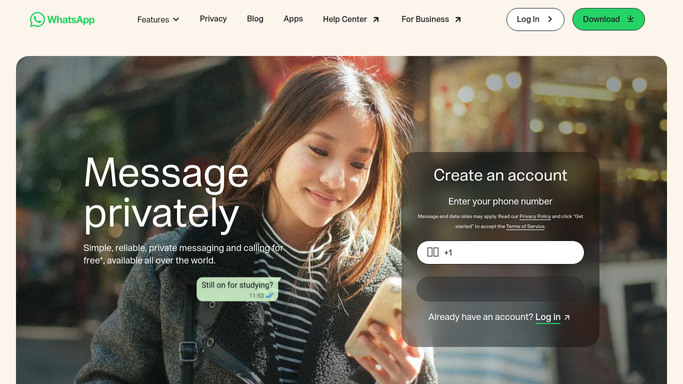
The whatsapp.com homepage, the app these three jobs run in. WhatsApp
Personal, not broadcast Each customer told about their own order, their own booking, their own balance, instead of everyone getting the same text.
The status looked up first The tracking page, the booking system or the ledger read before the message is written, so the number in it is right.
Drafted before it is sent Messages to customers land in front of a person first. Nothing goes out on its own unless you decide it should.

The Business app covers the generic, not the specific

The free WhatsApp Business app does more than most owners have set up, and it is worth using properly first.

It gives you a greeting message for first contact, an away message for out of hours, quick replies you can fire with a shortcut, labels for organising chats, a catalogue for products, and broadcast lists for sending one message to many people at once. The Business Platform, the paid API tier, adds templated messages and proper integrations for larger operations.

Notice what all of those have in common. They send something written in advance. A greeting is the same for everyone. A quick reply is the same paragraph every time. A broadcast is one message to a list.

The moment a message needs a fact about that specific customer, the automation stops and a person takes over, because the app has no way to find out where that particular order is.

Each customer can be told their own answer

Change what is able to look things up and the five shapes above stop being work.

The customer asking where their order is gets the actual status, read off the courier site using the reference from their own confirmation. The customer asking when you are coming gets tomorrow's window from the scheduling system. The one asking about payment gets told what the ledger says, rather than a promise to check.

It works in the other direction too, before anyone asks. The delivery that slipped, flagged to the person waiting for it. The appointment reminder that goes out the evening before with the right time on it. The part that came back into stock, mentioned to the three people who asked about it last month.

This is also where the care belongs. WhatsApp is somebody's personal phone, sitting next to messages from their family, and people are far less forgiving of an automated mistake there than in email. Anything going to a customer should be drafted and read by a person before it leaves, at least until you trust the shape of it completely.

The lookup is what needs handing over

Typing the message was never the slow part. Finding out what to put in it was.

WebRun is an AI agent that works a real Chrome browser, signed in as you. It opens the courier site, the booking system or the ledger, finds the line about that customer, and prepares the reply with the real detail in it, ready for you to glance at and send.

It runs on your schedule in your own private environment, and you can watch a run and stop it. Customer messages draft and wait by default, because this is the channel where that matters most.

The workflows below are already built, and each one names what it opens.

Questions people ask

Will it message my customers on its own?

Not by default. It prepares the message with the details already filled in and leaves it for you to send. This is the channel where an automated mistake is least forgivable, so approval is the starting position.

Does this need the paid WhatsApp Business API?

No. It works the WhatsApp interface you already use, signed in as you, which is why it suits small operations that were never going to set up the Business Platform.

How does it know which customer a message is about?

From the conversation itself, plus whatever reference is in it. It reads the thread, takes the order number or the name, and looks that up in the system that holds the answer.

1,350 ready-made WhatsApp workflows

Each one names the apps it touches and the exact steps it takes. Open one to read what it will do, then turn it on.
Automated Typesense Index Sync Reconciliation
WebRun compares your Typesense collection document counts against the source database every night, creates a Trello card for any mismatch, and pings the on-call engineer on WhatsApp.
TypesenseTrelloWhatsApp
Automated Tuple Weekly Pairing Scorecard
WebRun reviews your team's Tuple call history every Monday, messages a WhatsApp scorecard of hours paired and top pairs, and adds next week's suggested pairing slots to Google Calendar.
TupleWhatsAppGoogle Calendar
Automated Trezor Firmware and Backup Checklist
Every month, WebRun checks Trezor Suite for a pending firmware update and reads back whether your recovery backup has been verified, tracks both on a Trello checklist, and sends a WhatsApp reminder if either is overdue.
TrezorTrelloWhatsApp
Automated TradingView Alert Digest
Every morning, WebRun reads which of your saved TradingView alerts triggered overnight, sends you a digest over WhatsApp, and adds any major earnings or economic event on your watchlist symbols to Google Calendar.
TradingViewWhatsAppGoogle Calendar
Automated Trading 212 Portfolio Scorecard
WebRun reviews your Trading 212 Pies and holdings every Monday, checks how far each Pie has drifted from its target allocation, and sends you a WhatsApp recap while logging the numbers to a Trello card.
Trading 212TrelloWhatsApp
Automated Tradestation Options Expiration Alerts
Every morning, WebRun reads your open Tradestation options positions, flags any expiring within 3 days along with assignment risk, adds a reminder to Google Calendar, and sends a WhatsApp alert.
TradestationWhatsAppGoogle Calendar
Automated Tokopedia Low Rating Review Alerts
Every hour, WebRun checks your Tokopedia store for any new low rating review, adds a follow-up reminder to Google Calendar, and sends a WhatsApp alert so a bad review never sits unanswered for long.
TokopediaWhatsAppGoogle Calendar
Automated imToken Wallet Backup Checklist
Every Monday, WebRun reviews your imToken wallet setup, adds a Google Calendar note confirming the backup check happened, and pings you on WhatsApp if anything looks like it needs attention.
imTokenWhatsAppGoogle Calendar
Automated Tencent Cloud Renewal Reminders
Every morning, WebRun checks your Tencent Cloud console for prepaid CVM instances and services expiring within 14 days, sends you a WhatsApp heads up, and adds a Google Calendar reminder for each.
Tencent CloudWhatsAppGoogle Calendar
Automated TeamCity Broken Build Alerts
WebRun watches your TeamCity build configurations, and the moment one fails on a main branch, it creates a Trello card for the fix and pings the build owner on WhatsApp.
TeamCityTrelloWhatsApp
Automated SwaggerHub API Spec Review Handoff
WebRun checks SwaggerHub for new or updated API definitions, schedules a review slot on Google Calendar, and messages the assigned reviewer on WhatsApp so no spec change ships unreviewed.
SwaggerHubWhatsAppGoogle Calendar
Automated Spocket Supplier Price Change Alerts
WebRun checks your Spocket sourced products every day for supplier price and stock changes, creates a Trello card for each, and sends you a WhatsApp heads up.
SpocketTrelloWhatsApp
Automated Soldo Flagged Transaction Review
Every morning, WebRun flags Soldo card transactions over a wallet's budget or missing a receipt, creates a Trello card for each, and drafts a WhatsApp alert to the cardholder asking for the missing receipt.
SoldoTrelloWhatsApp
Automated Soda Data Quality Failure Alerts
Every time a Soda scan runs, WebRun checks the results, creates a Trello card the moment a data quality check fails, and pings the data owner on WhatsApp with the table and rule so a bad batch of data gets caught before it reaches a dashboard.
SodaTrelloWhatsApp
Automated SnapLogic Pipeline Failure Alerts
Every few minutes, WebRun checks your SnapLogic pipelines for a failed run, pings the on-call integration engineer on WhatsApp with the pipeline and the error, and books a fix review on Google Calendar so a broken integration does not sit unnoticed.
SnapLogicWhatsAppGoogle Calendar
Automated Smile.io Weekly Loyalty Scorecard
WebRun checks your Smile.io loyalty program activity every week, sends the marketing lead a WhatsApp scorecard, and schedules a 30-day campaign review reminder.
Smile.ioGoogle CalendarWhatsApp
Automated Sakura Internet Renewal Reminders
WebRun checks your Sakura Internet server and domain contracts for upcoming renewal, tracks each one on a Trello card, and messages you on WhatsApp before it's due.
Sakura InternetTrelloWhatsApp
Automated RunCloud Server Setup Checklist
WebRun checks a newly connected RunCloud server's setup, from web app to SSL, messages you on WhatsApp when it's ready, and logs a calendar review for anything pending.
RunCloudWhatsAppGoogle Calendar
Automated Qrvey Embedded Report Issue Handoff
Every few hours, WebRun checks your Qrvey embedded analytics for a broken widget or a report failing to load, creates a Trello card with the details, and pings the engineering lead on WhatsApp so a customer-facing analytics issue gets fixed fast.
QrveyTrelloWhatsApp
Automated Pyramid Analytics Weekly KPI Scorecard
Every Monday, WebRun opens Pyramid Analytics, reads the current value of every tracked KPI, books a short review slot on Google Calendar, and messages the full scorecard to the team on WhatsApp so the numbers get a proper look at the start of the week.
Pyramid AnalyticsWhatsAppGoogle Calendar
Automated Procreate Project Setup Checklists
When a new illustration job comes in, WebRun builds a Procreate project checklist in Trello covering canvas setup and export presets, and WhatsApps the illustrator it's ready.
ProcreateTrelloWhatsApp
Automated Prismic Stale Draft Content Chase
WebRun reviews your Prismic content every morning, creates a Trello card for any draft document sitting unpublished for more than a week, and pings the content owner on WhatsApp.
PrismicTrelloWhatsApp
Automated Prezi Rehearsal Scheduling Reminders
Every week, WebRun checks upcoming Prezi presentations against their scheduled dates, books a rehearsal slot on Google Calendar, and WhatsApps the presenter a reminder.
PreziGoogle CalendarWhatsApp
Automated Poshmark Closet Share Reminders
WebRun checks your Poshmark closet's share activity each evening, tracks what still needs sharing in Trello, and sends you a WhatsApp reminder if the closet is not fully shared for the day.
PoshmarkTrelloWhatsApp

Want one of these running on your own WhatsApp?

Show WebRun the process once and it will run it on schedule, in your own private browser environment.