How to Automate DockMaster
DockMaster automates the yard itself: estimates signed and turned into work orders, slips and dry stack scheduled visually, technician time tracked on mobile. The chasing that keeps a boat in the yard happens on distributor, manufacturer and state websites, and that outside layer suits a browser agent like WebRun.
 Written by
Marcus Deleon
Support operations
Written by
Marcus Deleon
Support operations
 Reviewed by
Samuel Adeyemi
Integrations writer
Reviewed by
Samuel Adeyemi
Integrations writer
A marina is three businesses sharing one waterfront
DockMaster is marina management software, used by marinas, boatyards, full-service yards and marine dealerships. Its scope is wider than most vertical packages because the businesses it serves usually are three businesses at once.
There is storage: slips, moorings, dry stack, who is in which berth, the utility billing and the launch schedule. There is service: work orders on other people's boats, technician time, parts, warranty. And there is sales: used boats on the lot, trade-ins, finance and insurance, commissions.
DockMaster holds all three against the same customer record, which is the point. The person whose boat is in slip B14 is also the person whose engine is being rebuilt and the person who might trade up in spring, and a yard that treats those as three unrelated conversations loses two of them.
Around that sit the accounting, a point of sale for the ship's store and the payments, on one database rather than three.
The paperwork keeps a finished boat in the yard
The mechanical work usually finishes on time. What holds a boat in the yard is everything around it.
The engine needed a part, the part is on backorder, and the only way to find out when it ships is to log into the distributor's site or ring somebody. The repair was under warranty, so a claim went to the manufacturer, and nobody knows whether it was paid until somebody opens that portal too. The trade-in that came in last month needs to be listed, which means writing the same description into a brokerage site by hand. A registration went off to the state weeks ago and nothing has come back.
The customer, meanwhile, wants to know when their boat is ready, and asks weekly.
Every one of those answers exists. It is just on a website belonging to a manufacturer, a distributor, a listing site or a government agency, each needing a person with a login and ten spare minutes.
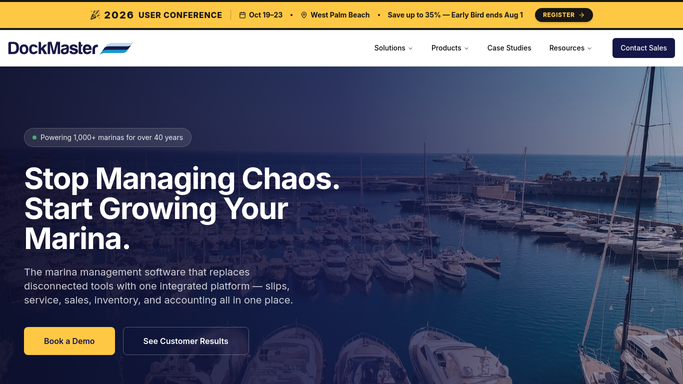
Service Management already turns an estimate into a work order
DockMaster automates the yard's own operations properly, and a lot of it is newer than its reputation suggests.
Service Management runs the whole job: an estimate created at the counter, signed digitally and converted into a work order without anyone retyping it, with technician time tracked on a mobile app that works without a signal. eSignature workflows cover the marine documents a yard has to sign and track what has come back. Visual marina management shows the slips as a picture rather than a list, and handles reservations, dry stack and launch scheduling against it. An AI scheduling assistant helps put the right technician on the right job.
All of that is work the yard controls, and inside that boundary it holds up well.
The boundary is where the yard's own systems stop. A work order can say the part is on order. It cannot say whether the distributor has shipped it. A warranty claim can be recorded. Whether the manufacturer paid it is on the manufacturer's portal. A used boat can be entered as inventory. Getting it in front of buyers means a brokerage listing site the software does not touch.
A boatyard that hears back before the customer calls
The difference between telling a customer soon and telling them a date is one page on the distributor's site.
Parts on backorder checked at each distributor every morning, so a ship date is written against the work order and the customer gets told on Tuesday, not after the third phone call. Warranty claims tracked through the manufacturer's portal to the point they are paid, so the ones that quietly failed get caught while resubmitting is still possible.
Used boat listings assembled from the inventory record and drafted for the brokerage sites, so a trade-in taken in March is visible in March. Registrations and titles chased on the state's own system rather than in somebody's memory.
The seasonal work has the same shape. Every boat due for haul-out or winterisation identified from the storage record and matched against who has already booked, so the outreach list exists before the first cold week. Slip renewals and unpaid balances gathered into one list with the largest and oldest first.
The rule is the one every yard already applies to its own staff. Looking things up runs unattended. Anything that goes to a boat owner, quotes a price or takes a payment gets drafted and waits for someone who knows them.
Marine skill belongs on the water, not in a browser tab
A marine technician spent years learning engines. Refreshing a distributor's backorder page is not part of that, and neither is checking whether a warranty claim was paid.
WebRun is an AI agent that works a real Chrome browser, signed in as you. It opens the parts distributor, the manufacturer's warranty portal, the brokerage site or the state registration system, reads what is there, and updates DockMaster or the sheet the service desk works from.
It runs on your schedule in your own private environment, and you can watch a run and stop it. Anything going to a boat owner, or moving money, is drafted and waits for approval.
The workflows below are already built, and each one names the sites it opens.
Questions people ask
Our customers hear from us personally. Does that change?
No. Status updates, winterisation outreach and overdue notices are drafted with the detail already filled in, then wait for the person who knows that owner to send them. Nothing goes out unread.
We run DockMaster on the desktop, not the web version. Does that matter?
The browser side is what it works. Anything reachable in DockMaster Web, plus every outside portal, is available to it. Where a task only exists in the desktop application, it gathers the outside facts and hands them to whoever is at that screen.
Manufacturer warranty portals all work differently. Can it handle that?
Yes, because it reads each portal the way a service writer would rather than through a connector somebody had to build. Each manufacturer shows a claim differently, and each is read on its own terms and reported back in the same shape.
15 ready-made DockMaster workflows
Each one names the apps it touches and the exact steps it takes. Open one to read what it will do, then turn it on.


Want one of these running on your own DockMaster?
Show WebRun the process once and it will run it on schedule, in your own private browser environment.