How to Automate Airtable

Airtable automates a lot on its own. Triggers fire on new or changed records, scripts run inside the base, and sync pulls from products that publish an API. Getting records in from a system with no API and no export is the gap, and it is usually filled by somebody pasting.

Airtable is the database an operations team can actually build

Airtable is a database that looks enough like a spreadsheet that people who would never open a database will build one. That single fact explains most of where it ends up.

The teams using it are operations, marketing, production and HR, not engineering. They build the thing nobody would ever get budget to have built: an applicant tracker, a content calendar, an inventory of equipment, a pipeline of properties, a register of every machine on site and when it was last serviced.

What they get is real structure. Linked records, so a supplier connects to its orders. Views, so the same data is a grid for one person and a calendar for another. Forms, so somebody outside the team can add a row without touching the base.

It works well enough that within a year it holds something the business genuinely depends on.

The base is only as current as its last paste

A base earns its keep by being accurate, and accuracy is where the manual work hides.

Somebody exports a CSV from the ordering system every Monday and imports it. Somebody checks four supplier sites for lead times and updates a column. Somebody opens the applicant tracking system, reads which candidates moved stage, and mirrors that into the base the team actually looks at.

It is a strange kind of work: high consequence and no skill. If it is skipped for a fortnight nothing appears to break, and then a decision gets made on a stale number and the base loses the team's trust for good.

Once people stop believing the base, they go back to asking each other, and the whole thing quietly becomes a very tidy museum.
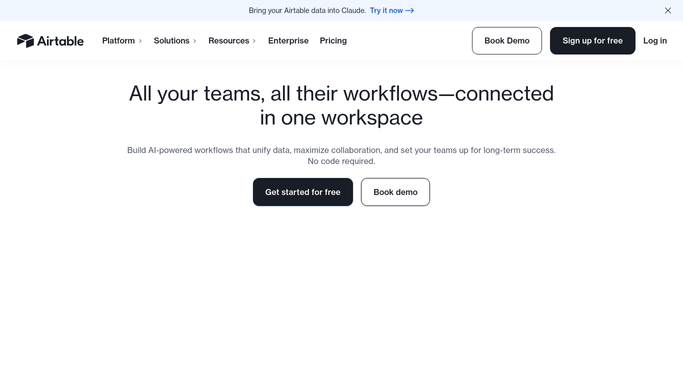
The airtable.com homepage, the app these three jobs run in. Airtable
Records that arrive on their own Orders, applications and stock levels written into the base from wherever they actually happen.
Fields kept current A status that changed in the source system changed in the base too, instead of quietly going stale.
No connector required The regional portal and the industry package never built an integration. They can still fill a table.

Automations and syncs stop at the connector list

Airtable is far from passive, and inside its own boundaries it is strong.

Automations trigger when a record is created, updated, or matches a condition, and then send email, update other records, post to chat or run a script. The scripting extension runs JavaScript against the base. Sync pulls a table from another base or from a product Airtable has built a connector for, and keeps it updated. Interfaces put a usable front end on top for people who should never see the raw grid.

All of that is triggered by something happening in the base, or by a product that already publishes an API and got a connector built for it.

The systems that hold most operational reality tend to have neither. The industry package the company runs on, the supplier portal, the customer's extranet, the government site with the licence status. Those are exactly the sources people paste in by hand, week after week.

The base can fill itself from anywhere you can log in

A connector list is a list of the systems somebody else decided to support. Your base can know more than that.

The orders that came in overnight, read from a system that only ever shows them on screen, written in as rows. Lead times checked across every supplier you buy from, updated in place, with the ones that moved marked. Candidate stages mirrored from the recruiting system so the base and the source agree by nine each morning.

The equipment register updated with the service dates the maintenance portal holds. The property pipeline updated with the listings that changed price. The compliance table updated with which certificates now expire inside ninety days.

One habit is worth adopting early: write incoming data to its own table that only the automation touches, and let your working views read from it. Then a bad run can never overwrite something a person typed, and you can compare the two when a number looks wrong.

Data entry is the part worth handing over

The judgement in a base is in how it is structured and what gets decided from it. Keeping the rows current is not judgement, it is transcription.

WebRun is an AI agent that works a real Chrome browser, signed in as you. It opens the ordering system, the portal or the industry package that has no API, reads what is on the screen, and writes the rows into your base.

It runs on your schedule in your own private environment, and you can watch a run and stop it mid-way. Anything that would message a person outside the team drafts and waits.

The workflows below are already built, and each one names the apps it touches.

Questions people ask

Do we need an Airtable paid plan for this?

No. It works the Airtable interface signed in as you, so whatever your current plan allows you to do by hand is what it can do. Sync and higher automation limits are separate Airtable features you may or may not want.

Will it create duplicate records?

Each workflow matches on a key from the source, such as an order number, so a second run updates the existing record rather than adding another. Writing to a dedicated intake table makes that easy to verify.

Can it pull from a system that offers no export?

Yes, and that is the usual reason to use it. It reads what is on the screen the way a person would, then writes the rows, so a portal with no download button stops being a weekly copy and paste job.

1,250 ready-made Airtable workflows

Each one names the apps it touches and the exact steps it takes. Open one to read what it will do, then turn it on.


Automated InMotion Hosting Backup Verification
Every morning, WebRun checks InMotion Hosting for last night's backup on every site, records the result in Airtable, and files the verification report in Google Drive.
InMotion HostingAirtableGoogle Drive
Automated Influitive Reward Fulfilment Queue
Every morning, WebRun reads the rewards advocates claimed in Influitive, adds each one to the fulfilment queue in Airtable, and writes Notion a short brief of who is owed what today.
InfluitiveAirtableNotion
Automated iFood Payout Reconciliation
Every Monday, WebRun matches iFood transfers against last week's orders, cancellations and fees, logs the gap in Airtable, and writes the summary to Notion.
iFoodAirtableNotion
Automated Hubstaff Timesheet Approval Queue
Every Monday, WebRun lists the Hubstaff timesheets still awaiting approval, logs each one in Airtable with the hours at stake, and posts the queue to Notion with the approver named.
HubstaffAirtableNotion
Automated Hubilo Registration Pace Tracking
Every morning, WebRun reads your Hubilo registration numbers, tracks the daily pace against target in Airtable, and drafts a stakeholder update in Gmail when the count falls behind.
HubiloAirtableGmail
Automated Honeycomb Telemetry Gap Checks
Every hour, WebRun checks each Honeycomb dataset for recent events, logs which services have gone quiet in Airtable, and writes the on-call note in Notion.
HoneycombAirtableNotion
Automated Hightail Delivery Download Tracking
Every night, WebRun checks who opened or downloaded your Hightail deliveries, records it in Airtable, and puts expiring links on your Google Calendar to resend.
HightailAirtableGoogle Calendar
Automated HiBob Time Off Approval Chasing
Every morning, WebRun finds HiBob time off requests still pending approval, names the manager holding each, and posts the chase list to Telegram and Airtable.
HiBobTelegramAirtable
Automated HealthEquity Receipt Reminders
Every Monday, WebRun finds the HealthEquity claims held up for documentation, records each one in Airtable with its deadline, and writes the chase list in Notion so nothing is denied for missing paperwork.
HealthEquityAirtableNotion
Automated Hasura Role Permission Audits
Every Monday, WebRun reads your Hasura project permissions, writes a role by table matrix into Airtable, and posts the over permissive rules to Notion before they ship.
HasuraAirtableNotion
Automated HashiCorp Run Approval Monitoring
Every hour, WebRun checks HashiCorp Cloud Platform for runs parked awaiting approval, records how long each has waited in Airtable, and files the plan summary in Google Drive.
HashiCorp Cloud PlatformAirtableGoogle Drive
Automated HaloITSM Change Approval Tracking
Every morning, WebRun reads your HaloITSM change requests, finds the ones still unapproved against their planned window, logs them in Airtable, and sends the queue to Telegram.
HaloITSMTelegramAirtable
Automated HackerOne Bounty Budget Tracking
Every Monday, WebRun reads the bounties your HackerOne program has awarded, logs them against your budget in Airtable, and posts Microsoft Teams a short read on spend to date and what is still pending.
HackerOneAirtableMicrosoft Teams
Automated Hacker News Reply Triage
Every hour, WebRun checks Hacker News for new replies to your comments and posts, logs the unanswered ones in Airtable, and drafts your responses in Notion.
Hacker NewsAirtableNotion
Automated Groww SIP Instalment Checks
Every morning, WebRun matches your Groww SIP schedule against the orders that really executed, logs each one in Airtable, and posts any miss to Microsoft Teams.
GrowwMicrosoft TeamsAirtable
Automated Groq API Usage and Cost Tracking
Every Monday, WebRun reads your Groq console usage and billing, writes requests, tokens, and spend into Airtable, and posts the week over week trend to Notion.
GroqNotionAirtable
Automated Groove Knowledge Base Gap Finder
Every Monday, WebRun reads last week's answered Groove tickets, finds the questions with no article behind them, and files each gap as a Trello card.
GrooveTrelloAirtable
Automated Gladly Shift Handoff Lists
Every night, WebRun reads open Gladly conversations, works out which ones belong to agents going off shift, logs them in Airtable, and writes the handoff brief in Notion.
GladlyAirtableNotion
Automated Gitee Issue Triage Queue
Every morning, WebRun gathers new Gitee issues across your repositories, suggests a label and an owner for each in Notion, and logs the queue in Airtable.
GiteeNotionAirtable
Automated Support Shift Handovers
Every night, WebRun reads your open Session conversations, records what was promised in Airtable, and posts the next responder a Telegram handover of what to pick up.
SessionAirtableTelegram
Automated Mailspring Follow-Up Chasing
Every morning, WebRun finds the Mailspring emails a contact opened but never answered, ranks the silent threads in Airtable, drafts the follow up, and holds time in Google Calendar.
MailspringAirtableGoogle Calendar
Automated Fyle Policy Violation Triage
Every morning, WebRun pulls the Fyle expenses flagged as policy violations, groups them by the person and the approver who must answer, logs them in Airtable, and posts the exceptions to Microsoft Teams.
FyleAirtableMicrosoft Teams
Automated Freetrade Dividend Records
Every morning, WebRun reads your Freetrade activity feed for dividends and cash movements, copies each one into an Airtable ledger, and sends a short daily note to Telegram.
FreetradeAirtableTelegram
Automated Flaticon Icon Shortlists
Every Monday, WebRun reads your open design requests, searches Flaticon for icons that fit each brief, and saves a shortlist collection per request for the designer to pick from.
FlaticonAirtableTelegram

Want one of these running on your own Airtable?

Show WebRun the process once and it will run it on schedule, in your own private browser environment.