How to Automate NextGen
NextGen automates the health center's internal work: Ambient Assist drafts the note, sliding fee schedules apply automatically, and UDS and MIPS reporting are built in. Coverage renewals, assistance program applications and payer decisions live on outside websites with dates attached, and checking those on a schedule is where an agent earns its place.
 Written by
Nora Whitfield
Editorial lead
Written by
Nora Whitfield
Editorial lead
 Reviewed by
Marcus Deleon
Support operations
Reviewed by
Marcus Deleon
Support operations
NextGen runs organizations that answer to a funder
NextGen Healthcare makes an ambulatory EHR and practice management system in two shapes: NextGen Enterprise for groups of ten providers and up, and NextGen Office for practices smaller than that. Plenty of ordinary private practices run on both.
But NextGen has a particular hold on a kind of organization that is not an ordinary private practice: the federally qualified health center and the community health center. Those places look like a clinic from the waiting room and like a grant-funded program from the back office. They carry a sliding fee scale keyed to household size and income, and they report to HRSA through the Uniform Data System. NextGen has built for exactly that, with sliding fee schedules in practice management, UDS reporting, and work on UDS+ patient-level reporting.
That is the customer worth writing for. A clinic that answers to its patients, to its payers, and to whoever wrote the grant.
Every patient arrives with a different way of paying
In a health center, the front of house does not have one process. It has a dozen.
This patient is on Medicaid and the coverage has to be live today. This one was on Medicaid and may not be any more, because a renewal packet went to an address they moved out of. This one qualifies for the sliding scale, so income has to be documented again this year. This one is in a state program with its own portal and its own rules. This one is uninsured, and there is a manufacturer assistance program that might cover the drug, which is another application on another website.
None of that lives in one place. It lives on a state Medicaid portal, on a payer's site, on a foundation's application tracker and in a pile of paper income verifications.
Every one of them has a date attached, and nobody is watching the dates.
Mirth moves what somebody already agreed to send
NextGen is well covered on the inside, and a health center running it usually has more automation available than it uses.
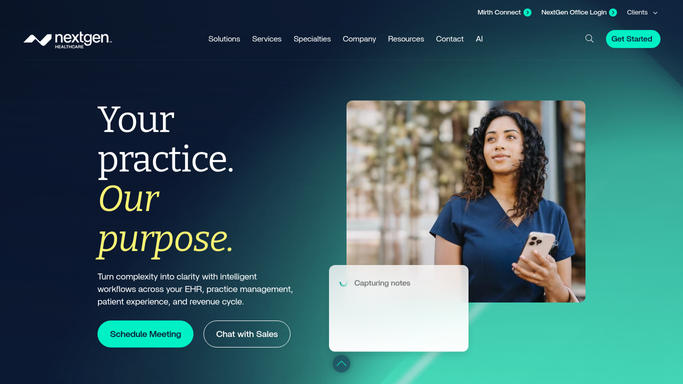
NextGen Ambient Assist turns the conversation in the room into a structured note, which is the largest documentation saving on offer. Registration and the sliding fee schedule apply the adjustment automatically once household size and income are on the record. Claims go out through the clearinghouse, and the reporting stack covers UDS, MIPS and the regulatory measures a health center has to file. Mirth Connect, the interoperability engine NextGen owns, moves data between the health center and hospitals, labs, registries and other systems.
Mirth is genuinely good, and it is also where the honest limit sits. An interface engine moves what an interface exists for. Somebody at the other organization had to agree to send it, in a format that was specified, over a connection somebody built and maintains.
Most of what a health center waits on has no interface and never will. A state Medicaid eligibility portal is a website. A pharmaceutical assistance foundation's application status is a website. They were built for a person with a password, and that is the only door in.
Coverage that lapses quietly is the expensive kind
A termination date is posted on a state website weeks before anybody in the practice sees its consequences.
Every patient on next week's schedule checked against the state Medicaid portal, so coverage that terminated is found in time for a renewal conversation rather than after the visit was delivered unpaid. Renewal dates collected across the panel and sorted by which comes first, which turns a quiet problem into a call list.
Authorization status read off each payer's site every morning, so an infusion needing approval before Thursday is chased on Monday. Manufacturer assistance and copay foundation applications followed until they are decided, because those funds open and close during the year and the patient is not the one who will notice. Denials collected from payer portals with the appeal window attached. Immunization records checked against the state registry, so the gap in the chart is a real gap and not a missing update.
The line in a clinical setting holds without argument. Gathering and checking runs unattended. Nothing that changes a record, files an application or reaches a patient leaves the queue without a qualified person reading it and sending it.
A health center can watch every renewal date at once
Nobody in the building has the hours to check three hundred renewal dates on a state website, and the cost of not checking arrives months later as uncompensated care.
WebRun is an AI agent that works a real Chrome browser, signed in as your staff are. It opens the Medicaid portal, the payer site or the foundation's application tracker, reads what is on the screen, and brings back a list with the names and the dates on it.
It runs on your schedule in your own private environment, sessions are not shared between tools, and a workflow can be locked to a named list of domains. You can watch a run and stop it at any point.
The workflows below are already built, and each one names what it opens.
Questions people ask
Will it submit an assistance application for a patient?
No. Filing an application is an action with a patient's money attached, so it is prepared and left for a person to submit. What runs on its own is the checking: whether a decision landed, and what it said.
Does this replace our UDS reporting?
No, and it should not try to. UDS comes out of NextGen, which holds the encounter data it is built from. This covers what NextGen cannot see, which is the state and payer websites holding coverage and approval status.
Our staff sign in with multi-factor codes. Does that break it?
A one-time code needs a person the first time a site is connected. The session is then reused on later runs, so the interruption is occasional rather than part of every morning.
13 ready-made NextGen workflows
Each one names the apps it touches and the exact steps it takes. Open one to read what it will do, then turn it on.

Want one of these running on your own NextGen?
Show WebRun the process once and it will run it on schedule, in your own private browser environment.