How to Automate TeleTracking
TeleTracking coordinates hospital flow inside the building: patient placement with real-time progression indicators, automated EVS cleaning requests, AutoDischarge from location data, transport zoning, and Decision IQ working bottlenecks like ED boarding. Outside bed registries, receiving facilities, payer portals and diversion boards each need a separate login, which an agent like WebRun reads.
 Written by
Sofia Marchetti
Marketing operations
Written by
Sofia Marchetti
Marketing operations
 Reviewed by
Nora Whitfield
Editorial lead
Reviewed by
Nora Whitfield
Editorial lead
The bed board is the hospital's operating picture
TeleTracking makes hospital operations software, and its own history is written into the product names. What health systems ran for years as the Capacity Management Suite is now Capacity IQ, part of the Operations IQ Platform, alongside Access, Throughput, Ambulatory and Data & Analytics. The job has not changed: know where every bed is, who is in it, and what has to happen before the next patient can be.
That job is unglamorous and it decides how a hospital feels to be inside. A bed request goes up from the emergency department. A placement decision is made. Housekeeping is tasked, the room is turned over, transport moves the patient, and a tile on the board changes colour. Multiply that by a few hundred a day across a building, or across a system, and it is the difference between a four-hour wait and a fourteen-hour one.
The people working it are not making clinical calls. They are making sure the ready bed and the waiting patient find each other.
An ED hold is resolved one facility at a time
The board shows the hold. Clearing it is a person with a phone and a list.
A patient in the emergency department on a psychiatric hold needs an inpatient behavioural health bed, and the hospital may not have one. So somebody starts ringing round. Where a state or region publishes a bed availability registry, somebody signs into it, reads it, and refreshes it an hour later because it has already changed. A receiving facility has to accept the referral on its own system. A payer has to authorise the transfer. Non-emergency transport has to be booked, and then confirmed.
Meanwhile the department fills. Ambulances keep arriving, the regional diversion picture matters more by the hour, and the patients who have waited longest start leaving without being seen. Every one of those facts is knowable. Almost none of it is knowable from inside the hospital's own software.
Operations IQ is authoritative up to the hospital's own walls
Inside the building this is about as complete as operational software gets, and it is worth being precise about that before naming what it cannot do.
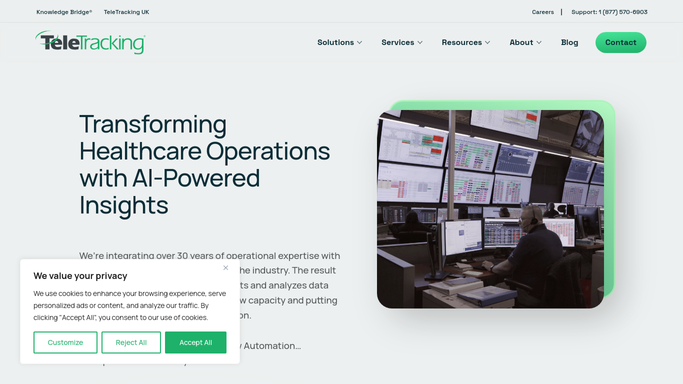
Operations IQ Throughput coordinates flow from admission to discharge and pulls placement, discharge, transport, housekeeping and nursing onto one workflow. Patient Placement gives real-time care progression indicators, so admissions stay in step with discharges. EVS Management issues automated cleaning requests, and AutoDischarge uses real-time location data to tell housekeeping a patient has left, which is how dirty bed time falls from hours to minutes. Transport Management runs a mobile interface with built-in zoning. Decision IQ, the AI module inside Throughput, works on bottlenecks like emergency department boarding and overstays, and Data & Analytics benchmarks performance across facilities.
Every one of those depends on events the hospital's own systems generate.
The bed a boarding patient actually needs is frequently in another organisation. State and regional bed registries, receiving facilities' referral systems, payer authorisation portals, transport vendors' dispatch pages and regional diversion boards each run their own login and their own screens, and none of them reports into a hospital's platform.
Bed registries and diversion boards checked on the hour
Give the capacity team something that can open those sites the way its own staff do, and the search stops being a phone tree.
Where a state or region publishes a psychiatric bed availability registry, it gets read every hour against the department's current holds, so a placement search begins with a shortlist instead of a blank page. Referral status on each receiving facility's own system checked and reported back, so an acceptance or a decline is known when it happens rather than when somebody rings again. Transfer authorisation followed on the payer's portal, because an authorisation still pending at five is a patient still boarding at nine.
The rest of the picture reads the same way. Booked non-emergency transport confirmed on the vendor's dispatch page. The diversion status of neighbouring hospitals collected before your own numbers turn, since knowing who else is closed changes what to do next. Outside records and reports for an accepted transfer gathered ahead of the handover.
Gathering runs unattended and on a schedule. Anything that changes a clinical record, accepts a placement or reaches a patient, a family or a receiving facility is prepared and left for a qualified person to review and send.
The placement search can start with a shortlist
None of that is clinical judgement. It is signing into other people's systems on the hour and writing down what they say.
WebRun is an AI agent that works a real Chrome browser, signed in the way your staff are. It opens a bed registry, a receiving facility's referral site, a payer portal or a transport vendor's board, reads what is there, and brings it back as a list with times against it.
It runs on your schedule in your own private environment, sessions are not shared between tools, and a workflow can be locked to an explicit list of sites. You can watch a run and stop it at any point.
The workflows below are already built, and each one names the sites it opens.
Questions people ask
Would it accept a placement or move a patient?
No. It reads and reports. Placement, transfer and every decision touching a patient's care stays with your staff, and a workflow can be set up with no ability to write into any clinical system at all.
Is it writing anything back into TeleTracking?
Not by default. The usual setup is read-only on both sides: it collects outside answers and delivers them as a list beside your holds. If you want a note added to a record, that is drafted and a qualified person posts it.
How does it handle patient information on outside sites?
It runs in your own private environment, signed in as your staff are, with sessions kept separate between tools and a workflow lockable to an explicit list of sites. You choose what it may open and what it may bring back, and you can watch any run.
12 ready-made TeleTracking workflows
Each one names the apps it touches and the exact steps it takes. Open one to read what it will do, then turn it on.


Want one of these running on your own TeleTracking?
Show WebRun the process once and it will run it on schedule, in your own private browser environment.