How to Automate Trello

Trello automates through Butler, which moves cards, sets due dates, posts comments and runs rules on a schedule. Butler acts on cards that already exist. Creating the card in the first place, from an order or an email or a form in another system, is the step still done by hand.

The board is how a team sees its own work

Trello is a board of lists and cards, and its whole appeal is that you can understand somebody else's work in about four seconds of looking at it.

That visibility is why it spreads through the parts of a company that never adopted a project tool. A small agency runs client work on it. A landlord runs maintenance requests. A workshop runs repairs, one card per machine, moving left to right as the job progresses.

The unit that matters is the card. A card is one real thing: a job, a fault, an application, an order. The board is honest only for as long as the cards match the things that actually exist in the world.

Which puts all the weight on how cards get made.

Cards get made by whoever remembers

The work arrives somewhere else first. It arrives as an email, a form submission, a phone call, an order in a system, a fault logged on a portal.

Then a person reads it and makes a card. They type a title, paste an address into the description, set a due date and drop it in the right list. It takes ninety seconds and it happens forty times a week.

Two things go wrong, and both are quiet. Cards that never got made, because it was busy on Thursday and nobody wrote it down, so a job simply does not exist as far as the board is concerned. And cards that were made but never updated, sitting in Doing for a fortnight after the customer cancelled.

A board people have stopped trusting gets checked less, which means it drifts further, which is how a team ends up back on a group chat.
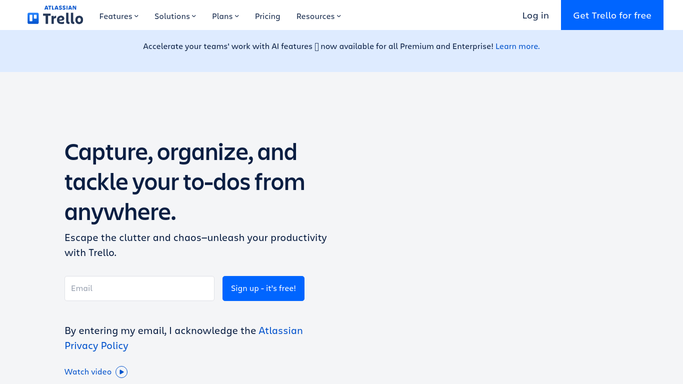
The trello.com homepage, the app these three jobs run in. Trello
Cards that create themselves A new order, application or fault becomes a card in the right list, without anyone transcribing it first.
Boards that match reality A job cancelled in the source system stops sitting on the board looking like work somebody still has to do.
Detail already on the card The reference, the address and the contact filled in, so nobody opens another system to start the job.

Butler acts on cards that already exist

Trello's automation is Butler, and it is genuinely capable for something included in the free plan.

Rules fire when a card is created, moved, labelled or has its due date arrive. Card buttons and board buttons run a set of actions on demand. Calendar commands run on a schedule, so every Monday you can sort, archive or move a batch of cards. Actions cover moving, copying, assigning, commenting, setting dates and posting to other lists.

Every one of those starts from something happening on the board. Butler is very good at what happens to a card once it exists.

It has no way to know that an order arrived in your ordering system, that a form was submitted on a site it cannot see, or that the job on that card was cancelled by a phone call this morning. The board can only react to itself.

The right card can appear on its own

The board reflects whatever was last typed into it, and nothing else. Everything missing from it was already recorded somewhere behind a login.

The overnight orders, each one a card in the intake list, with the reference and the delivery address already in the description. The faults logged on a customer's own portal, which is a site your team has a login for and no integration with. The applications submitted through a recruiting system, each becoming a card in the first column.

The updates matter as much. A job marked complete in the source system moves to Done rather than aging on the board. A cancelled visit gets archived instead of sending somebody out. A date that moved shows the date it moved to.

Worth deciding up front: let one system be the truth. If the board and the source system can both change a job's state, they will eventually disagree, and the disagreement will show up as an engineer standing outside a locked building.

Nobody has to transcribe the work first

Work arrives as an email, a form or a line in another system, and it becomes a card only when a person retypes it. That is not skilled work, but skipping it is how jobs get lost.

WebRun is an AI agent that works a real Chrome browser, signed in as you. It opens the ordering system, the customer portal or the inbox where work arrives, reads what is there, and creates or updates the cards on your board to match.

It runs on your schedule in your own private environment, and you can watch a run and stop it. Anything that would contact a customer drafts and waits for a person.

The workflows below are already built, and each one shows the steps it takes.

Questions people ask

Should we use this instead of Butler?

No, alongside it. Butler is the right tool for what happens once a card exists, and it is free. This handles the part Butler cannot reach: creating and updating cards from systems outside Trello.

Will the board fill up with duplicates?

Each workflow matches on a reference from the source system, so a second run updates the card it already made. Cards it has created can also be kept in their own list until someone triages them.

Does it work with a free Trello plan?

Yes. It works the Trello interface signed in as you, so anything you can do by hand on your current plan it can do too. There is no Power-Up to install.

1,079 ready-made Trello workflows

Each one names the apps it touches and the exact steps it takes. Open one to read what it will do, then turn it on.
Automated Coupang Item Winner Monitoring
Every morning, WebRun checks your Coupang listings for the Item Winner slot, records what each one now sells for, and gives you a same-day fix list.
Coupang›Slack›Trello
Automated CoreWeave Console Access Reviews
Every Monday, WebRun audits CoreWeave organization members, access policies, and API credentials, opens a Trello card for each one to remove, and sends the summary to WhatsApp.
CoreWeave›Trello›WhatsApp
Automated Copper Won Deal Handoff
Every morning, WebRun finds the Copper opportunities that moved to won, builds the client folder in Google Drive, and opens a kickoff card with scope and contacts.
Copper›Trello›Google Drive
Automated Contentful Translation Coverage Checks
Every Monday, WebRun checks which published Contentful entries exist in your main locale only, opens a Trello card per content type, and sends the coverage summary to WhatsApp.
Contentful›Trello›WhatsApp
Automated Community.com Net Growth Reviews
Every Monday, WebRun counts new Community.com members against opt outs, posts the net growth number to Slack, and opens a Trello card when a send drives people away.
Community.com›Slack›Trello
Automated CommSec Announcement Digests
Every morning before the open, WebRun reads the company announcements published against your CommSec holdings, posts a plain summary to Slack, and opens a Trello card for anything needing a decision.
CommSec›Slack›Trello
Automated Comm100 Bot Gap Reporting
Every Monday, WebRun reviews the Comm100 bot conversations that ended in a handoff, ranks the missing answers by how often they came up, opens a Trello card each, and files the transcripts in Google Drive.
Comm100›Trello›Google Drive
Automated Codility Hiring Funnel Reports
Every Monday, WebRun totals your Codility invitations, starts, completions and scores per role, files the numbers in Airtable, and puts the weak spots on a Trello board.
Codility›Trello›Airtable
Automated Codecov Missing Upload Alerts
Every morning, WebRun checks which Codecov repositories have stopped uploading coverage, raises a Trello card naming the last commit that reported, and files the record in Google Drive.
Codecov›Trello›Google Drive
Automated Code Climate Issue Triage
Every night, WebRun collects the issues newly introduced in your Code Climate repositories, opens a Trello card with the file and the rule that fired, and sends a WhatsApp summary.
Code Climate›Trello›WhatsApp
Automated Cloudflare Config Change Review
Every morning, WebRun reads the Cloudflare audit log, lists every DNS and setting change with the member who made it, and raises a card for anything unexpected.
Cloudflare›Notion›Trello
Automated Clearbit Company Domain Enrichment
Upload a list of company domains and WebRun looks each one up in Clearbit, fills in industry, size, and location, saves the finished sheet to Google Drive, and cards the best fits in Trello.
Clearbit›Trello›Google Drive
Automated Circle Event RSVP Reminders
Every Monday, WebRun counts RSVPs for each upcoming Circle event, drafts a reminder post for the light ones, queues it on Trello, and sends the numbers to WhatsApp.
Circle›Trello›WhatsApp
Automated Chorus Rep Coaching Playlists
Every Monday, WebRun picks coachable moments from each rep's Chorus calls, builds a per-rep card in Trello, and logs the coaching history in Airtable.
Chorus›Trello›Airtable
Automatic Chime Direct Deposit Monitoring
Every morning, WebRun checks your Chime account for the direct deposit you were expecting, posts to Slack the moment one is missing, and opens a Trello card to chase payroll.
Chime›Slack›Trello
Automated Chegg Textbook Delivery Tracking
Every morning, WebRun checks your Chegg orders, records which textbooks have shipped, which are running late, and which still have no tracking, onto a Trello board.
Chegg›Trello›WhatsApp
Automated Catho Resume Search Digest
Every morning, WebRun runs your saved Catho resume searches, picks out the profiles that are new since yesterday, posts them to Slack, and opens a Trello card per candidate.
Catho›Slack›Trello
Automatic Cash App Unpaid Request Chasing
Every morning, WebRun finds the Cash App payment requests still unpaid, ages each one, posts the chase list to Telegram, and opens a Trello card for anything gone cold.
Cash App›Telegram›Trello
Automated Carfax Open Recall Checks
Every morning, WebRun checks your inventory VINs against Carfax for open recalls, sends the day's list to WhatsApp, and puts each affected car on a Trello board for the shop.
Carfax›WhatsApp›Trello
Automated Careem Scheduled Ride Checks
Every night, WebRun reads your scheduled Careem rides, matches them against tomorrow's appointments in Trello, and sends you the meetings still without a car on WhatsApp.
Careem›Trello›WhatsApp
Automated Canada Post Service Alert Watch
Every morning, WebRun reads the Canada Post service alerts, works out which of your destinations are affected, posts the list to Slack, and cards the orders to hold in Trello.
Canada Post›Slack›Trello
Automated CallRail Tracking Number Audit
Every Monday, WebRun audits your CallRail tracking numbers, flags the ones whose call volume has collapsed in Slack, and opens a Trello card per quiet number.
CallRail›Slack›Trello
Automated Cal.com Availability Checks
Every Monday, WebRun reads your Cal.com availability for the coming week, counts the bookable time left per day, cards the full days in Trello, and files the report in Google Drive.
Cal.com›Trello›Google Drive
Automated Built In Employer Profile Audit
Every Monday, WebRun audits your Built In company profile against the roles you have posted, opens a Trello card per gap, and drafts the summary email in Gmail.
Built In›Gmail›Trello

Want one of these running on your own Trello?

Show WebRun the process once and it will run it on schedule, in your own private browser environment.