How to Automate Trello

Trello automates through Butler, which moves cards, sets due dates, posts comments and runs rules on a schedule. Butler acts on cards that already exist. Creating the card in the first place, from an order or an email or a form in another system, is the step still done by hand.

The board is how a team sees its own work

Trello is a board of lists and cards, and its whole appeal is that you can understand somebody else's work in about four seconds of looking at it.

That visibility is why it spreads through the parts of a company that never adopted a project tool. A small agency runs client work on it. A landlord runs maintenance requests. A workshop runs repairs, one card per machine, moving left to right as the job progresses.

The unit that matters is the card. A card is one real thing: a job, a fault, an application, an order. The board is honest only for as long as the cards match the things that actually exist in the world.

Which puts all the weight on how cards get made.

Cards get made by whoever remembers

The work arrives somewhere else first. It arrives as an email, a form submission, a phone call, an order in a system, a fault logged on a portal.

Then a person reads it and makes a card. They type a title, paste an address into the description, set a due date and drop it in the right list. It takes ninety seconds and it happens forty times a week.

Two things go wrong, and both are quiet. Cards that never got made, because it was busy on Thursday and nobody wrote it down, so a job simply does not exist as far as the board is concerned. And cards that were made but never updated, sitting in Doing for a fortnight after the customer cancelled.

A board people have stopped trusting gets checked less, which means it drifts further, which is how a team ends up back on a group chat.
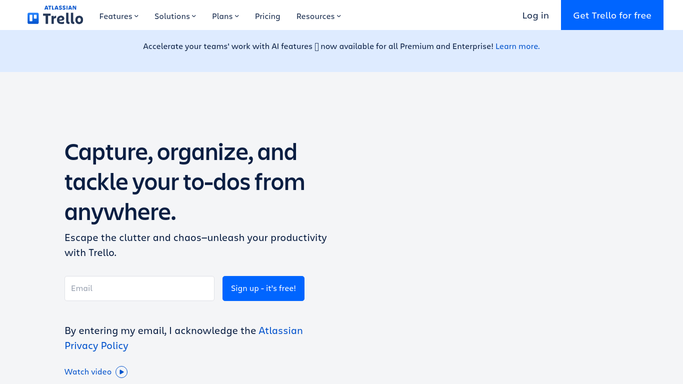
The trello.com homepage, the app these three jobs run in. Trello
Cards that create themselves A new order, application or fault becomes a card in the right list, without anyone transcribing it first.
Boards that match reality A job cancelled in the source system stops sitting on the board looking like work somebody still has to do.
Detail already on the card The reference, the address and the contact filled in, so nobody opens another system to start the job.

Butler acts on cards that already exist

Trello's automation is Butler, and it is genuinely capable for something included in the free plan.

Rules fire when a card is created, moved, labelled or has its due date arrive. Card buttons and board buttons run a set of actions on demand. Calendar commands run on a schedule, so every Monday you can sort, archive or move a batch of cards. Actions cover moving, copying, assigning, commenting, setting dates and posting to other lists.

Every one of those starts from something happening on the board. Butler is very good at what happens to a card once it exists.

It has no way to know that an order arrived in your ordering system, that a form was submitted on a site it cannot see, or that the job on that card was cancelled by a phone call this morning. The board can only react to itself.

The right card can appear on its own

The board reflects whatever was last typed into it, and nothing else. Everything missing from it was already recorded somewhere behind a login.

The overnight orders, each one a card in the intake list, with the reference and the delivery address already in the description. The faults logged on a customer's own portal, which is a site your team has a login for and no integration with. The applications submitted through a recruiting system, each becoming a card in the first column.

The updates matter as much. A job marked complete in the source system moves to Done rather than aging on the board. A cancelled visit gets archived instead of sending somebody out. A date that moved shows the date it moved to.

Worth deciding up front: let one system be the truth. If the board and the source system can both change a job's state, they will eventually disagree, and the disagreement will show up as an engineer standing outside a locked building.

Nobody has to transcribe the work first

Work arrives as an email, a form or a line in another system, and it becomes a card only when a person retypes it. That is not skilled work, but skipping it is how jobs get lost.

WebRun is an AI agent that works a real Chrome browser, signed in as you. It opens the ordering system, the customer portal or the inbox where work arrives, reads what is there, and creates or updates the cards on your board to match.

It runs on your schedule in your own private environment, and you can watch a run and stop it. Anything that would contact a customer drafts and waits for a person.

The workflows below are already built, and each one shows the steps it takes.

Questions people ask

Should we use this instead of Butler?

No, alongside it. Butler is the right tool for what happens once a card exists, and it is free. This handles the part Butler cannot reach: creating and updating cards from systems outside Trello.

Will the board fill up with duplicates?

Each workflow matches on a reference from the source system, so a second run updates the card it already made. Cards it has created can also be kept in their own list until someone triages them.

Does it work with a free Trello plan?

Yes. It works the Trello interface signed in as you, so anything you can do by hand on your current plan it can do too. There is no Power-Up to install.

1,079 ready-made Trello workflows

Each one names the apps it touches and the exact steps it takes. Open one to read what it will do, then turn it on.
Automated Meltano Overnight Run Reconciliation
Every morning, WebRun checks every scheduled Meltano extract and load run from overnight, creates a Trello card for any that failed, and pings the data engineer on WhatsApp so a broken pipeline gets fixed before the day's reporting relies on it.
Meltano›Trello›WhatsApp
Automated Media Temple Stale Ticket Chase
WebRun checks your open Media Temple support tickets for ones going quiet, flags them on a Trello board, and messages you on WhatsApp when one has waited too long.
Media Temple›Trello›WhatsApp
Automated Cinema 4D Render Job Tracking
WebRun checks the render queue, creates a Trello card for each job, and WhatsApps the 3D artist the moment their render finishes or fails.
Maxon Cinema 4D›Trello›WhatsApp
Automated Magalu Marketplace Order Handoff
WebRun checks your Magazine Luiza marketplace seller panel for new orders, creates a Trello fulfillment card for each one, and sends your teammate a WhatsApp heads up on anything shipping within 24 hours.
Magazine Luiza›Trello›WhatsApp
Automated Lucidchart Diagram Review Routing
When a Lucidchart process diagram is marked ready, WebRun creates a Trello review card and WhatsApps the assigned reviewer.
Lucidchart›Trello›WhatsApp
Automated Loox Photo Review Digests
Every morning, WebRun checks Loox for new photo and video reviews, posts the standout ones to Microsoft Teams, and creates a Trello card to feature the best in marketing.
Loox›Microsoft Teams›Trello
Automated Loggly Error Rate Spike Alerts
WebRun watches your Loggly log data, posts a Microsoft Teams alert the moment the error rate spikes above normal, and creates a Trello card to track the investigation.
Loggly›Microsoft Teams›Trello
Linode Automated Instance Reconciliation
Every week, WebRun lists every Linode instance on the account, reconciles it against your provisioning board in Trello, and messages you on WhatsApp when it finds an instance that isn't tracked.
Linode›Trello›WhatsApp
Automated Ledger Wallet Onboarding Checklist
WebRun tracks a new Ledger device through your team's setup checklist, from authenticity check to backup confirmation, updating a Trello card at each step and posting status to Microsoft Teams, without ever touching a seed phrase or key.
Ledger›Microsoft Teams›Trello
Automated Kissmetrics Declining Engagement Alerts
Every Monday, WebRun opens Kissmetrics, finds accounts whose behavior and engagement score has dropped over the past two weeks, posts the list to Microsoft Teams, and creates a Trello card for each one so customer success has a clear follow up queue.
Kissmetrics›Microsoft Teams›Trello
Automated Kamatera Weekly Cloud Scorecard
WebRun reads your Kamatera servers, usage, and billing each week, posts a scorecard to Microsoft Teams, and archives it on a Trello card so spend never sneaks up on you.
Kamatera›Microsoft Teams›Trello
Automated John Lewis Order Delivery Tracking
Every morning, WebRun checks the status of open John Lewis orders placed for clients, creates a Trello card per order, and pings the fulfillment team on WhatsApp when one is out for delivery.
John Lewis›Trello›WhatsApp
Automated iStock Download Usage Reporting
Every Friday, WebRun checks which iStock images were downloaded that week, matches each to its Trello project card, and posts the breakdown to Microsoft Teams.
iStock›Trello›Microsoft Teams
Automated Instana Performance Anomaly Alerts
WebRun watches your Instana application performance data, creates a Trello card the moment an anomaly is detected, and pings the on-call engineer on WhatsApp.
Instana›Trello›WhatsApp
Automated InfinityFree Site Launch Checklist
WebRun checks a new InfinityFree account's setup status, builds a launch checklist in Trello, and messages you on WhatsApp the moment everything's ready to go live.
InfinityFree›Trello›WhatsApp
Automated Independent Reserve Approval Chase
Every morning, WebRun checks for withdrawal address whitelist requests sitting unapproved on Independent Reserve, adds a Trello card for each, and pings WhatsApp so requests do not sit pending for days.
Independent Reserve›Trello›WhatsApp
Automated Improvado Connector Sync Monitoring
Every morning, WebRun opens Improvado, checks every connected ad and marketing data source for a failed or stale sync, creates a Trello card for each broken connector, and pings the marketing ops lead on WhatsApp so reporting gaps get fixed before anyone builds a dashboard on bad data.
Improvado›Trello›WhatsApp
Automated IG Expiry and Margin Reminders
Every morning, WebRun reads your open IG positions for upcoming expiries and current margin level, creates a Trello card for anything due this week, and posts a margin warning to Microsoft Teams if it drops near your threshold.
IG›Microsoft Teams›Trello
Automated Home Depot Pro Delivery Handoffs
Every morning, WebRun checks your Home Depot Pro orders for anything delivered or ready for pickup, creates a Trello card on the matching job's board, and notifies the site foreman in Microsoft Teams so materials get checked in fast.
Home Depot›Microsoft Teams›Trello
Automated Hivelocity Server Provisioning Checklist
When a new Hivelocity dedicated server is provisioned, WebRun checks whether monitoring, backups, and basic firewall rules are in place, posts the status to Teams, and creates a Trello card for anything still outstanding.
Hivelocity›Microsoft Teams›Trello
Automated Gmarket Order Handoff to Trello
Every morning, WebRun checks the Gmarket seller center for new orders, creates a Trello card for each one with the packing details, and posts the day's order count to Microsoft Teams.
Gmarket›Microsoft Teams›Trello
Automated GIMP Project Setup Checklists
When a new image editing job comes in, WebRun builds a GIMP project checklist in Trello covering file structure and export presets, and WhatsApps the designer it's ready.
GIMP›Trello›WhatsApp
Automated Ghost Inspector Daily Test Run Digest
WebRun reviews your Ghost Inspector browser test suites every morning, posts a Microsoft Teams summary of pass and fail counts, and creates a Trello card for each newly failing test.
Ghost Inspector›Microsoft Teams›Trello
Automated Geckoboard Weekly KPI Scorecards
Every Monday, WebRun opens Geckoboard, reads the live numbers on your team's KPI dashboards, posts a weekly scorecard to Microsoft Teams, and logs a recap card on Trello so the numbers do not just scroll by on a TV screen.
Geckoboard›Microsoft Teams›Trello

Want one of these running on your own Trello?

Show WebRun the process once and it will run it on schedule, in your own private browser environment.