How to Automate Mailchimp
Mailchimp automates the sending. Journeys react to signups, purchases and clicks, segments update themselves, and campaigns can be scheduled well ahead. Assembling what goes in the email, the new stock, the current prices, the week's news, is the part that still takes a person a morning.
 Written by
Tom Kessler
Field operations analyst
Written by
Tom Kessler
Field operations analyst
 Reviewed by
Julian Adeniyi
Retail operations
Reviewed by
Julian Adeniyi
Retail operations
Mailchimp is the audience a business actually owns
Mailchimp is an email marketing platform, and its importance has less to do with email than with ownership. A list is the only audience a business controls outright.
Social reach is rented and the rent changes without notice. Search rankings move. An email list is a set of people who said yes, sitting in a file you could export tomorrow, worth roughly the same today as it was last year.
That is why even businesses with no marketing team keep one. The shop with two thousand customers. The studio with a class list. The wholesaler whose buyers actually want to know when something is back in stock.
And it is why the list quietly decays when nobody sends anything, which is the usual outcome.
The newsletter waits on somebody assembling it
Almost nobody stops sending because they ran out of things to say. They stop because putting one together takes a morning.
The morning goes on gathering. Opening the shop admin to see what came into stock. Checking which lines changed price. Finding the photo. Copying descriptions. Checking which of these went out in the last one. Then, finally, writing.
The writing is twenty minutes. The gathering is two hours, and it happens in six browser tabs.
So the monthly newsletter becomes quarterly, then stops, and a list that took three years to build gets one email in eighteen months and half of it forgets who you are.
It is the least dramatic way a business loses money. Nothing breaks, nobody complains, and a channel that cost nothing to keep simply stops working.
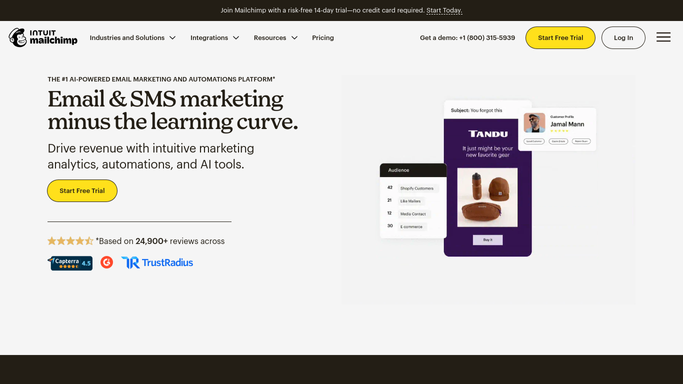
Journeys react to what the audience does
Mailchimp's own automation is strong on the behavioural side and worth setting up properly.
Customer Journeys branch on signups, purchases, clicks, tags and dates, so a welcome sequence, an abandoned cart or a lapsed-buyer nudge all run without anyone touching them. Segments update themselves from conditions. Send Time Optimisation picks the hour. Transactional and product blocks pull items in when a connected store is supported.
Every one of those reacts to something the audience did, or to something a connected platform told Mailchimp about.
What none of it can do is find out what happened in your business. Mailchimp has no idea that eleven products arrived on Tuesday, that a supplier changed a price, that a class filled up, or that the thing three hundred people asked about is finally back. Somebody has to go and look, then type it in.
The campaign can be built from what changed this week
The email itself takes twenty minutes to write. The hour in front of it goes on opening other screens and copying what they say, and that hour is why the email often does not go at all.
This week's arrivals, read out of the shop admin with names, prices and images, laid into the campaign in the order you want them. The lines that dropped in price. The classes with places left on Saturday. The three items that came back into stock, which is the single email this kind of business sends that gets opened by everyone.
The audience side matters too. Who actually bought in the last ninety days, taken from the system that knows rather than an export somebody did in March. Who lapsed. Who churned and should stop receiving this entirely.
One boundary, and it is a firm one. A campaign to a whole list cannot be recalled and reaches thousands of real people at once. Assembling it can run unattended. Sending it should be a person looking at the thing and pressing the button.
Assembling the content is the slow part
Writing the email is a job for somebody who knows the customers. Collecting what goes in it is not.
WebRun is an AI agent that works a real Chrome browser, signed in as you. It opens the shop admin, the booking system or the supplier site, reads what changed, and builds the campaign in Mailchimp with the items, prices and images already placed.
It runs on your schedule in your own private environment, and you can watch a run and stop it. The campaign waits as a draft for you to read and send.
The workflows below are already built, and each one names what it opens.
Questions people ask
Will it send a campaign to my list on its own?
No. It prepares the campaign and leaves it as a draft. An email to a whole list cannot be recalled, so pressing send stays with a person.
Can it pull products from a shop with no Mailchimp integration?
Yes. It reads the shop admin the way you would, taking names, prices and images, which is why it suits the platforms that never appeared on an integrations list.
How does it keep the audience accurate?
By reading the system that actually knows who bought and when, then updating tags or segments to match, so the list reflects this month rather than the last time somebody did an export.
240 ready-made Mailchimp workflows
Each one names the apps it touches and the exact steps it takes. Open one to read what it will do, then turn it on.












Want one of these running on your own Mailchimp?
Show WebRun the process once and it will run it on schedule, in your own private browser environment.