How to Automate Fathom
Fathom automates the reporting layer. Scheduled Reports deliver the pack on a cadence, KPI Alerts fire when a measure crosses a line you set, and three-way forecasting and consolidation run off the ledgers it imports. Numbers that never reach the ledger, from ad spend to a lender's balance, are what an agent like WebRun fetches.
 Written by
Julian Adeniyi
Retail operations
Written by
Julian Adeniyi
Retail operations
 Reviewed by
Dimitri Vasilev
Logistics analyst
Reviewed by
Dimitri Vasilev
Logistics analyst
Fathom is the report a business owner actually reads
Fathom takes the numbers out of an accounting system and turns them into something a person outside finance can act on. Plenty of people search for it as FathomHQ. It imports from QuickBooks Online and Desktop, Xero, MYOB, Sage, Excel and Google Sheets, then produces the management report, the KPI analysis, the cash flow forecast and the consolidation.
Three sorts of people live in it. Small and medium businesses use it to see how the month went. Accountants and bookkeepers use it to deliver advisory work, the half of the profession that is not compliance. Franchises and groups use it to rank thirty locations against each other on the same measures.
What it produces is the artefact that gets discussed. The board pack. The monthly pack a fractional CFO sends a client the week after close. The one-page scorecard pinned up in a franchise office. Those documents are how a company understands itself, so being a fortnight out of date matters more than it sounds.
Every board pack waits on a ledger somebody has to close
A report is only as true as the accounts under it, and the accounts are almost never ready.
Somebody is chasing a client to reconcile the bank feed. Somebody is waiting on a payroll journal. Somebody has to check the stock figure got posted before the pack goes out, because last quarter it did not and the gross margin chart was wrong in front of the board.
Then there are the numbers that were never in the ledger at all. Pipeline value from the CRM. Headcount from the HR system. Ad spend split by platform. Units sold on a marketplace. Occupancy, utilisation, billable hours, tonnes shipped. Each has a different owner, each sits behind a different login, and each gets typed into a spreadsheet once a month by somebody hoping they read the right row.
An advisory practice with forty clients does all of that forty times, in the same fortnight, every month.
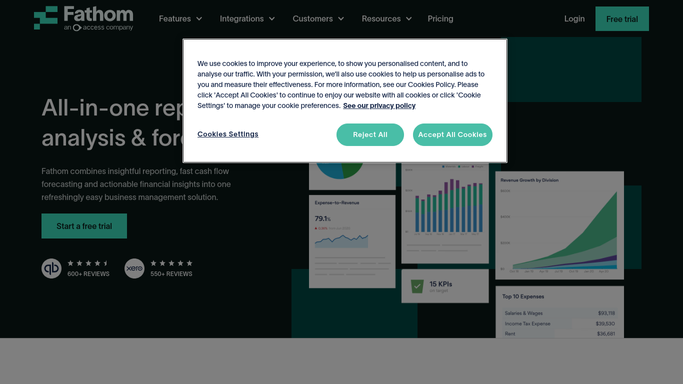
Fathom reads the ledger it is connected to
Fathom automates a great deal of the assembly, and most firms use a third of it.
Scheduled Reports send the pack on a cadence without anybody clicking export. KPI Alerts fire when a measure crosses a line you set, so a margin or a covenant does not need a person watching it. The cash flow forecasting is three-way, covering profit and loss, the balance sheet and cash together, with scenario planning, driver-based forecasting and rolling forecasts on top. Consolidation handles multiple entities, currencies, eliminations, and even multiple source systems inside one group report.
All of that runs on data Fathom has imported, and Fathom imports from accounting systems.
That is the ceiling, and it is a real one. If the ledger is not closed, the schedule still sends and the report is confidently wrong. If a KPI needs the pipeline figure, somebody keys it in first, and the alert is only as fresh as that keying. If a covenant test needs the lender's own statement of the balance, there is no import for it. The analysis is automated. The gathering before it is not.
A KPI that is not in the accounts at all
The interesting measures in most businesses have never lived in a ledger.
Ad spend read from each platform's own dashboard every morning and written into the custom KPI beside revenue, so cost per acquisition is a line on the pack rather than a calculation done once a quarter. Pipeline and weighted forecast lifted out of the CRM the day before the board meeting instead of the week before. Headcount and starters from the HR system. Units sold and returned on each marketplace.
Close readiness is the other half. A check the day before the pack is due: are the bank accounts reconciled, has payroll been posted, is anything stranded in suspense, are there unreconciled items older than a month. Answered per client, across all forty, so the chasing happens before the deadline instead of during it.
Then the things a forecast should react to. This morning's bank balance against the forecast line. A covenant tested against the figure on the lender's portal rather than the one in the model. A large customer whose account has gone quiet. Fuel, freight or an input price that moved enough to change next quarter.
Report day stops depending on who has the logins
Every one of those figures is on a screen somewhere, and getting it into Fathom means a person opening a tab, reading a number and typing it into a spreadsheet the import picks up.
WebRun is an AI agent that works a real Chrome browser, signed in as you. It opens the ad platform, the CRM, the bank, the marketplace or the lender's portal, reads the figure, and puts it where Fathom will find it, on the morning of the day you need it.
It runs on your schedule in your own private environment, and each workflow is limited to the sites you name. Reports that go to a client, a board or a bank are drafted and left for a person, because a number that leaves the building is a number somebody is accountable for.
The workflows below are already built, and each one names what it opens.
Questions people ask
Will it send the board pack to our client automatically?
No. Reports that leave the building are drafted and left for a person to release. The gathering, the close checks and the KPI updates all run unattended, but a number sent to a board or a bank is one somebody has to be accountable for.
Does it change our QuickBooks or Xero ledger?
No. Nothing is posted to the accounting system. It reads the source systems and writes the figures into the spreadsheet or the custom KPI that Fathom imports, so the ledger is untouched and nobody's coding gets overwritten behind them.
We run forty client files. Does it work per client?
Yes, and that is where it earns its place. The same run repeats across every client with its own logins and its own list of what to check, which is what turns a fortnight of chasing into a report you read on Monday morning.
13 ready-made Fathom workflows
Each one names the apps it touches and the exact steps it takes. Open one to read what it will do, then turn it on.




Want one of these running on your own Fathom?
Show WebRun the process once and it will run it on schedule, in your own private browser environment.