How to Automate Fusion Web Clinic
Fusion Web Clinic, sold today as Fusion by Ensora Health, automates a paediatric therapy practice from the inside. Ensai Session Assistant drafts notes, integrated billing catches claim errors, and scheduling handles waitlists and reminders. Checking what each funder has actually approved, on the funder's own portal, is still manual.
 Written by
Priya Raghavan
Solutions lead
Written by
Priya Raghavan
Solutions lead
 Reviewed by
Aiko Tanabe
Product researcher
Reviewed by
Aiko Tanabe
Product researcher
Fusion was built for the clinic where the patients are children
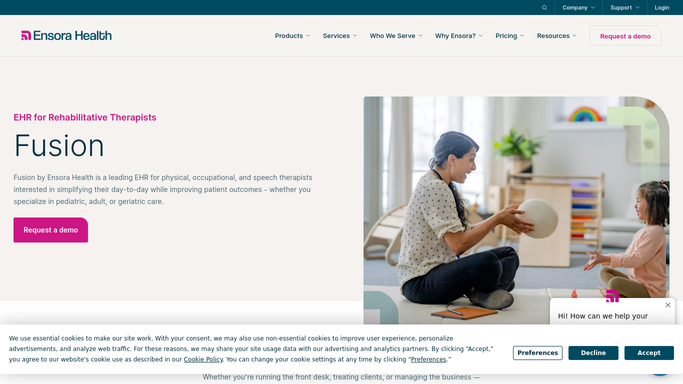
Fusion is an EHR and practice management system for rehabilitation therapy, and it was built for paediatric practices before it was anything else. It is sold today as Fusion by Ensora Health, and it covers scheduling, documentation, billing and reporting for physical, occupational and speech therapy clinics.
A paediatric therapy clinic is not a smaller version of an adult one. A child may be on the caseload for years rather than weeks, working through goals that get rewritten every few months. The person who books, cancels and asks all the questions is a parent, not the patient.
And the money almost never comes from a single commercial insurer. It arrives from Medicaid, from a school district contract, from an early intervention programme, from a private plan, and sometimes from three of those for the same child in the same month. Each funder has its own rules about what it will pay for, how many units it has approved, and what it wants to see before it approves any more.
One cancelled session moves three other things
The scheduler in a paediatric clinic is running a logistics problem, not a diary.
Most children can only come after school, so the valuable hours are a narrow band at the end of the day and the rest of the calendar is half empty. A parent cancels at two o'clock and that four o'clock slot is worth nothing unless somebody works the waitlist within the hour. A therapist calls in sick and every family booked that day has to be reached one at a time.
Around that sits the funder work. Somebody tracks how many authorised units each child has left and requests more before they run out, because a session delivered past the authorisation is a session the clinic paid for itself. Somebody writes the progress reports on a schedule the funder set. Somebody chases the paediatrician's office for referral paperwork that has been outstanding for weeks.
When that person takes a week off, nothing visibly collapses. Units quietly run out instead.
Fusion covers the note, the goal and the claim
The internal workflow is well handled, and a clinic weighing this up should know how much is already there.
Ensai Session Assistant records the session and drafts the note from it. Goals are tracked with visual progress charts, which matters when the audience for those charts is a parent and a funder rather than another clinician. Scheduling includes waitlist management and automated appointment reminders. Billing is integrated and catches errors before a claim goes out, and on the Premier tier eligibility checks and claim submission run automatically. Reporting dashboards track outstanding tasks and monitor authorisations. Home exercise programmes come through Wibbi, remote therapeutic monitoring generates its own billing codes, and the Client Portal gives families their appointments, intake forms and exercises.
The authorisation dashboard is the point worth pausing on, because it does the right thing with what it has. It shows the units recorded against a child inside Fusion.
It cannot open the state Medicaid portal to see what was actually approved this morning, or the school district's system, or a private payer's site. Those live somewhere else entirely, behind their own logins.
The paperwork between sessions can arrange itself
A funder's portal is an ordinary website with an ordinary login. Read every morning on the clinic's behalf, it is the difference between knowing now and finding out late.
Authorised units checked against each funder's portal rather than against the clinic's own count, so the two are known to agree before a child is seen and not after a claim comes back. Renewal requests raised while there are sessions still left. Eligibility confirmed for every child on next week's list, including the ones whose coverage was quietly redetermined over the summer.
Cancellations turned into offers within the hour, matched against the waitlist by which family said they could come at short notice. Progress reports assembled from the goal data ahead of the deadline instead of on the evening of it. Referrals from paediatricians' offices pulled in and closed off, so nobody spends a fortnight waiting on a fax that was never sent.
There is no setting that turns this part off. Gathering, comparing and flagging happen unattended. Anything that alters a clinical or billing record, or that reaches a family, is prepared and waits for a qualified person to review it. Nobody automates a decision about a child.
A therapist's hour belongs to the child in the room
Every one of those jobs is somebody logging into another organisation's website and reading a screen, and in a small clinic that somebody is usually a therapist between sessions.
WebRun is an AI agent that drives a real Chrome browser, signed in as your staff are. It opens the funder portal, the referring practice's site or the state system, reads what is there, and brings back a list with the dates and the numbers attached.
It runs on your schedule inside your own private environment, sessions are not shared between tools, and a workflow can be locked to a named list of domains. You can watch it work and stop it at any point.
Each of the workflows below names the site it opens and what it brings back.
Questions people ask
Can it tell three funders apart for the same child?
Yes, because it checks each funder on that funder's own site rather than inferring anything. A child covered by Medicaid, a school district and a private plan is looked up in all three, and the results are reported separately with the units each one shows.
Does anyone see a message before a parent does?
Always. Messages to families are prepared and held for a person to read and send. The unattended part is the looking up, not the talking to parents, and that split does not change.
How is a child's information kept contained?
Everything runs in your own private environment, and a workflow can be restricted to an explicit list of domains so it cannot reach anywhere you did not name. Sessions are not shared between tools, and it sees only what your own login already shows.
20 ready-made Fusion Web Clinic workflows
Each one names the apps it touches and the exact steps it takes. Open one to read what it will do, then turn it on.

Want one of these running on your own Fusion Web Clinic?
Show WebRun the process once and it will run it on schedule, in your own private browser environment.