How to Automate WebPT
WebPT automates the clinical and administrative core of a rehab therapy clinic. Its EMR, AI scribing, compliance alerts and CPT suggestions handle documentation and coding, and Electronic Benefits Verification pulls coverage. The payer portals, authorisation renewals and referral relationships around the clinic are where staff time still goes.
 Written by
Nora Whitfield
Editorial lead
Written by
Nora Whitfield
Editorial lead
 Reviewed by
Marta Ellison
Automation strategist
Reviewed by
Marta Ellison
Automation strategist
WebPT holds every visit a rehab clinic gets paid for
WebPT is an electronic medical record and practice management platform built for outpatient rehabilitation therapy rather than general medicine. Physical therapists, occupational therapists and speech-language pathologists document in it, the front desk books in it, and the billers work from what comes out of it. Chiropractors and behavioural health clinicians use it too.
A rehab clinic is a particular kind of business. It sees the same patient two or three times a week across a course of care, so the money arrives in small increments over a long relationship rather than in one procedure. Volume is high and each visit is worth comparatively little, so an hour of unpaid administration costs more here than in almost any other corner of medicine.
The clinic also does not choose its own patients. Most arrive on a referral from a physician, a surgeon or an occupational health team, and next month's schedule depends on relationships with people who work in entirely different software.
Between the visit and the payment sits a person with twelve logins
Ask a rehab front office what it actually does all day and the answer is rarely scheduling.
It verifies benefits on each payer's portal for tomorrow's arrivals, one plan at a time, because a visit delivered without coverage is a visit delivered for free. It counts authorised visits down and requests more before they run out. It watches which plans of care are approaching the end of their certification period. It logs into payer sites to read why a claim came back and how long the appeal window stays open. It downloads remittance advice. It checks whether a workers' compensation adjuster approved anything this week.
Then there is the referral side, which nobody schedules and everybody knows matters. Somebody is supposed to tell the referring surgeon how her patient is progressing. Somebody is supposed to notice when a reliable referrer has stopped sending anyone.
None of it is difficult. All of it has a date attached to somebody else's calendar.
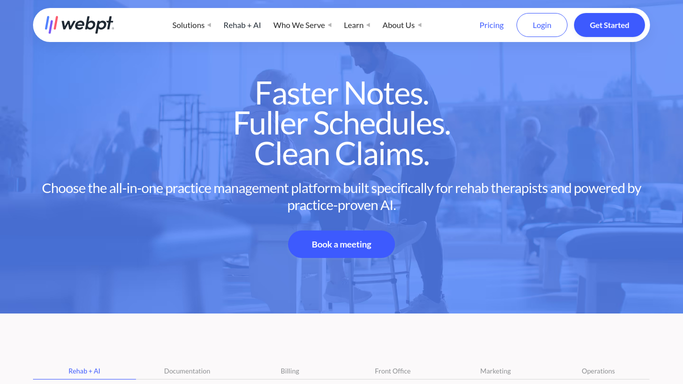
WebPT already guards the note and suggests the code
WebPT has put real work into the parts of this it can reach, and it is worth being precise about how much.
Documentation is covered thoroughly. AI voice-to-text scribing captures the encounter, predictive text and adaptive learning speed the note up, information carries forward from previous visits, and real-time compliance alerts and safeguards catch a note that will not stand up before it is finalised. Billing gets AI-guided CPT suggestions and flags underbilling. Digital Patient Intake collects the paperwork before the patient arrives, Electronic Benefits Verification pulls coverage, Schedule Management and Referral Management sit alongside, Outcomes tracks standardised tests, MIPS reporting runs automatically, and Reach handles marketing back to the patient list.
Electronic Benefits Verification is the one to notice, because it is exactly the right idea. If it covers the payers you actually bill, use it and stop reading here.
What none of these can do is act on a site WebPT has no arrangement with. The regional payer's portal, the workers' compensation carrier's system, the surgeon's practice, the auto insurer on a road traffic claim: each holds something the clinic needs and offers no route in except a person with a password.
A caseload that flags a problem before the units run out
Front desk staff can open any of those sites. A clinic cannot staff the edges one login at a time.
Tomorrow's arrivals checked against their payers overnight, so a lapsed policy is a phone call in the morning rather than a conversation at the front desk with the patient already standing there. Authorised visits counted down across the whole caseload, with anything down to its last two raised at two rather than discovered at zero. Certification periods listed by expiry date, so a plan of care is renewed rather than reconstructed afterwards.
Denied claims pulled from every payer portal with their appeal deadlines attached, ordered by which closes first. Workers' compensation approvals read without anyone sitting on hold to an adjuster. Referral volumes reported back per referring physician, so a source that has gone quiet is noticed in weeks rather than at the end of the quarter.
One line does not move in a clinical setting. Gathering information can run unattended overnight. Anything that changes a clinical or billing record, or that reaches a patient or a referring physician, is handed to a qualified person, who does the reviewing and the sending. The fetching is what goes away, not the judgement.
Volume is exactly the problem an agent is for
That is the argument in a clinic like this one. Each of those tasks is trivial on its own, there are hundreds of them every week, and every one carries a date somebody else set.
WebRun is an AI agent that works a real Chrome browser, signed in the way your staff are. It opens the payer portal, the carrier's system or a referring practice's site, reads what is there, and brings it back for a person to act on.
It runs on your schedule in your own private environment, sessions are not shared between tools, and a workflow can be restricted to an explicit list of sites. You can watch a run and stop it at any point.
Everything below is already built, and each one names the sites it will open.
Questions people ask
Does a therapist have to change how they document?
No. Documentation stays exactly where it is, inside WebPT and its own templates and compliance checks. This works on the sites around the clinic, so nothing about the note, the code or the clinician's routine changes.
How does this sit alongside our billing service?
It feeds the billing service rather than replacing it. Denials, appeal deadlines and remittance advice are collected from the payer portals and handed over as a worked list, which is the part a billing team usually spends its mornings assembling.
Where does the patient information actually go?
It stays in your own private environment. A workflow can be locked to a named list of domains, sessions are not shared between tools, and it sees only what the staff member whose login it uses can already see.
21 ready-made WebPT workflows
Each one names the apps it touches and the exact steps it takes. Open one to read what it will do, then turn it on.


Want one of these running on your own WebPT?
Show WebRun the process once and it will run it on schedule, in your own private browser environment.