How to Automate Therap
Therap holds the documentation: GERs for incidents, support plans and goal data, the medication record, EVV with GPS and signature capture, and a billing suite that turns verified visits into claims. What sits outside is the payer portal, the state registry and the aggregator queue. Reading those is work an agent like WebRun can take on.
 Written by
Owen Hartley
Workflow engineer
Written by
Owen Hartley
Workflow engineer
 Reviewed by
Marta Ellison
Automation strategist
Reviewed by
Marta Ellison
Automation strategist
Therap carries the daily record of every person supported
Therap is documentation software for providers serving people with intellectual and developmental disabilities, and for the state agencies that oversee them. Agencies running group homes, host homes and shared living, day programmes, supported employment and community-based supports keep their record in it, and several states run it across an entire system.
What it holds is unusually personal. Not accounts and orders, but a person: their support plan, their goals, the medications they take and who passed them, the shift notes a direct support professional wrote in their kitchen, every incident that happened and what was done about it afterwards.
The people entering all of that are not at desks either. A direct support professional documents at the point of care, usually on a phone, sometimes with no signal at all. That fact shapes the whole product, and it is why so much of Therap is mobile and works offline.
Documentation is the easy half of the paperwork
Writing it down is the part Therap made straightforward. Proving it to everyone entitled to ask is the part that still takes a person with a list of logins.
An agency of any size has somebody whose week is spent inside other organisations' systems. The state Medicaid portal, to see which claims went through and which came back. Each managed care organisation's own portal, with its own login and its own quirks. The EVV aggregator, where visits that failed validation sit in a queue nobody gets told about. The nurse registry and the certification boards, to check a support worker's credentials have not quietly expired. The background check system for somebody starting Monday.
Then there is the survey. When the state arrives, months of evidence have to be assembled out of several systems into one folder, and the office stops doing anything else for a week.
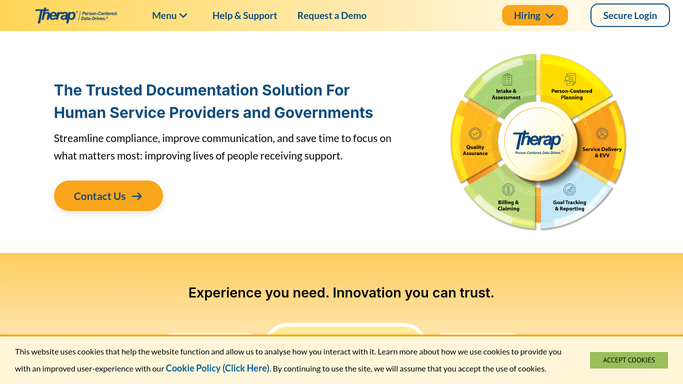
Therap documents the care and bills for it
Inside its own walls Therap automates more than most agencies switch on, and the compliance argument for using all of it is strong.
The General Event Reports module handles incidents from point-of-service submission through notifications and follow-up, and GER Resolution carries the investigation to a close. Individual Support Plans link measurable outcomes to daily notes, with ISP Agendas tracking reviews and Personal Focus Worksheets gathering the person's own input. The Medication Administration Record covers scheduled passes and PRN doses, and a pharmacy interface turns an incoming script into a MAR entry rather than a retyping job. EVV captures GPS location and time stamps, voice and signature verification, runs offline, and transmits visits to state aggregators such as Sandata and HHAeXchange. The billing suite generates 837 claims from verified visits, tracks service authorisations against units used, and imports 835 remittance files to surface denials. Quality assurance tools and business intelligence dashboards report across the agency.
All of that describes what the agency itself recorded.
The other half of every answer is on somebody else's screen. Whether the payer accepted the claim. Whether the aggregator took the visit. Whether the licence is still valid this month. Therap holds no login to any of those, and neither does any single person in the office.
Funding gaps should surface while they can still be fixed
Once the record in Therap can be carried out to the systems that judge it, most of the bad surprises stop being surprises.
Every active authorisation checked against the units already delivered, so funding running out in three weeks becomes something the team plans around rather than something a bounced claim announces. Denials read off the payer portal weekly and matched back to the visit and the note behind them, while the correction window is still open.
The aggregator's exception queue checked against what was documented, so a visit that failed validation is fixed by the person who actually remembers that shift. Staff certifications and registry statuses watched on the sites that issue them, so a lapse is caught before somebody works a shift on it.
Referrals and waiting list movement followed on the county and state pages that publish it, because a vacancy in a host home is only worth anything while it is still open.
And when a survey is coming, the evidence pulled together from each system into one place, steadily, instead of by everyone stopping work for a week.
One line stays fixed through all of it. Every item here is looking, reading and comparing. Nothing about a person's care gets decided anywhere except by their team.
Nothing is written into a person's record
That last line is what decides whether any of this belongs near an agency at all. A record about somebody's life is not a system to let something loose in.
So the boundary is reading. WebRun is an AI agent that works a real Chrome browser, signed in as you. It opens the payer portal, the aggregator or the registry, reads what is there, and puts it in front of the person whose job it is, with the differences named. It makes no clinical judgement, and nothing reaches a guardian or a family member unless a person sends it.
It runs on a schedule you set, in your own private environment, and any run can be watched and stopped.
The workflows below are already built, and each one names what it opens and what it only reads.
Questions people ask
Does anything it finds get entered into Therap automatically?
No. Findings are reported to the staff member who owns them, and a person decides what goes into the record. Documentation about an individual is written by the people supporting them, which is the only way it stays defensible in a survey.
Our state uses an EVV aggregator we sign into separately. Can it read that?
Yes. The aggregator opens in a browser like everything else, so the exception queue can be read and lined up against what was documented in Therap, which is usually where failed visits sit unnoticed for weeks.
Will it contact a guardian or a family member?
No. Anything going to a family is drafted and waits for a person to read and send. Families of the people you support are owed a human on the other end of that message, and a mistake there is not recoverable.
24 ready-made Therap workflows
Each one names the apps it touches and the exact steps it takes. Open one to read what it will do, then turn it on.


Want one of these running on your own Therap?
Show WebRun the process once and it will run it on schedule, in your own private browser environment.