How to Automate SwiftComply
SwiftComply already runs the program: notice cascades that escalate on their own, a tester portal that refuses reports from a lapsed certification or gauge, live compliance dashboards and preconfigured state reporting. Jurisdictions on other systems, plus quoting, scheduling and getting paid, sit outside it, and an agent like WebRun works those.
 Written by
Dimitri Vasilev
Logistics analyst
Written by
Dimitri Vasilev
Logistics analyst
 Reviewed by
Sofia Marchetti
Marketing operations
Reviewed by
Sofia Marchetti
Marketing operations
A backflow program is a deadline attached to every device in town
Cross connection control is one of the quieter pieces of public health. Between the public water main and most commercial buildings, irrigation systems and fire lines sits a backflow prevention assembly, and each one has to be tested by a certified tester, usually once a year, or the utility is entitled to shut the service off.
SwiftComply is the software that program runs on. It is sold to water and wastewater utilities, public works departments and water districts, and it covers backflow prevention alongside stormwater, industrial pretreatment and fats, oils and grease, so a compliance coordinator is not keeping four spreadsheets and a wall planner.
Two populations live inside it and they see very different screens. Utility staff run the program: the device inventory, the notices, the enforcement. Certified testers hold their own accounts, file test reports through the tester portal, keep certifications and gauge calibrations current there, and can switch between every jurisdiction they are registered in from one login.
Fifteen cities, fifteen ways to file the same test report
A backflow testing company does not work one water system. It works whatever falls inside a day's drive.
So a tester finishes a route and then sits down that evening filing the same information in whatever way each jurisdiction wants it. One takes an online submission. One wants a scanned form emailed to a named inspector. One still lists a fax number on the tag. The county has its own portal with its own password. The report is identical; the destination is not.
Around that sits everything that makes it a business rather than a trade. A property manager asks for a quote and nobody follows up. An invoice for eleven devices at a strip mall goes out and is never chased. A gauge falls due for calibration and the certificate is in a drawer. A tester certification renews through a state board on its own cycle. Failed devices need a repair and a retest inside a window, and the window is the thing that gets missed.
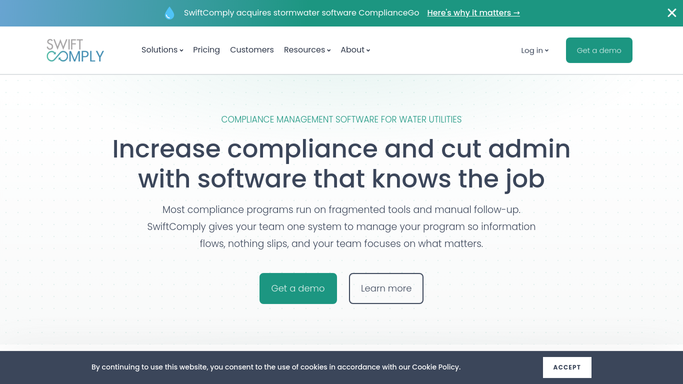
SwiftComply will not take a report from an expired gauge
That check is a good example of the platform doing something a spreadsheet cannot, and it is worth naming what else is already handled.
Notices go out as configurable cascades: an initial notice, a follow-up, then a final one that makes the service eligible for shut-off, sent by mail, email or postcard and routed to the right person when the landlord, the property manager and the billing contact are three different people. Submissions are checked for accuracy as they arrive, and a tester whose certification or calibration has lapsed cannot file a valid result until it is put right. Live dashboards show compliance by hazard type and establishment size, state reports come preconfigured, everything carries a timestamped audit record, and the platform connects to GIS and utility billing.
All of that describes one program, inside one system, for the utilities that run on it.
A testing company's week crosses jurisdictions that do not. And the quotes, invoices, calibration certificates and board renewals that keep the company solvent were never the software's job to begin with.
Retest windows that watch themselves
The tester who finished the route should not be the one still filing that evening. Everything between the last test and a confirmed submission is reading one screen and typing into another.
Passing tests entered into each jurisdiction by whatever route it accepts, ready for the tester to send on the day the work was done, rather than sitting in a van while a deadline passes. Submissions confirmed as received rather than assumed, because a rejected report is usually discovered when the customer gets a shut-off notice.
Failed assemblies tracked against their repair and retest windows, with a note drafted to the property contact well before the date. Test-due lists pulled per jurisdiction and turned into next month's route instead of next month's emergency.
Then the company's own paperwork. Gauge calibration checked against the calibration house's own record, so nobody leaves on a lapsed kit. Certifications checked at the board that issued them rather than at a reminder somebody typed into a calendar. Quotes for multi-device sites followed up on a schedule. Invoices tracked into the property management company's payables portal, which is where a strip mall invoice usually goes to be paid.
The filing runs overnight, the enforcement does not
Filing a passing test is clerical. Telling a building its water is about to be shut off is not, and the second should never happen because a script decided it.
WebRun is an AI agent that works a real Chrome browser, signed in as you. It opens SwiftComply, a neighbouring city's own portal, a calibration house's record, a state certification board or a property manager's payables system, reads what is there, and prepares the filing that used to happen at a kitchen table.
It runs on your schedule inside your own private environment, and a run can be limited to an explicit list of domains. Anything that reaches a customer, a property owner or a utility inspector is drafted and waits for the person whose certification number is on the report.
The workflows below are already built, and each one names the sites it opens.
Questions people ask
Will it send a shut-off notice to a customer?
No. Notices, reminders and customer emails are drafted and left for a person. SwiftComply's own cascade is the right tool for enforcement anyway, and deciding that a service becomes eligible for shut-off is a utility decision rather than an automated one.
Most of the cities we test in are not on SwiftComply. Does that matter?
That is rather the point of it. It opens each jurisdiction's own portal, form or submission page the way your office manager does, prepares the report there, and brings back one list of what has been accepted and what came back rejected.
Can it submit a test report under my certification number?
It prepares the submission and leaves it for you to send. The certification on a backflow test report is a personal one, and the tester who performed the test is the only person who should be signing that report off.
11 ready-made SwiftComply workflows
Each one names the apps it touches and the exact steps it takes. Open one to read what it will do, then turn it on.

Want one of these running on your own SwiftComply?
Show WebRun the process once and it will run it on schedule, in your own private browser environment.