How to Automate RDN (Recovery Database Network)
RDN holds the assignment: lenders and forwarders place orders, recovery agents work them, and Clearplan and Cleardata cover the field run and the post-recovery tasks. Counting storage days, reading short-paid invoices and checking state licence registers happens on other sites, which is what a browser agent like WebRun is for.
 Written by
Hannah Vogel
Finance operations
Written by
Hannah Vogel
Finance operations
 Reviewed by
Clara Bennett
Revenue operations
Reviewed by
Clara Bennett
Revenue operations
Every recovery begins as somebody else's assignment
RDN is the software the repossession industry runs its orders on. It has been going since 2002, is based in Mesa, Arizona, and is now part of OPENLANE. A lender, a credit union or a forwarder places an assignment in it; a recovery agency somewhere picks the work up and starts.
The unit of work is the case. It carries the collateral, the debtor, the addresses to try, the lender's instructions on what may and may not be done, the fee schedule it will be billed under, and every update typed against it since. Around that sit the field run, the condition photos, the personal property inventory, the storage record and the invoice.
Two very different businesses share that file. The lender wants a car and a paper trail. The agency wants a fee, a lot that turns over, and a close ratio good enough to keep next month's assignments coming.
Lenders buy updates almost as much as they buy cars
The recovery is the visible half. The invisible half is the reporting, and there is far more of it than outsiders expect.
Every client wants a note at its own cadence, on cases that have not moved. An agency working twenty lenders writes update text all day for accounts where the honest answer is that the car was not there again. Miss the cadence and the account gets graded down, quietly, on a scorecard nobody shows you.
Then the clock work. A unit comes in and storage accrues by the day. A debtor rings wanting a redemption appointment and personal property back, and both have windows set by state law rather than by the lender. An invoice goes out and comes back short-paid for a reason somebody has to open a portal to read. Meanwhile the agency's licences, the lot's insurance and each agent's certification expire on dates nothing sends a reminder about.
RDN, Clearplan and Cleardata carry the case they were handed
The platform is good at the thing it was built for, and an agency not using all of it is paying wages for the difference.
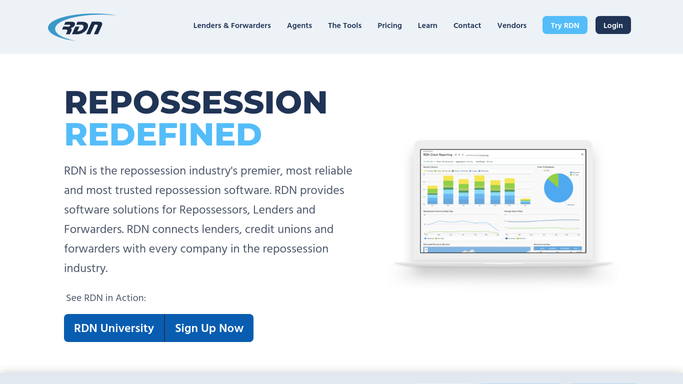
RDN itself is the secure, encrypted system of record: the order arrives, the agency works it, and communication between the repossessor and the lender, credit union or forwarder runs through one place instead of voicemail, with the RDN Reporting Dashboard reading back what has been logged. Clearplan takes the field side, giving agents digital workflows in place of the paper that used to run an account. Cleardata handles what comes after the recovery, where most of the administrative time goes: processing personal property, scheduling transports and setting debtor appointments.
What they share is a starting point: each is authoritative about material somebody in the agency already put there.
The facts that decide whether this week is profitable are not in the case yet. The lender's own portal knows the invoice was reduced. The state licensing board knows a renewal window opened. The bank knows which of last month's fees actually landed. None of them will say so unless a person signs in and looks.
The lot can be counted overnight instead of on a Friday
Give something the case file and a set of logins, and the outside record gets checked against it before anyone goes looking.
Every open assignment aged against how long that client's work normally takes to close, so a stale case is a line on a list on day nine rather than a close ratio explained in a quarterly review. Storage counted on every unit still standing, days multiplied by that lender's fee schedule, so the accrual is known before the invoice is drafted rather than after it is disputed.
Submitted invoices read back on each lender's portal for reductions and rejections, with the stated reason attached to the case number. Transport pickups confirmed on the hauler's own site against the release date the file assumes. Condition photos and the property inventory checked as present before a claim goes out, because a missing photograph is a reduction waiting to happen.
And the compliance side, which ends a business rather than costing it money. State recovery licences, agent certifications and the lot's insurance checked against the registers that hold them, each renewal listed by date and by state.
Talking to a debtor was never clerical work
Recovery agents who were out at four in the morning come back to five websites and a list of what each one says. Every line of it is transcription.
WebRun is an AI agent that works a real Chrome browser, signed in as you. It opens RDN, reads the assignments and units you point it at, then opens a lender's portal, a state licensing register or the bank, and sets what it found beside what the case already says.
Reading and counting run unattended on a schedule you set, and a run can be watched and stopped. Anything that changes a case record, goes back to a lender or reaches a debtor is drafted and waits for someone accountable for it. Recovery work is regulated, and a notice about somebody's vehicle is a legal document before it is a task.
Each workflow below is built already, and every one names the sites it opens.
Questions people ask
Can it update a case or close an assignment on its own?
No. It reads and compiles. Updates to a case, responses to a lender and anything a debtor would receive are drafted and held for a person, because an update is a contractual statement to a client and a notice is regulated correspondence. The gathering behind them runs unattended.
Our lenders each use a different portal. Is that a problem?
It is usually the reason to run it. It works screens rather than an API, so a client with no export and no integration is handled exactly like one that has both. Adding a lender means adding a login and saying which figures matter on which page.
Debtor information is sensitive. What can it actually reach?
Only the sites a given workflow names. Every run carries an allowlist, so it opens the lender portal or licence register it was pointed at and is blocked everywhere else. It runs on your own logins in your own environment, and a run can be watched and stopped mid-way.
12 ready-made RDN (Recovery Database Network) workflows
Each one names the apps it touches and the exact steps it takes. Open one to read what it will do, then turn it on.


Want one of these running on your own RDN (Recovery Database Network)?
Show WebRun the process once and it will run it on schedule, in your own private browser environment.