How to Automate Graphium Health
Graphium Health automates the anesthesia record and what it becomes. AnesthesiaEMR captures the intraoperative chart on a phone or tablet, Charge Capture pushes it toward billing, and MACRA Ready collects MIPS and QCDR measures with scorecards by organization and facility. The facility-side chasing is still manual.
 Written by
Sofia Marchetti
Marketing operations
Written by
Sofia Marchetti
Marketing operations
 Reviewed by
Grace Okafor
Healthcare operations
Reviewed by
Grace Okafor
Healthcare operations
Graphium Health turns the anesthesia record into a billable case
Graphium Health is an anesthesia EMR and revenue cycle platform, used by groups that range from a handful of providers to thirty or more physicians, across hospitals, surgery centers and the billing companies that work for them.
Anesthesia is an unusual specialty to write software for. The clinical record is made in an operating room, often on a phone or a tablet, by a clinician whose full attention belongs somewhere else. That record then has to carry the case all the way into a claim: the times, the units, the modifiers, the concurrency, the quality measures.
So the anesthesia chart is doing two jobs at once, and it is the second one that decides whether the group gets paid. A case documented slightly incompletely is not a clinical problem. It is a charge that never happened. Multiply that across a group covering several hospitals and a couple of surgery centers, and small gaps become the difference between a good year and a thin one.
The group's revenue depends on a schedule it does not control
An anesthesia group almost never owns the building it works in. The hospital or the surgery center owns the operating rooms, posts the schedule, and changes it.
That leaves an administrator doing rounds, in a browser. Tomorrow's posted schedule at each facility, checked room by room against who the group has actually assigned. The add-on board that moved at five o'clock. The case that was canceled and freed a provider nobody has reassigned.
Then the credentialing file, which is the other quiet emergency. Every provider holds privileges at several hospitals, each with its own medical staff office and its own reappointment cycle, on top of a state license, a DEA registration and certification cards. A provider whose privileges lapsed at one facility is scheduled into a room they cannot legally work.
None of this is clinical work, and all of it is checked by a person opening one site after another.
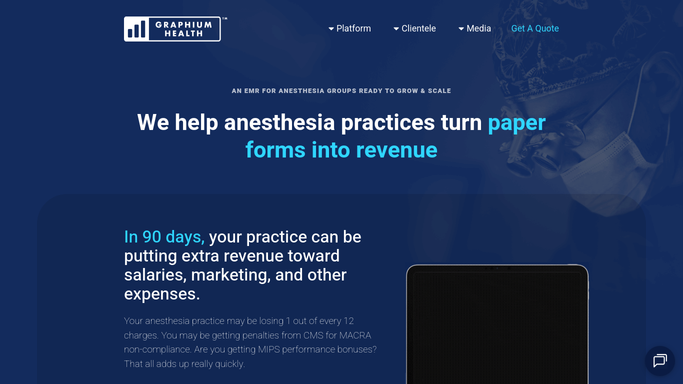
MACRA Ready reports the measures once the case exists
Graphium has automated the part it can reach, and the coverage inside the platform is real.
AnesthesiaEMR captures the intraoperative record on an iPhone or iPad, with visual cues for fields left incomplete before the chart is closed. Charge Capture takes that documentation straight into billing rather than waiting for a coder to read a paper sheet. MACRA Ready collects MIPS and QCDR quality data as part of the case, and its organizational and facility scorecards let a group see where performance is drifting before the reporting year closes. Graphium ONE wraps the whole revenue cycle as a service for groups that would rather not run one.
Every one of those begins with a case that already exists in Graphium.
The facility's scheduling system is where the case exists first, and Graphium is not in it. Neither is the medical staff office that holds a privileging file, the state board that renews a license, or the hospital portal where a quality or compliance requirement is posted. Those are the systems that decide whether tomorrow works.
Every facility the group covers is a separate login
Problems surface the evening before rather than the morning of. The rounds get made by something that does not need to sleep.
Tomorrow's posted schedule read off each facility's own system overnight and held against the group's assignments, so an unstaffed room is a call at eight in the evening rather than a scramble at a quarter to seven. Cancellations and add-ons caught the same way, while a provider can still be moved.
The facility's case log compared with what actually reached billing, so a case that was worked and never charged surfaces in days instead of at quarter end. Privileges, reappointment dates, state licenses, DEA registrations and certification cards checked on the sites that issue them, for every provider, sorted by what expires first.
One line holds in any clinical setting. The checking can happen with the office empty. Anything that changes a clinical or billing record, or that goes to a facility, a payer or a patient, is prepared for a qualified person to review. The value is in removing the rounds, not the decision at the end of them.
The administrator's week belongs to the group, not the hospital's portals
A group's scarcest people are the ones who understand both the OR schedule and the claim. Those people currently spend a large part of the week logged into other organizations' systems on the group's behalf.
WebRun is an AI agent that works a real Chrome browser, signed in as your administrators are. It opens each facility's scheduling system, the medical staff portal or the state board site, reads what is there, and brings back a list with the room, the name and the date attached.
It runs on your schedule in your own private environment, sessions are not shared between tools, and a workflow can be locked to an explicit list of sites. A run can be watched and stopped.
The workflows below are already built, and each one names exactly what it opens.
Questions people ask
Can it close or edit an anesthesia record for us?
No. It reads and compares, then reports. Anything that changes a clinical or billing record is prepared for a qualified person to review, because an anesthesia chart is a legal document as well as a claim.
Will it work with a hospital scheduling system we do not own?
Yes, and that is the common case. It signs in the way your administrator does and reads the posted schedule, which is usually the only access an outside group is given.
What happens with portals that require multi-factor authentication?
A login needing a one-time code needs a person the first time. That session is then reused on later runs, so the interruption is occasional rather than part of every morning.
12 ready-made Graphium Health workflows
Each one names the apps it touches and the exact steps it takes. Open one to read what it will do, then turn it on.

Want one of these running on your own Graphium Health?
Show WebRun the process once and it will run it on schedule, in your own private browser environment.