How to Automate Towbook
Towbook already automates the call. Digital Dispatching accepts motor club jobs, Motor Club Direct Billing and Payment Importing settle them, and the Impound Manager holds stored vehicles with state required letters built in. Lien deadlines, club provider portals and rotation compliance sit on other logins, which is where WebRun works.
 Written by
Elliot Nakamura
Platform writer
Written by
Elliot Nakamura
Platform writer
 Reviewed by
Yara Haddad
Data operations
Reviewed by
Yara Haddad
Data operations
Towbook runs the call from the hook to the release
A towing company is two businesses wearing one uniform. One of them is the call: a phone rings, a truck goes, a car moves, an invoice follows. The other is the lot behind the office, where vehicles sit for weeks and the money is measured in days of storage.
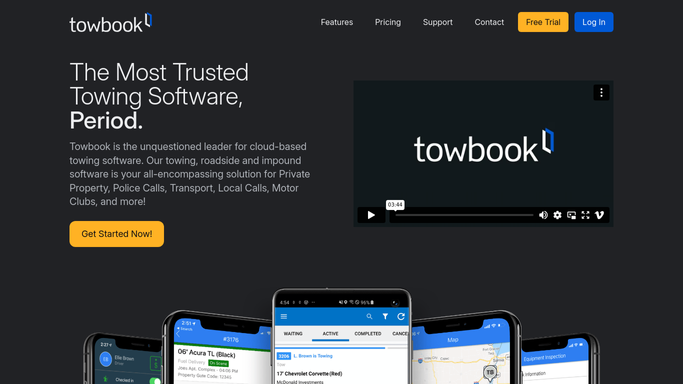
Towbook is the cloud-based towing software both of those run on. It covers dispatching, invoicing, vehicle inventory and impounds, liens and auctions, and it is used for private property tows, police calls, transports, local calls and motor club work, which are five different jobs with five different ways of getting paid.
The people in it are dispatchers, drivers, and whoever does the billing, often the owner's spouse at a desk in the corner of a shop. Calls come in at three in the morning. Nobody is at a keyboard when the work happens, and the paperwork the work creates does not care.
The impound lot creates more office work than the tow does
Hooking a car takes twenty minutes. Getting rid of one can take ninety days.
Once a vehicle is in the lot a clock starts. The registered owner and any lienholder have to be identified, which means a records request to a state on its own timetable. Notices go out, usually by certified mail, and the proof that they went has to be kept. A period runs, then another. Only then is it something you can sell or scrap, and only if every date was met.
The other half of the office reads motor club portals. Each club usually keeps its own record of the calls it sent, what it paid, what it short-paid, and how the company is performing on acceptance and arrival times, and that record quietly decides how much work comes next month.
The rotation list at the police department has its own file: insurance certificates, driver background checks, truck inspections, each with an expiry date nobody sends a reminder about.
Digital Dispatching already takes the club call off the phone
Towbook does the hard part of this trade genuinely well, and a company that has not turned all of it on is paying for that in wages.
Digital Dispatching and Email Processing accept calls straight from the motor clubs, so work from AAA, Agero, Allied Dispatch, Geico, Progressive, Quest or Urgently arrives as a job rather than as a phone call somebody types up. Those same clubs can be invoiced through Motor Club Direct Billing, and Payment Importing pulls the payment information back in and marks the invoices paid. The Impound Manager records stored vehicles, with state required letters built in and an integration to Auto Data Direct. The mobile apps let a driver accept a call, attach geocoded photos, capture a signature and file a damage report from the truck. QuickBooks connects so nothing is keyed twice.
That is a large share of the day gone, and none of it should be replaced.
What it cannot do is sign in somewhere else. The club's provider portal, the state records site, the certified mail account, the auction listing and the police department's compliance file are separate logins, and Towbook has never been given one.
Motor clubs grade you on a scorecard kept somewhere else
The second business, the one made of portals and lien deadlines, is the one that can be worked while the trucks are out.
Each club's provider portal read every morning, so a short-paid call, a rejected invoice or a slipping acceptance rate turns up as a line on a list instead of a thinner dispatch queue three months later. The lien calendar checked against the state's own record, so a vehicle whose notice window opens today lands on the desk today, not on the day it closed. Certified mail tracking pulled back and filed against the impound, because proof of notice is what makes the sale legal.
Insurance certificates and driver credentials checked against their expiry dates before the department asks for them, since a place on a rotation list is a privilege that gets withdrawn quietly. Vehicles ready for auction listed, and the results collected. Card payments compared with what actually reached the bank, by driver and by shift.
Draw the line at the vehicle owner. Reading a portal, checking a date and assembling a notice can run unattended. A storage invoice or a release letter is a legal document, and a person should read it first.
The lot's paperwork gets done between calls
The club portal, the state site and the mail account each changed overnight, and each needs opening and reading. That work need not fall to the person who was also up at three taking calls.
WebRun is an AI agent that works a real Chrome browser, signed in as you. It opens a motor club's provider portal, a state records site, the bank or an auction listing, reads what is there, and lines it up against what Towbook already holds about the call and the car.
It runs on a schedule you set, in your own private environment, and you can watch a run and stop it. Anything going to a vehicle owner is drafted and waits.
Each workflow below is built already, and every one names the sites it opens.
Questions people ask
Can it keep track of our lien deadlines?
Yes. It reads the impound list in Towbook, checks each vehicle against its notice and holding window, and brings anything approaching a date onto a daily list. The notice itself is drafted and left for a person, because it is a legal document.
Do we need a Towbook integration or a developer?
No. It drives a browser signed in as you, so it uses the access your office already has. Nothing is connected to your Towbook account and nothing has to be built first.
Will it invoice the motor clubs for us?
It reconciles them rather than replacing them. Motor Club Direct Billing should keep sending the invoices. This reads each club's provider portal for short-pays, rejections and performance, then hands your billing desk a list to work through.
12 ready-made Towbook workflows
Each one names the apps it touches and the exact steps it takes. Open one to read what it will do, then turn it on.


Want one of these running on your own Towbook?
Show WebRun the process once and it will run it on schedule, in your own private browser environment.