How to Automate Practice Fusion
Practice Fusion automates the visit. Charting templates, certified e-prescribing including controlled substances, lab and imaging orders that return results to the chart, online booking and automatic appointment reminders all run on what the practice already holds. Following what happens on payer and lab portals afterwards is where an agent like WebRun helps.
 Written by
Elliot Nakamura
Platform writer
Written by
Elliot Nakamura
Platform writer
 Reviewed by
Priya Raghavan
Solutions lead
Reviewed by
Priya Raghavan
Solutions lead
The cloud chart made the small practice possible
Practice Fusion is a cloud electronic health record built for independent practices with one to five providers and no IT department. Family practice, primary care, pediatrics, and a long tail of small specialties: an allergy and immunology clinic is a good example, where the same patients come back weekly for injections for years.
It runs in a browser, updates itself, and needs no server in a cupboard, which is much of why a solo physician can have a certified record at all. The provider charts in it, the front desk schedules in it, and prescriptions and claims go out of it electronically.
For a practice that size the record is not one system among several. It is the system. There is no informatics team, no interface analyst and no queue for a request. Whoever is on the front desk this morning also follows up on everything the practice is waiting for.
The waiting is what actually costs the practice
Documentation is the part that gets discussed. Waiting is the part that causes harm.
An allergy panel is ordered and the report is meant to come back. A referral goes out to a dermatologist. A prior authorization for a biologic is filed on the insurer's site, and after that there is nothing to do but check it every few days. A claim comes back denied, and the reason sits on the payer's portal, one claim at a time.
None of those announce themselves. An open order that never closed appears nowhere. The chart records what was ordered and what arrived; the difference is what matters, and it is the one thing no screen puts in front of you.
So a small practice runs on somebody's memory and a paper list. That works, until the person keeping the list takes a week off, and a mammogram ordered in March is found in July.
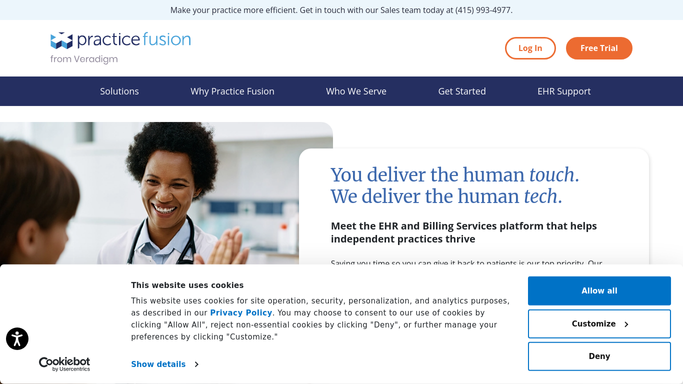
Practice Fusion runs on what has already reached the chart
The record handles the clinical day well, and a practice paying for it should use all of this first.
Customizable charting templates cut the visit note down, and frequently ordered panels can be saved and reused. Certified e-prescribing sends prescriptions electronically, including controlled substances through EPCS. Lab and imaging orders go out from inside the chart to connected labs and imaging centers, with results returning into the patient's record rather than a fax machine. Scheduling covers online booking, recurring appointments and automatic appointment reminders, the cheapest fix for no-shows a practice has. Claim submission and the quality, clinical and practice management reports are built from the same data.
Every one of those runs on something the record already holds: a chart, an order, an appointment, a claim it sent.
The moment the answer is on somebody else's website, it stops. Practice Fusion cannot log into a payer's portal to read why a claim was denied, check a prior authorization sitting with an insurer, open an imaging center's result site where there is no interface, or look at the specialty pharmacy holding a biologic. Nor can it tell you what has not happened, which is the whole problem.
Pending results and authorizations can be listed before clinic opens
What the practice is still waiting on becomes a page instead of a worry.
Every order placed more than three weeks ago with no result attached, listed with the patient, the date and what was ordered, so the pathology nobody reported back is visible while it still matters. Pending prior authorizations checked each morning on the insurer's own site, approvals separated from the ones still sitting and ranked by how long they have waited.
Denials read out of the payer portal into a worklist naming the claim, the payer and the reason, rather than discovered one by one. In an allergy practice, patients on an immunotherapy schedule who have not been in for six weeks assembled as a list for a nurse, alongside the vials approaching expiry and the ones running low. Balances past sixty days gathered with their ages on them.
Everything in that paragraph is reading and listing. Nothing in it writes to a chart, places an order, or reaches a patient. Those are different acts, and they belong to the people licensed to make them.
The chart stays exactly where the clinician left it
A biopsy ordered in March that never came back is visible in two systems, and flagged in neither. Finding it means looking in two places and comparing them, which is not a clinical judgment.
WebRun is an AI agent that works a real Chrome browser, signed in as you. It opens Practice Fusion, the payer portal, the imaging center's result site or the insurer's authorization page, reads what is there, and hands the practice a worklist.
It runs on your schedule in your own private environment, and you can watch a run and stop it. It does not write to a chart, place an order, or send anything to a patient. Every clinical decision, and every message that reaches a patient, waits for the person qualified to make it.
The workflows below are already built, and each one names the sites it opens.
Questions people ask
Will it write anything into a patient's chart?
No. It reads the record and the outside portals and produces a list. Nothing is written to a chart, no order is placed, and no result is marked as reviewed. Those are clinical acts and they stay with clinical staff.
Is letting software sign in to our EHR compliant?
It runs in your own private environment, signed in as you, under a policy naming which sites it may open, and every run can be watched and stopped. Treat it as you would any staff member with a login, and scope it the same way.
Can it check a lab or imaging portal that has no interface to us?
Yes, and that is the common case for a small practice. Where there is no interface, it opens the result site the way your medical assistant does and tells you which orders are still outstanding.
12 ready-made Practice Fusion workflows
Each one names the apps it touches and the exact steps it takes. Open one to read what it will do, then turn it on.

Want one of these running on your own Practice Fusion?
Show WebRun the process once and it will run it on schedule, in your own private browser environment.