How to Automate athenahealth
athenahealth automates the practice through athenaOne and the network behind it. Claims are scrubbed against rules maintained from payer behaviour across every practice on the service, Authorization Management chases payers, and Ambient Notes drafts the visit. Work on portals outside that network is still a person with a login.
 Written by
Clara Bennett
Revenue operations
Written by
Clara Bennett
Revenue operations
 Reviewed by
Yara Haddad
Data operations
Reviewed by
Yara Haddad
Data operations
The network behind athenaOne is the reason practices choose it
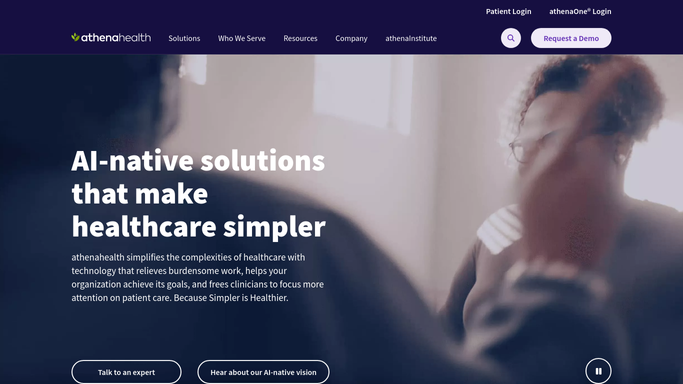
athenahealth sells athenaOne, one cloud service carrying the medical record, the revenue cycle and the patient side of an ambulatory practice. Inside it, athenaClinicals is the chart, athenaCollector is the billing, and athenaCommunicator is what the patient sees: the reminder, the portal, the balance. Plenty of staff still say athenaNet, which is the name the software used to carry.
What separates it from other practice software is not the feature list. Every practice on it sits on the same service, and athenahealth watches how payers behave across all of them. A denial pattern that appears at one cardiology group becomes a claim rule that protects the next one before it ever files that claim.
That is a genuine advantage, and it is a large part of why a practice puts up with the work of switching. It also defines precisely where the advantage stops.
Waiting on other organisations is a full-time role
Spend a morning with the staff of a cardiology practice and most of what you see is waiting, then checking, then waiting again.
The authorisation for a stress echo went out on Monday, and the insurer's portal is where the answer will appear, if it appears. A pacemaker's remote transmissions land on the manufacturer's monitoring site, and somebody has to open it to know that a patient's device reported something overnight. Bone density results sit on the scanner vendor's reporting system. A denial arrived carrying a reason code that only means anything on the payer's own site, with an appeal window attached that nobody wrote down.
Each one is a separate login, a session that times out, and a person in the practice who has quietly become the one who checks it. None of it is skilled work. Missing it is expensive, and once in a while it is dangerous.
The claim rules improve because somebody else got denied
athenahealth has automated a great deal, and the network is what makes its automation unusual.
athenaCollector pre-populates claims from the record and runs them through a rules engine of more than thirty thousand rules before submission, and those rules are maintained centrally from payer behaviour seen across the whole service. Authorization Management goes further: an eligible order is checked by an Authorization Determination Engine against that payer's requirements, and where authorisation is needed, athenahealth specialists submit the documentation and follow it to completion. Ambient Notes, in athenaOne Mobile, records the visit and drafts the note from it.
Notice what those share. Each acts on something already moving along athenahealth's own rails: a claim, an order, an encounter, a patient athenaOne knows about.
The device manufacturer's monitoring portal is not on those rails. Neither is the imaging vendor's reporting site, the state registry, the hospital's scheduling system or the diabetes platform holding three months of readings. Those organisations run their own logins and have no reason to build an interface to anyone. The network is very large and it still ends at its own membership.
Answers that never touch the network can still arrive each morning
The outside of that network can arrive as a worked list instead of a queue, in the way the inside of it already does.
Open authorisations checked on each insurer's site before the clinic opens, with anything still pending after three days marked so a person telephones while the appointment can still be moved rather than cancelled. Remote device transmissions reviewed on the manufacturer's portal overnight and turned into a queue for the device clinic, ordered by what actually reported an event.
A recall notice read against the practice's own list of implanted devices, so affected patients are named instead of counted. Imaging and bone density reports pulled from vendor systems and matched to the patient who was booked for them. Denials collected from payer portals with their appeal windows attached, ordered by which closes first. Patients overdue an anticoagulation check, listed with how far past they have gone.
The boundary in a clinical setting does not move for convenience. Gathering information can run unattended. Anything that changes a clinical or billing record, or that reaches a patient, is prepared for a qualified person to review and act on.
The refreshing gets handed over, the judgement does not
Every one of those checks is somebody signing into a website belonging to another company and reading a status that has usually not changed since yesterday.
WebRun is an agent that works a real Chrome browser, signed in as your staff are. It opens athenaOne alongside the payer, device and imaging portals in the same run, reads each screen, and brings back a worklist with the dates and the patients attached.
It runs on your schedule in your own private environment, sessions are not shared between tools, and a workflow can be locked to an explicit list of domains. You can watch a run and stop it.
The workflows below are already built, and each one names what it opens.
Questions people ask
athenahealth already has an interface programme. Why drive a browser?
Because the organisations on the other side do not have one. An interface can move data between athenaOne and something built to talk to it. A device manufacturer's monitoring site or a state registry offers a login and a screen, and reading that screen is the only route in.
We run several locations on athenaOne. Does that complicate it?
No. It signs in the way your staff do, so it sees whichever locations and departments that login already covers. A workflow can also be pointed at one site's schedule and left alone by the rest.
Our device clinic covers three manufacturers. Can one run handle all of them?
Yes. A single run can sign into each manufacturer's monitoring portal in turn and bring the transmissions back as one queue, ordered by what actually reported an event. The logins stay separate and sessions are not shared between them.
17 ready-made athenahealth workflows
Each one names the apps it touches and the exact steps it takes. Open one to read what it will do, then turn it on.




Want one of these running on your own athenahealth?
Show WebRun the process once and it will run it on schedule, in your own private browser environment.