How to Automate StoriiCare
StoriiCare automates a great deal on its own: Workflows fire on an admission, an incident report or a form submission, Attendance signs people in by QR code, and Storii Family carries updates to relatives. Every one of those triggers is an internal event, so outside changes still need fetching, which WebRun does.
 Written by
Hannah Vogel
Finance operations
Written by
Hannah Vogel
Finance operations
 Reviewed by
Ben Kirkwood
Solutions engineer
Reviewed by
Ben Kirkwood
Solutions engineer
Life story and care plan sit in the same record
StoriiCare, from Storii Global, is the care record used by adult day, residential and community-based services: care homes and nursing homes, memory care, PACE programs, senior centres, home care agencies and learning disability services. The people in it are called service users or clients rather than patients, and that is not decoration.
In memory care especially, the clinically useful information is biographical. A resident who spent thirty years at sea settles when there is water on the screen. One who taught infants will fold laundry for an hour if it is framed as helping. Sundowning starts at a particular time for a particular person.
So StoriiCare keeps life stories next to care plans, and treats an activity, a mood note and a photograph as parts of the record rather than as extras. The evidence a family wants and the evidence a regulator wants turn out to be the same: this person had a day.
Writing up the week for a family takes the shift's last hour
The staff who know the residents best are the ones with the least time to write anything down.
A care assistant logs a mood, a refusal, an activity, a behaviour incident. A nurse needs the pattern across a fortnight, not the twenty individual notes. The activities coordinator needs to know who has not joined anything in a week. The manager needs a care conference booked with a daughter who works shifts and a GP who does not answer email. Somebody promised a family photographs on Monday.
Each of those is a person reading back through entries already sitting in the system and assembling them by hand into something that can be sent or discussed. And the events that would change any of it, an overnight hospital admission, a medication switch at the pharmacy, an email from a daughter at eleven at night, arrive somewhere else entirely.
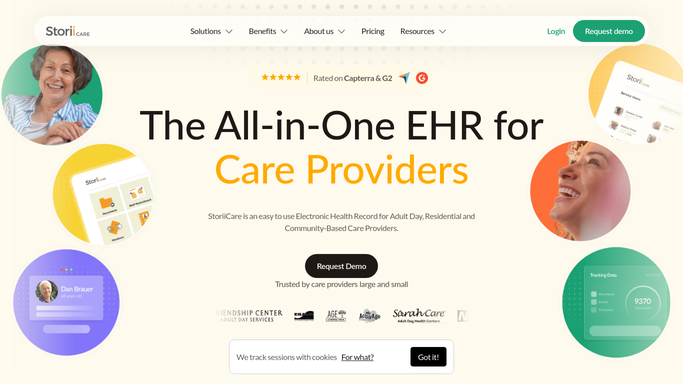
StoriiCare fires a workflow the moment something happens inside it
This is a product that has taken automation seriously, and it does more of it inside itself than most records in this sector.
Workflows lets a service build a step-by-step process with due dates, owners and role-based assignments without code, triggered by an event such as a new service user admission, an incident report or a form submission, with personalised task lists and live progress tracking. Attendance is signed in and out by QR or PIN code and reported in real time, absences included. Storii Family gives relatives a mobile app carrying updates, photos, notices and secure messaging, and lets them contribute to a life story. eMAR, EVV, billing, scheduling, a form builder and a CRM sit alongside, with an AI Assistant, AI Care Planning and AI Note Translations layered on top.
Every trigger in that list is a StoriiCare event. The workflow starts because something was recorded here.
The hospital records nothing here. Neither does the pharmacy, the local authority, the payer, or the daughter who emailed at eleven last night. A record that automates well from its own events still waits for a person to tell it what happened outside.
Care conferences and photo updates can start themselves
The admission is typed into a hospital system at two in the morning. The care record can have it by seven.
A resident admitted to hospital overnight picked up from the hospital's own portal, so the morning handover already knows, and the bed, the medication and the call to the family are dealt with together. Funding and authorisation decisions read from the payer or local authority site rather than waited on. A pharmacy portal checked for the order that changed on Friday against what the eMAR still says.
Then the human work that never quite gets done. A month of mood and behaviour notes summarised into the pattern a nurse would look for, ready before the review rather than assembled during it. Care conference slots proposed against the calendars of a daughter, a GP surgery and the care manager. A photo and activity update for each family drafted from what staff already logged this week, ready for someone to glance at and send.
The rule in a care setting does not bend. Gathering and drafting run unattended. No care plan is written, no clinical conclusion is drawn, and nothing reaches a family until a person who knows the resident has read it.
The outside world reaches the care record on its own
A care assistant who has already logged the mood, the meal and the activity should not have to write the same week up again for a family, and a manager should not learn about Tuesday's hospital admission on Thursday.
WebRun is an AI agent that uses a real Chrome browser, signed in as a member of staff would be. It opens the hospital portal, the pharmacy site or the funding authority, reads what is on the screen, and brings back what changed with the resident's name attached.
It runs on your schedule in your own private environment, sessions are not shared between workflows, and a workflow can be restricted to a named list of sites. You can watch a run and stop it.
The workflows below are already built, and each one names what it opens.
Questions people ask
Our care plans are clinical documents. Is anything altered?
No. Care planning stays with qualified staff. An agent reads what has already been recorded, assembles the pattern across a period, and presents it for the review, so the person making the decision starts from a summary rather than from scrolling.
Our families are sensitive about photos. Is anything shared automatically?
Nothing is shared without a person. Updates and photo selections are prepared as drafts against each family's existing permissions in Storii Family, and a member of staff decides what goes out and presses send.
The hospital portal sends a code to a phone. Does that break it?
Only at the start. Somebody has to be there for the first sign-in and type the code. After that the session is kept and reused, so a texted code interrupts you occasionally instead of every morning.
12 ready-made StoriiCare workflows
Each one names the apps it touches and the exact steps it takes. Open one to read what it will do, then turn it on.

Want one of these running on your own StoriiCare?
Show WebRun the process once and it will run it on schedule, in your own private browser environment.