How to Automate AMPECO
AMPECO automates the chargers: Remote Management and Maintenance handles faults and firmware, Dynamic Load Management shares the power, EV Roaming connects other networks over OCPI. The rest of a charging business sits on other people's websites, from grid connection applications to host agreements and warranty cases, which is where a browser agent like WebRun works.
 Written by
Sofia Marchetti
Marketing operations
Written by
Sofia Marchetti
Marketing operations
 Reviewed by
Devon Ruiz
Workflow engineer
Reviewed by
Devon Ruiz
Workflow engineer
The chargers are in the ground, the network is in AMPECO
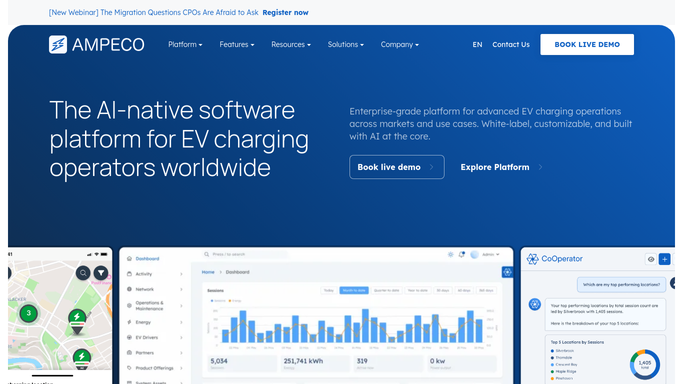
A charging network is a strange asset. The part the customer sees is a steel post in a car park. The part that decides whether the business works is a row in a database. AMPECO is where that row lives: an AI-native charge point management system used by charge point operators, e-mobility service providers, utilities, parking companies and fleets.
Open it and the network appears as an operator thinks of it. Sites and connectors, each reporting over OCPP from whatever hardware is bolted down there. Sessions, with the kilowatt hours and the tariff that priced them. Drivers and vehicles, some on Plug and Charge, some tapping a card at a terminal. Tariffs, plans and invoices. B2B partners and sub-operators, because a network of any size is rarely one company's.
That last part is what outsiders underestimate. A charging business is mostly relationships: with the landowner, the grid, the hardware vendor and the roaming partner.
Every new site adds a landlord, a permit and a grid application
None of that is where the week goes.
Growth here happens site by site, and each site brings its own paperwork. There is a host agreement with a landowner, with an end date in a spreadsheet somebody made two years ago. There is a grid connection application sitting on a distribution network operator's portal, moving through stages visible only if you log in. There is a permit with a status page of its own.
Then the site goes live and a second set begins. A charger fails in a way the manufacturer has to fix, so somebody opens the vendor's warranty portal and chases a case number. A technician's electrical certification expires, and sending them to a live unit without it is a serious problem. A roaming partner's settlement has to be reconciled against your own sessions. A grant claim needs evidence uploaded before a date nobody diarised.
Every one of those is a website, a login and a person remembering.
Everything AMPECO automates speaks OCPP to it
The platform is not the bottleneck, and it takes a great deal off the table.
Remote Management and Maintenance covers the daily work: sessions started and stopped remotely, charging profiles set, firmware pushed out, and faults detected in real time with automated recovery routines that bring a station back without a site visit. Dynamic Load Management shares a fixed supply across a site so a full car park does not force a capacity upgrade. EV Roaming connects the network to roaming hubs over OCPI, so drivers from other networks can charge on yours. CoOperator, the platform's AI operations agent, is built to understand the network and act on the operator's behalf.
Look at what those have in common. Each is an instruction to a charger, or an answer derived from what chargers report. The protocol is the boundary. OCPP and OCPI are why the platform can talk to almost any hardware, and why it cannot talk to a landowner's property system, a grid operator's application tracker, a certification body's register or a hardware vendor's support desk. Those are websites, with logins, publishing nothing to anyone.
A charging network that chases its own paperwork
Obligations live in somebody's memory because the dates behind them sit on sites nobody opens from one month to the next. Those sites can be opened every morning without anyone having to remember.
Host agreements tracked with real end dates, so a renewal conversation starts three months out rather than the week a landowner mentions it. Grid connection applications checked on the network operator's portal every morning, with a stage change reported the day it happens. Technician certifications read from the issuing body's register, so a card expiring in six weeks is on a list now, not after a job is booked.
The commercial half is the same habit pointed elsewhere. A warranty case opened on the vendor's portal, with its status pulled back next to the station, so a charger down eleven days is a number rather than a feeling. Roaming settlements set against your own session records while a query is still worth raising. Grant claims tracked against their deadlines.
The line worth holding is between finding out and acting. Reading a status, comparing two figures and building a list is safe every morning. Submitting an application, or emailing a landowner about a renewal, is prepared and read by a person first.
The logins outnumber the engineers
Each of those checks is the same three minutes: open a site you did not build, find one field, write it down somewhere else. Nobody does it better for having an engineering degree, and everybody does it worse in a busy week.
WebRun is an AI agent that works a real Chrome browser, signed in as you. It opens the grid operator's portal, the vendor's warranty desk, the certification register or the roaming statement, reads the screen, and puts the answer next to the site in the sheet your team already uses.
It runs on your schedule in your own private environment, and you can watch a run and stop it mid-way. Anything that submits a form or messages a partner is drafted and waits.
The workflows below are already built, and each one names what it signs into.
Questions people ask
We already build on the AMPECO API. Where does this fit?
Alongside it. The API covers what the platform holds. This covers the sites that publish nothing: grid operator portals, certification registers, hardware vendor support desks and landlord systems that have no API for anyone to call.
Will it submit a grid connection application on our behalf?
No. It reads the status, records the change and flags what needs doing. Submitting an application, signing an agreement or contacting a landowner commits the company, so all three are prepared and left for a person.
Does it need admin rights on our operator account?
No more than the person it runs as. It signs in with an account you create, at whatever permission level you set, in your own private environment. You can watch a run live and stop it mid-way.
13 ready-made AMPECO workflows
Each one names the apps it touches and the exact steps it takes. Open one to read what it will do, then turn it on.

Want one of these running on your own AMPECO?
Show WebRun the process once and it will run it on schedule, in your own private browser environment.