How to Automate TrichoSuite
TrichoSuite automates the hair clinic record. LiDAR scalp scans feed a graft calculator that prices the quote, the photo gallery keeps standardised before and after angles, and smart scheduling sends appointment reminders. Sweeping the whole patient book for overdue photographs, unpaid deposits and expiring consents is where an agent such as WebRun earns its place.
 Written by
Dimitri Vasilev
Logistics analyst
Written by
Dimitri Vasilev
Logistics analyst
 Reviewed by
Ben Kirkwood
Solutions engineer
Reviewed by
Ben Kirkwood
Solutions engineer
A hair transplant is a two-year relationship
A hair transplant is not an appointment. It starts with a photograph sent over WhatsApp and finishes with a review posted long after the surgery, and everything between is somebody keeping in touch.
TrichoSuite is built for that whole arc. It is a platform for hair transplant clinics, run out of Madrid and Mexico City, and it holds the clinical record and the commercial one together: the medical history and Norwood or Ludwig classification, the LiDAR scalp scan captured on an iPhone, the graft calculation from it, the quote, the signed consent, the surgery and every progress photograph afterwards.
Two portals hang off it: the doctor's side, where the clinic works, and the patient's, where somebody in another country sees their own photographs, documents and medication. It is run by single-surgeon practices and by chains working across several sites and languages.
The clinic's real work happens between appointments
Between those two portals, a hair clinic's week is chasing.
Enquiries arrive as an Instagram message with a photograph attached, a WhatsApp voice note, or a form filled in at midnight in another time zone, and each one needs a scan booked. A quote goes out and the deposit either arrives or it does not, and finding out which means opening the payment processor and matching names by hand. Two days before surgery somebody assembles the pre-op instructions. After surgery the photographs are the product: three months, six months, twelve months, and every one of them has to be asked for. Medication runs out and nobody refills it. A patient marked no-show three weeks ago was never rung back. And before a result goes on Instagram, somebody checks that the consent covers it.
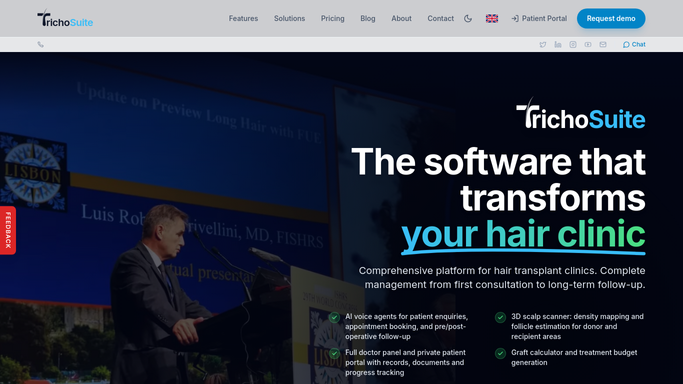
TrichoSuite talks to patients one conversation at a time
TrichoSuite already does more of this than most clinic software, and a practice should have all of it switched on before adding anything.
LiDAR 3D scanning captures the scalp from an iPhone, and the graft calculator turns that into an estimate by zone against the Norwood scale, which becomes the quote. Smart scheduling sends automatic appointment reminders. The photo gallery keeps standardised angles with a before and after comparator and an evolution timeline. Medication management covers digital prescriptions and stock, and digital documents cover consent forms with electronic signature. The larger plans add AI agents on voice, WhatsApp, web chat, email and SMS that will take an enquiry, book an appointment and follow up after an operation.
That is a great deal, and much of it is conversational work done without a person.
What all of it has in common is one patient at a time, in a channel the clinic already runs. The other shape of the work is a sweep: reading every patient on the books at once to ask which are overdue a photograph, short a deposit, out of medication or past a consent date. And the money sits in the payment processor, the enquiries sit in a social inbox, and neither is where the record lives.
A whole book of patients can be checked at once
Nobody has ever had the hours to go through every patient on the list before the clinic opens.
New enquiries collected out of Instagram and WhatsApp, opened as patient records, with a message drafted offering scan slots that are genuinely free. Each new scalp scan turned into a graft estimate and a priced quote, drafted for a consultant to check.
Upcoming procedures matched against payments in the processor, so the front desk starts the day knowing who still owes a deposit and who owes a balance. Pre-op packets assembled for everyone operating this week, drafted in the channel each patient actually uses. Months since surgery counted for every patient, so the three, six and twelve month photograph requests go out on time rather than when somebody remembers. Medication supply tracked so a refill reminder is drafted before the bottle empties.
Donor-zone density compared against that patient's earlier scans, with a real drop flagged for the surgeon. No-shows found and offered a rebooking against slots that are open. And before any before-and-after is published, the consent read and anything expired or missing flagged.
The line in a clinic is simple. Gathering, comparing and drafting run unattended. A record edited, a patient contacted, anything published: each waits for the qualified person whose name is on it.
Hair clinics lose money in the follow-up, not the theatre
Every item on that list is somebody opening a screen, reading it, and writing down what it said.
WebRun is an AI agent that drives a real Chrome browser, signed in the way your clinic signs in. It opens the patient record, the payment processor, the enquiry inbox or the photo folder, reads what is there, and hands back a list ordered by what is most overdue.
There is no integration to build first, which matters most for the places that were never going to offer one. It runs on your schedule inside a private environment of your own, a workflow can be locked to an explicit list of sites, and a run can be watched and stopped.
Nothing is sent to a patient, published, or written into a record without a qualified person approving it. Each workflow below names what it opens.
Questions people ask
Can it message a patient without us seeing it first?
No. Messages to patients are drafted in the channel that patient uses and left for somebody to read and send. Post-operative advice and medication reminders are clinical communication, so a qualified person signs them off.
Would it ever post a before-and-after to our Instagram?
No. It reads the consent behind each result and flags anything expired or missing, then leaves the post to a person. A published photograph of a patient cannot be taken back once it is out, so the approval stays with the clinic.
Our enquiries come through Instagram and WhatsApp. Can it read those?
Yes, in a browser with your own sign-in, the same way your team reads them. That is the advantage of driving a browser rather than an API: an enquiry sitting in a social inbox is reachable exactly as a member of staff reaches it.
11 ready-made TrichoSuite workflows
Each one names the apps it touches and the exact steps it takes. Open one to read what it will do, then turn it on.
 Instagram
 Instagram

 Instagram›
Want one of these running on your own TrichoSuite?
Show WebRun the process once and it will run it on schedule, in your own private browser environment.