How to Automate Khatabook
Khatabook automates the chasing on its own. Reminders go out the day before and on the repayment date, over WhatsApp, SMS or a call, in the customer's language, and bulk reminders cover a whole list at once. Matching bank and UPI credits back to each khata is where an agent like WebRun helps.
 Written by
Tom Kessler
Field operations analyst
Written by
Tom Kessler
Field operations analyst
 Reviewed by
Julian Adeniyi
Retail operations
Reviewed by
Julian Adeniyi
Retail operations
The udhaar that used to live in a notebook now lives on a phone
Khatabook is a free mobile app used by small businesses across India to keep a khata: the running account of what each customer owes and what is owed to each supplier. It works in Hindi, English and a dozen other languages, which is the point, because the person keeping the ledger is usually the owner and not a bookkeeper.
Udhaar is the working model of a great deal of Indian retail. The kirana that lets a family settle at the end of the month, the wholesaler supplying six shops on thirty days, the chemist, the hardware store. Before the app that was a diary with a rubber band around it, and the balance was whatever the two sides agreed it was.
What sits inside Khatabook is every credit and every payment, per customer, dated, backed up to the cloud rather than to a drawer that floods. For a shop that size it is the only record there is, and it is the one both sides trust.
The entries go in easily; the money still has to be found
Writing the khata takes seconds. Getting it settled is the rest of the month.
A customer pays by UPI and says nothing about it. The credit appears under a name that is not the customer's name, and somebody has to work out which of forty balances it belongs to before the next reminder goes out to a person who has already paid. That is the mistake that costs a customer.
A cheque was deposited on Monday, and a bounced cheque is not news that arrives. Somebody goes and looks for it.
Then the buying side, which the khata never sees at all. The distributor's rate this month against what was paid last month. Which regular has not walked in since the middle of June. Which customer with four entries already open should not be given a fifth.
Every one of those checks is a screen in somebody else's app, opened with a thumb, between customers.
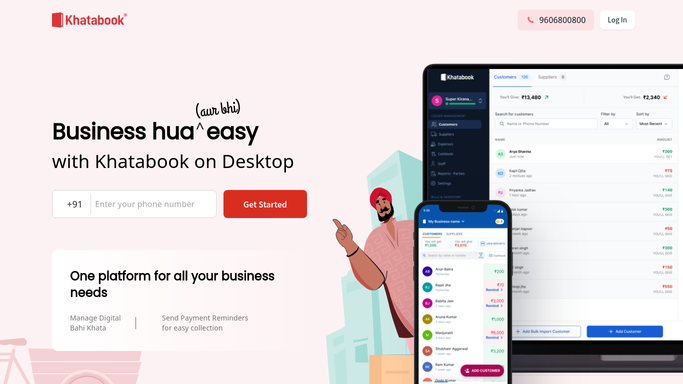
Khatabook already chases; it just cannot confirm
Khatabook automates the collection side better than most shops realise, and nothing below is a reason to switch any of it off.
Payment reminders go out automatically, one the day before the repayment date and one on the day itself, in the customer's own language, over WhatsApp or SMS or as a call, sent from the business account rather than from a personal number. Bulk reminders do the same for a whole list at once, turning an evening of messages into a few taps. A QR code and UPI collection put money straight into the bank account rather than a wallet somebody then has to move. Reports come out as a PDF you can hand to a customer who disputes a figure.
All of that works on entries somebody typed in. Khatabook knows the reminder went out. It does not know whether the money came, because the money lands in a bank account and a payments app it cannot see, under a reference that matches nothing. The distributor's price list, the tax portal and the shop down the road are further away still.
A payment that already landed should stop the next reminder
The bank knows things the khata does not, and it will tell anyone who signs in.
Yesterday's credits read and matched against the open balances, so the customer who paid on Sunday is off the chase list before Monday's reminder reaches them. The reference that means nothing turned into a name by amount and timing, which is what a person does by hand and what a person gets wrong on the fortieth one.
Cheques followed to cleared or bounced, so a bounce is a phone call the same afternoon rather than a discovery a fortnight later.
The rest follows the shape of the shop. A month-end list of who is outstanding and by how long, oldest at the top, ready before the shutters go up. A repeat customer's history read before more credit is extended, so the answer is a number and not a feeling. This month's distributor rate held up against the last one you were charged, and the items that went up named.
The ledger is yours; the checking does not have to be
Every morning starts the same way: the bank on one screen, the ledger on the other, and a list of credits to match between them. Nobody started a shop in order to do it.
WebRun is an AI agent that works a real Chrome browser, signed in as you. It opens your bank, a payments dashboard or a distributor's site, reads what each shows, matches it against what your books say is outstanding, and hands back a short list: who paid, who did not, what bounced.
It runs on your schedule in your own private environment, and any run can be watched and stopped, and the matching itself runs unattended. A reminder to a customer or a change to a balance is drafted and waits for you, because a message sent to someone who has already paid is the one mistake that loses a customer.
The workflows below are already built, and each one names what it opens.
Questions people ask
The khata only exists on my phone. Does that rule this out?
No, because the useful checking happens elsewhere. The screens worth opening are your bank, the payments dashboard, a distributor's site and any portal you sign into, and all of those have a web login. The agent reads them, compares them with what you are owed, and gives you the difference.
A customer paid but I have not recorded it. Will they still be chased?
That is the exact case this is for. The agent reads the credits that actually arrived at the bank, matches them to open balances by amount and timing, and flags the ones that look settled. The chase list you get has already had those names taken off it.
Can it change or delete an entry in my ledger?
Not on its own. The pattern is read and report: findings come back as a list, and any correction to a balance is prepared for you to make yourself. Your books stay yours to edit, which also means a wrong match is a suggestion you reject rather than damage you have to undo.
12 ready-made Khatabook workflows
Each one names the apps it touches and the exact steps it takes. Open one to read what it will do, then turn it on.


Want one of these running on your own Khatabook?
Show WebRun the process once and it will run it on schedule, in your own private browser environment.