How to Automate GorillaDesk
GorillaDesk handles the visit itself: Appointment Confirmations and Reminders, OMW texts, the Route Optimizer, subscription billing and material tracking that records every chemical application. Compliance is what stays manual, because state use reports, applicator licence renewals and a commercial client's own vendor portal all live elsewhere. Those logins are where WebRun works.
 Written by
Clara Bennett
Revenue operations
Written by
Clara Bennett
Revenue operations
 Reviewed by
Rosa Lindqvist
Operations editor
Reviewed by
Rosa Lindqvist
Operations editor
GorillaDesk keeps a route running week after week
Pest control does not sell jobs, it sells intervals. A quarterly perimeter treatment. A monthly commercial account. A bait station checked on a schedule. A lawn programme with five applications a year. The money is in the fact that next quarter's visit is already booked.
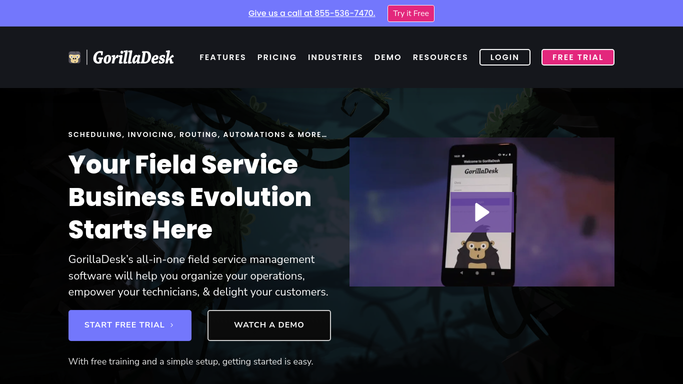
GorillaDesk is the field service platform local service businesses run those intervals on, built first for pest control and used alongside it by lawn care, cleaning and small contracting firms.
Work is scheduled as a one-off visit or a recurring contract, dragged around a calendar, and pushed to technicians on a phone. The Route Optimizer builds the week or the month. Material tracking records what was applied where, against the job, the client or the property, and the chemical application history can be pulled back out. Device and barcode scanning logs each station as it is checked. Subscription billing takes the saved card without anyone asking.
The state wants a record of every drop applied
Applying a pesticide is a licensed activity, and the licence comes with homework.
Depending on where the business operates there is a use report to file with a state agency, on a portal with its own login and its own deadline. Applicator certifications expire, and each technician's expiry date lives on the licensing board's website rather than anywhere useful. Continuing education credits have to be earned before a renewal, and whether a course actually posted to the record is something only that board's site can confirm. Product registrations change, and a label that was legal last season may not be this one.
Then the commercial side. A restaurant group or a warehouse client will not accept an emailed service ticket. It wants the report uploaded into the facilities management portal it makes every vendor use, and it will sit on the invoice until that happens.
Each of those is a website, a password and a date, and none of them is the route.
The Route Optimizer and the reminders handle the visit itself
GorillaDesk automates the appointment thoroughly, and the money spent on it is well spent.
Appointment Confirmations go out when work is booked and Appointment Reminders before the visit, which matters more here than in most trades, since a locked gate is not a rescheduled job, it is a hole in a route that was optimised around it. OMW text messages tell the customer the technician is on the way and where they are. The Route Optimizer sequences the stops. Two-way texting and VoIP keep the conversation in one place. Subscription billing charges the saved card for recurring services and invoicing runs off the completed job. Commission tracking works out what the salesperson earned. eSignatures close the service ticket on the doorstep, and review generation asks for the review afterwards.
Material tracking captures the application, and the chemical history is there to download when someone asks for it.
That last point is the shape of the whole thing. GorillaDesk will hand you the record. Filing it with the agency, keeping a licence current and uploading it into a client's own portal are three different websites, and none of them has ever heard of GorillaDesk.
A lapsed applicator licence stops the whole route
Compliance is dated work, and the dates sit on the agency's site, where a weekly read replaces the monthly panic.
Every technician's licence and certification checked against the state board's own record each week, with an expiry three months out surfaced early, when a renewal course can still be booked and sat. Continuing education credits confirmed as actually posted, not merely attended. The state's use report assembled from the application history GorillaDesk already holds and taken to the portal before the deadline, with a copy kept. Registration status checked for the actives you use, so a label change is news rather than a discovery.
On the commercial side, service reports uploaded into each client's facilities management portal on the day, because that upload is often the only thing standing between a completed visit and a paid invoice. Work orders read out of those same portals so they reach the schedule without anyone retyping them. Distributor stock checked for a product a route depends on. Card failures on recurring subscriptions caught at the processor before a customer quietly drops off the round.
Keep a person at the customer end. Reading a portal, filing a report and checking a licence can run unattended. Anything that texts a homeowner should be drafted and read first, because a badly timed message about their house becomes a public review.
The filing can happen while the truck is out
The skill is knowing where they got in. The rest is a browser, and it does not have to wait for somebody to sit down at one.
WebRun is an AI agent that works a real Chrome browser, signed in as you. It opens the state licensing board, the reporting portal, a client's facilities system or the distributor, reads what is there, and lines it up against what GorillaDesk already knows about the route.
It runs on a schedule you choose, in your own private environment, and you can watch it work or stop it. Anything a customer would receive is prepared and waits for a person.
Each workflow below is built already, and every one lists the sites it works.
Questions people ask
Can it file our state pesticide use report?
It assembles the report from the application history already in GorillaDesk and opens the agency portal with it ready. A regulatory filing is worth a person's eyes, so the final submission is left for you to confirm.
Does it need an integration with GorillaDesk?
No. It works the browser signed in as you, so it uses the access you already have. Nothing has to be connected to your GorillaDesk account and nothing has to be built first.
Can it handle a commercial client's vendor portal?
Yes, and those are usually the least automatable thing a pest firm deals with. It reads work orders out of the portal and uploads the service report back, using your own login.
16 ready-made GorillaDesk workflows
Each one names the apps it touches and the exact steps it takes. Open one to read what it will do, then turn it on.


Want one of these running on your own GorillaDesk?
Show WebRun the process once and it will run it on schedule, in your own private browser environment.