How to Automate RICS Software
RICS Software automates the shop floor and the stockroom. The Global Product Catalog fills in SKUs from the brands themselves, purchase orders track ordered against shipped, and a library of more than 185 reports covers sales, inventory and customers. Checking the brand's own portal for availability is still somebody's morning.
 Written by
Grace Okafor
Healthcare operations
Written by
Grace Okafor
Healthcare operations
 Reviewed by
Elliot Nakamura
Platform writer
Reviewed by
Elliot Nakamura
Platform writer
RICS knows every shoe in the stockroom by size and width
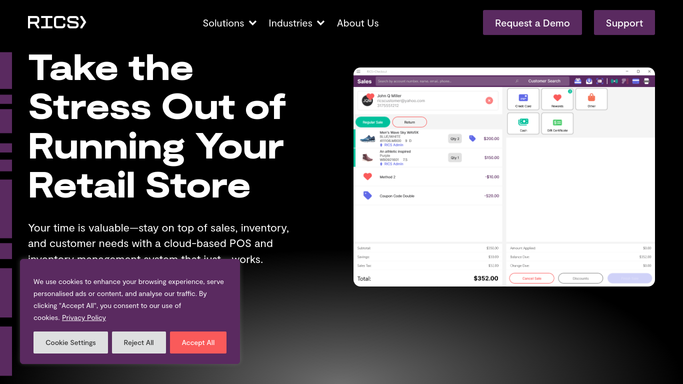
RICS Software is the till and the stock file for specialty retailers: running shops, footwear and apparel boutiques, western wear, workwear, outdoor and surf. Places where one style exists in nine sizes, three widths and four colours, and where a customer asking for a 10.5 in a wide fitting is asking a question the system has to answer exactly.
So the product record is the heart of it. Every SKU carries its supplier, its class, its grid position, its colour and its cost, and every transaction through the point of sale and the Back Office moves those figures. Customer profiles hold purchase history and loyalty. Reporting turns all of it into sell-through by style, by size and by store.
The people using it are an owner who buys, a manager who counts, and staff on the floor who need the answer to be right while somebody is sitting there with one shoe on.
Next spring gets bought in August
Specialty retail has a timing problem most shops do not.
You commit to next season months ahead, at quantities you are guessing, against a size run you hope the brand can still supply. Between the pre-book and delivery sit a ship window, a cancel date and a brand portal where all of it changes without anyone telling you. So somebody signs in to see whether the order is still complete, whether the drop date moved, and what can fill the hole where a colour got dropped.
Meanwhile the shop keeps selling. The best model of the spring sells through its middle sizes in three weeks, and the reorder depends on whether the brand has any left, a fact that lives on their site and nowhere in yours. A competitor two towns over lists the same shoe below the price you agreed to hold. A rep calls asking for sell-through numbers, and pulling them together is a job.
None of that is retail. It is a browser and a morning.
The report library ranks what already sold
Inside the shop, RICS covers the work properly, and it should all be used before looking anywhere else.
The Global Product Catalog pulls product data straight from the brands, so a new style arrives with its SKUs, sizes and colours filled in rather than typed by hand. Purchase orders can be built with quantities and agreed costs, then audited against what actually shipped. Physical Inventory runs a proper count, with a Variance report and an Items Not Counted report behind it. And the reporting library runs to more than 185 reports across sales, inventory, financials and customers, scheduled and delivered without anyone opening the system.
That is a serious back office for an independent shop.
What none of it can do is look outward. Every report ranks what has already happened in your stores. Nothing in it signs into a brand's portal to see whether the size run you reordered is still there, whether your open order has a cancel date on Friday, or whether the drop moved to July. It cannot check what the store down the road lists the same style at, or the brand itself. The buy is the biggest decision of the shop's year, and half the information behind it sits on somebody else's website.
A buy can be checked against what the brand can actually ship
A buyer working from the brand's own portal is working from this week, not from a report that ranks what already sold.
Every open purchase order checked weekly on the brand's own site, so a cancel date, a short-shipped size run or a pushed delivery turns up with weeks left to put something else in its place. The models selling through fastest set against what is available to ship at once, so a reorder is placed on real stock rather than hope.
Your prices on the website checked against the brand's stated minimum advertised price and against the other shops selling the same style locally, so an undercut is found the same day. Season drop dates gathered from each brand into one calendar. Warranty and returns claims followed up on the portals holding them. The sell-through numbers the rep asks for assembled before the call rather than during it.
The buy itself stays yours. Reading portals, comparing prices and preparing numbers can run overnight. Placing a purchase order, changing a price on the live website or emailing a rep is a commitment, and commitments belong to the person whose money it is.
The buy stays the buyer's call
All of that information can be gathered without any of it being decided.
WebRun is an AI agent that works a real Chrome browser, signed in as you. It opens RICS, each brand's portal, your own website and the listings you watch, reads what is on the screens and sets them side by side, so open orders, availability and price gaps arrive as one short list.
It runs on your schedule in your own private environment, and you can watch a run and stop it. Orders and price changes are prepared and left for you to approve.
The workflows below are already built, and each one names what it opens.
Questions people ask
Will it place a purchase order for us?
No. Orders are prepared with the quantities and the evidence attached, and a person places them. Buying commits your money, so it stays a decision rather than a step in a run.
Can it sign into a brand's wholesale portal?
Yes, if you can sign into it in a browser. That is usually the whole reason: those portals hold availability, cancel dates and drop dates, and almost none of them offer an export or an API.
Does it write anything back into RICS?
Only where a workflow says so, and each one states what it touches first. Most of them read RICS and write their findings into a sheet or a message, leaving your stock file untouched.
12 ready-made RICS Software workflows
Each one names the apps it touches and the exact steps it takes. Open one to read what it will do, then turn it on.




Want one of these running on your own RICS Software?
Show WebRun the process once and it will run it on schedule, in your own private browser environment.