How to Automate PoultryPlan
PoultryPlan runs the flock record across the whole chain: OptiRearing, OptiBreed, OptiHatch, OptiLayers, OptiBroilers and OptiSlaughter benchmark each batch against earlier flocks, with a Farm Monitor dashboard and alerts. The mill portal, the lab and the processor's grower site sit outside it, and an agent like WebRun reads those.
 Written by
Dimitri Vasilev
Logistics analyst
Written by
Dimitri Vasilev
Logistics analyst
 Reviewed by
Marta Ellison
Automation strategist
Reviewed by
Marta Ellison
Automation strategist
Every flock ends as a single line in a benchmark
A broiler flock is a short, one-way experiment. Day-old chicks arrive on a Tuesday, six weeks or so later they leave for the plant, and everything that happened in between is settled. PoultryPlan is where that gets written down.
It is Dutch software, built around the egg and meat chain rather than around a single barn. Chiel ter Heerdt established it with a strong hold in the layer market, and QF Soft, a hatchery and processing planning company founded in 2008, bought it in late 2022. The modules are named for the stage they cover: OptiRearing and OptiBreed for parent stock, OptiHatch in the hatchery, OptiLayers for egg production, OptiBroilers on the grow-out farm, OptiSlaughter at the plant.
What each one produces is a benchmark. The point is never the figure this flock hit on its own, but what your last flock hit, and what the grower down the road hit, on the same genetics and feed.
The week is spent copying numbers between the barn and the office
The record only exists because somebody walks the house and writes things down.
Mortality is counted on the walk and goes on the card by the door, then gets keyed in that evening. Feed deliveries arrive with a weighbridge ticket that has to be matched against what the silo actually took. The climate controller in the corridor holds yesterday's temperature, humidity and water figures on its own small screen, and somebody copies them across. Nothing in the barn talks to anything in the office.
Then the numbers come back the other way. The packing station returns grading results days after the eggs left. The plant returns a kill sheet with average weight, condemnations and the grade the flock was paid on. The mill sends invoices that have to be checked against deliveries. Each of these lands somewhere different, in a different format, on a different day, and every one belongs in the flock record if the benchmark is to mean anything.
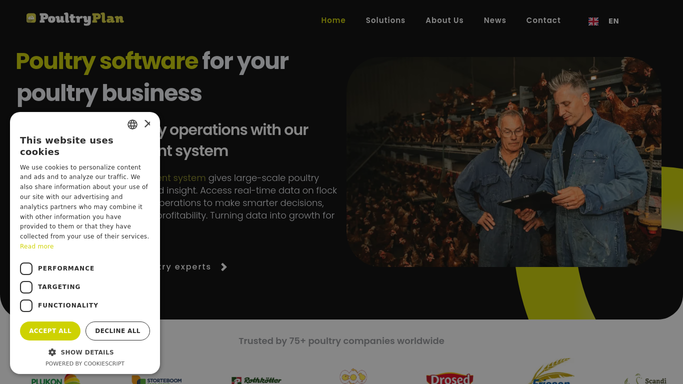
The Opti modules stop at the edge of the farm
The software handles more of this than a grower coming to it fresh expects, and that deserves saying plainly.
The Farm Monitor dashboard gives each user a results page, a daily status summary and alerts to a phone or an inbox when something goes wrong in a house. OptiFeed turns live flock data and the delivery schedule into feed recommendations you can hold against past deliveries. OptiHatch puts a QR code on the batch so it stays traceable, and carries hatching egg planning for the short and long term. OptiSlaughter follows a batch through the plant, so a barn's performance and the result it was paid on end up in one view.
That is a joined-up chain, and it reaches further than most farm software bothers to. But it joins up the parts that report into PoultryPlan. The mill keeps its own portal. The lab publishes results on its own site. The processor's grower portal shows settlement in its own format, on its own schedule. PoultryPlan can hold every one of those numbers. It simply has no way to collect them.
Flock reports that already carry the mill and the processor
Work starts in the flock record, so the useful direction to think in is outward from it.
Picture the weekly report leaving on Sunday evening with the mill's delivered tonnages already set against what the silos actually took, so a short delivery is a line in the report rather than an argument three invoices later. Picture the kill sheet read off the processor's grower portal the morning it posts, with average weight, condemnations and the grade you were paid on placed beside what that barn was expected to do, and the gap named.
Picture swab results collected from the lab's site as they publish, matched to the house and the batch they came from, so anything needing action is in front of the farm manager that same day instead of at the end of the week. Or the hatchery's portal read the night before placement, so chick numbers and the delivery window are confirmed before anyone sets an alarm. Or this week's feed contract prices lined up against the tonnage the next two flocks are going to eat, so the buying decision starts from a real requirement.
The barn walk begins with the whole picture
Each of those numbers exists already. It is just sitting on somebody else's website, behind a login, in a table with no download button underneath it.
WebRun goes and reads them. It drives a real browser signed in as you, on a schedule you set: the mill portal, the lab, the processor's grower site, the hatchery. What it collects arrives as a report, a message, or a line ready for the flock record.
Collecting runs unattended. Anything that writes into PoultryPlan, or that sends a message to your vet, your mill or the plant, is drafted and waits for a person to release it. A flock record is the evidence behind a payment and a health declaration, so that stays a decision somebody on the farm makes. The cards below are where most poultry operations start.
Questions people ask
Will it write flock figures into PoultryPlan without us checking?
No. Collecting from the mill, the lab and the processor runs on its own, but anything written into the flock record is drafted and held for someone on the farm to approve. Those figures sit behind a payment and a health declaration, so a person signs them off.
Our feed mill has a portal but no integration. Does that matter?
No, and it is the main reason to run this in a browser. It signs in to the mill's site the way your office does, reads the delivery tonnages and dates off the screen, and reports them. The mill does not have to build anything or agree to anything first.
Can it read the climate controller in the house?
If that controller has a web page you can sign in to, yes, it reads it like any other site. If the only display is the panel on the corridor wall, it cannot, and neither can anything else. The screen has to be reachable from a browser.
12 ready-made PoultryPlan workflows
Each one names the apps it touches and the exact steps it takes. Open one to read what it will do, then turn it on.




Want one of these running on your own PoultryPlan?
Show WebRun the process once and it will run it on schedule, in your own private browser environment.