How to Automate Oryx Dental
A pediatric practice runs most of its day inside Oryx. The Patient Communication Manager reaches guardians, eligibility verifies in real time, and claims submit as they are finished. Denials, state Medicaid portals, signature services and referral inboxes all sit outside it, and reading those is where WebRun fits.
 Written by
Rosa Lindqvist
Operations editor
Written by
Rosa Lindqvist
Operations editor
 Reviewed by
Nora Whitfield
Editorial lead
Reviewed by
Nora Whitfield
Editorial lead
Every pediatric chart has a second name on it
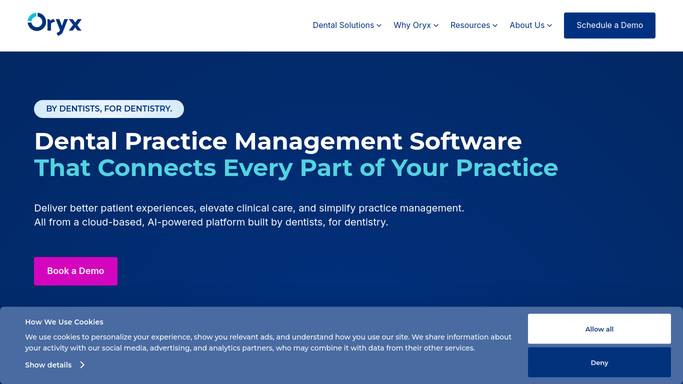
Oryx was founded by a dentist, and it shows in the shape of the product: charting built on evidence-based protocols, and an appointment book that prioritises by patient risk rather than by whoever rang first. It is cloud dental practice management software for independent practices, startups, multi-site groups and specialists, with a pediatric configuration a children's practice runs on directly.
A pediatric office differs from a general one in a way that shows up in every task. The patient in the chair is a child. The person who books, consents, pays and decides whether the family comes back is not. The record is really a family record: siblings on separate recall clocks, one guardian, one calendar and often one policy between them.
The clinical side moves faster too. A child's mouth changes between visits. Primary teeth, mixed dentition, permanent teeth arriving out of order, sealants that need placing inside a window, fluoride on a schedule that counts only if it is kept.
The guardian is the one who has to be reached
Which means almost every job in the practice runs through an adult who is at work.
A child booked for sedation needs a consent signed by a guardian before the appointment, not on the morning of it. A visit that ran through school hours needs a note for the school, written by hand at the end of the day if anybody remembers. Treatment done this afternoon needs home-care instructions that reach a parent who sat in the waiting room and heard half of them.
Underneath sits the coverage, which in pediatric dentistry frequently means a state Medicaid plan. Those change. Eligibility can lapse between one six month recall and the next, quietly and without notice, and nobody finds out until a claim comes back denied. Denials then go into a queue worked when somebody has a spare afternoon, which is not most weeks, and a rejected pediatric claim is small enough that ignoring it is cheaper, right up until there are three hundred of them.
Oryx has automated the parts that reach the parent
The platform is strong here, and unusually so on the communication side.
The Patient Communication Manager runs automated messaging and reminders, two-way texting reaches a guardian on their phone, and online scheduling lets them book without ringing. Insurance Eligibility Verification confirms coverage in real time, and claims go out through real-time claim submission, with SmilePay and electronic billing behind them. On the pediatric side there is primary and mixed dentition charting, pediatric-specific exams, family scheduling and records, remote consent and form completion, and automated consents and post-ops. The AI layer transcribes, summarises and charts an exam.
That covers a great deal of the day. What it does not cover is what happens once something has left the building. A claim submitted in real time can still come back denied, and the denial lives on the payer's website with a reason code attached. A referral to an orthodontist lands in another practice's inbox. A consent packet sits in a signature service until somebody checks. A Medicaid plan changes on a state portal the practice does not own.
The recall list can rebuild itself every night
Work that only happens in a quiet week happens every week once the checking stops depending on a spare afternoon.
Denied and rejected claims pulled into one worklist, ranked by what is worth working first, the reason code already attached so the biller starts on the fix rather than the diagnosis. Coverage rechecked ahead of each child's visit, so a lapsed plan becomes a call to a parent before the appointment instead of a write-off after it.
Sedation consents reconciled three days out, so an unsigned packet is chased while there is still time. Children overdue for sealants or fluoride, and children past their six month recall, listed with the date they were last seen. Families with more than one child due, matched against adjacent openings, because a parent who can bring both in one trip books and a parent who cannot does not. School notes written for the day's visits and home-care summaries drafted per treatment, both waiting for the front desk.
Because these are children's medical records, the split is enforced rather than encouraged. Gathering, checking and listing run unattended. Anything that alters a chart, submits to a payer or reaches a guardian is drafted and waits for a person at the practice.
A denial does not chase itself off the payer's site
Eight tabs and an afternoon is what all of that costs today, and the afternoon is the part the practice does not have.
WebRun is an AI agent that drives a real Chrome browser, signed in the way your team is. It reads Oryx, opens the Medicaid portal, the payer or the signature service when a run needs them, and leaves a list with the names, reasons and amounts attached.
It runs on your schedule in a private environment of your own, sessions are not shared between tools, and a workflow can be held to a named list of sites. You can watch a run and stop it.
Below, each workflow states what it reads and who has to approve the result.
Questions people ask
Can it resubmit a denied claim for us?
No. It reads the denial, works out what is missing, and hands your biller a ranked worklist with the reason code and the amount already attached. Submitting to a payer is a statement about a child's treatment, so a person makes it.
Would a parent ever get a message we had not seen?
No. Reminders, recall notes, school absence notes and home-care summaries are drafted with that family's own details filled in, then held for the front desk. Nothing addressed to a guardian leaves without somebody at the practice sending it.
Our Medicaid checks happen on a state website. Can it reach that?
Yes, and that is the usual reason to run it. It signs in with your own credentials and reads each child's status the way your coordinator does, then logs it against the upcoming schedule. State portals rarely offer any other route in.
11 ready-made Oryx Dental workflows
Each one names the apps it touches and the exact steps it takes. Open one to read what it will do, then turn it on.

Want one of these running on your own Oryx Dental?
Show WebRun the process once and it will run it on schedule, in your own private browser environment.