How to Automate Notion
Notion automates inside its own pages. Database automations fire when a property changes, buttons run a set of actions, and recurring templates create pages on a schedule. Keeping the content true, when the facts come from systems Notion has no connection to, is still a person opening tabs.
 Written by
Priya Raghavan
Solutions lead
Written by
Priya Raghavan
Solutions lead
 Reviewed by
Marta Ellison
Automation strategist
Reviewed by
Marta Ellison
Automation strategist
Notion holds the version of the process people actually read
Notion is a document tool with a database hiding inside it, and that combination is why it ends up holding a company's operating manual.
A page can be prose for the parts that need explaining and a table for the parts that need tracking, on the same screen. So the onboarding checklist, the client list, the product roadmap and the description of how a refund gets approved all live in one place, which is genuinely rare.
New staff are pointed at it in week one. Contractors are given a link. When somebody asks how a thing works, the answer is a Notion URL rather than a conversation.
That makes accuracy the whole product. A wiki that is right is the most useful thing a company owns. A wiki that is out of date is worse than nothing, because people act on it.
A workspace goes stale in about three weeks
The decay is predictable and it always follows the same curve.
Someone builds a beautiful workspace in a burst of enthusiasm. For a fortnight it is maintained daily. Then the person who built it gets busy, one table stops matching reality, somebody notices, and trust starts leaking.
The maintenance is not intellectually demanding. It is opening the billing system to update which clients are active. Checking the recruiting tool to move three candidates along. Copying this month's numbers onto the dashboard page. Marking which pieces of equipment were serviced.
Nobody is assigned to any of it, because it does not look like a job. It looks like tidying, and tidying is what gets dropped first in a busy week.
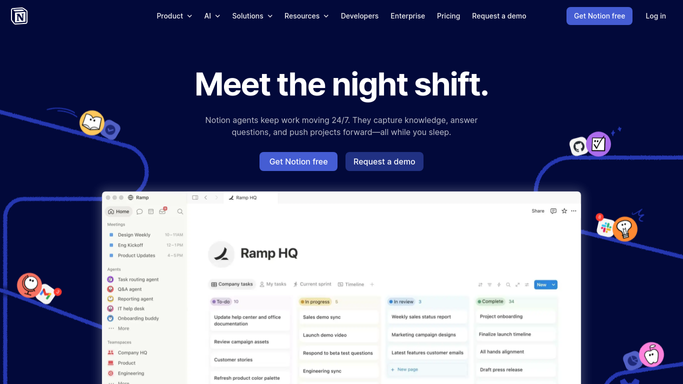
Notion automations work on Notion's own pages
Notion has become considerably more capable, and it is worth using what is already there.
Database automations fire when a page is added or a property changes, and can edit properties, add pages or send a Slack message. Buttons run a set of steps on a click. Recurring database templates create a page on a schedule, which covers weekly reports and meeting notes. Formulas and rollups keep derived numbers correct across linked databases. Synced blocks keep one paragraph identical in six places.
Every one of those is triggered by something happening in Notion, or by a person pressing something in Notion.
None of it can find anything out. A formula cannot open your billing system. An automation cannot check whether an invoice cleared. The workspace is excellent at rearranging what it has been told and has no way to learn anything new.
The database can stay current without a maintainer
Give the workspace a way to find things out, and the weekly tidy-up stops being volunteer work. It becomes something that already happened overnight, before anybody opened the page.
The client database reconciled against the billing system each morning, so active and churned are actually right. The hiring board updated from the recruiting tool, with candidates in the stage they are really in. The dashboard page carrying this week's numbers, read from the places those numbers live rather than typed in by whoever remembered.
The equipment register updated with what got serviced. The content calendar updated with what actually published. The supplier table updated with the lead times that changed this week.
One practical note. Let the automation own specific properties and leave the prose to people. A page where a machine keeps a status field correct and a human writes the explanation underneath it is a page that stays useful. A page where both are fighting over the same paragraph is a page nobody edits again.
Keeping it fed is the unglamorous half
Building the workspace is the enjoyable part, and it is the part that gets done. Feeding it every week is the part that decides whether any of it was worth doing.
WebRun is an AI agent that works a real Chrome browser, signed in as you. It opens the billing system, the recruiting tool or the portal that holds the numbers, reads what is there, and updates the pages and database rows you point it at.
It runs on your schedule in your own private environment, and you can watch a run and stop it mid-way. Anything that would reach someone outside the team drafts and waits.
The workflows below are already built, and each one names what it opens.
Questions people ask
Do we need the Notion API and a developer?
No. It works the Notion interface signed in as you, so there is no integration to create, no token to manage and no developer needed to keep it running.
Will it overwrite something a person wrote?
Only the properties or blocks a workflow is pointed at. The usual setup has the automation own specific fields and leaves written content alone, so the two never compete for the same paragraph.
Can it read from a tool that Notion has no integration with?
Yes. It opens the tool in a browser the way you would and reads what is on screen, which is why it suits the industry systems and portals that will never appear on an integrations list.
1,067 ready-made Notion workflows
Each one names the apps it touches and the exact steps it takes. Open one to read what it will do, then turn it on.




 Instagram›
Want one of these running on your own Notion?
Show WebRun the process once and it will run it on schedule, in your own private browser environment.