How to Automate Knowify
Knowify already automates what it can see: G702 and G703 pay applications, retainage by phase, approved change orders, time entries and a two-way QuickBooks Online sync. General contractor payment portals, labour compliance sites and supply house accounts belong to other companies, and an agent like WebRun is what reads those each morning.
 Written by
Rosa Lindqvist
Operations editor
Written by
Rosa Lindqvist
Operations editor
 Reviewed by
Ben Kirkwood
Solutions engineer
Reviewed by
Ben Kirkwood
Solutions engineer
Knowify is where the estimate meets what the job actually cost
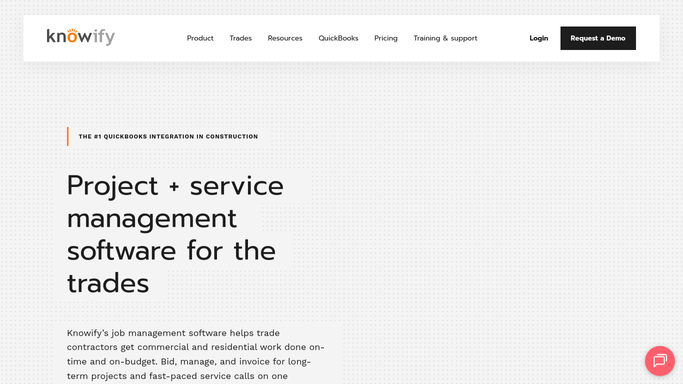
Knowify is construction management and job costing software built for trade contractors: the electrical shop, the plumbing outfit, the concrete and excavation crews who work under a general contractor rather than for a homeowner directly.
What separates it from a scheduling tool is where it points. Every hour a crew clocks, every material purchase, every subcontractor invoice and every approved change order lands against a phase of a job and sits next to what that phase was estimated at. A foreman looks at a schedule. An owner looks at whether the third floor is running eleven percent over while the third floor is still being built.
The office runs from it too. Proposals and contracts go out of it, invoices and pay applications come out of it, and the books stay in step with QuickBooks Online instead of being rebuilt at month end.
A subcontractor gets paid through somebody else's software
The awkward part of being a trade contractor is that almost nothing about getting paid happens on your own systems.
The pay application does not go to the customer. It goes into whatever the general contractor uses, and every general contractor uses something different: a construction payment portal, a project management system you were handed a guest login to, or an email address and a PDF. Once it is in there it joins a queue you cannot see. Approved, pending, held for a missing lien waiver, scheduled for the fifteenth. Finding out which means logging in, or ringing a project engineer who is standing on a site.
Prevailing wage work adds a second track. Certified payroll goes up weekly to a compliance portal, and a rejected upload stays rejected until somebody notices. Around it sit the bid invitations waiting in a plan room, the prequalification that lapses quietly, and the supply house account holding the real price of copper this month.
The G702 assembles itself once the hours are in
Knowify automates the part of this it can reach, and a contractor who has not switched that on is doing arithmetic for no reason.
AIA billing is the clearest case. Knowify generates G702 and G703 pay applications from the contract and the costs already recorded, tracks retainage by phase, reminds you to invoice that retainage when it becomes releasable, and pulls approved change orders into the correct billing period rather than leaving them to drift into the next one. Time tracking feeds the same numbers: crews clock in through the geofenced mobile app or a foreman enters the day for them, and entries are approved on one review screen before becoming both a labour cost on the job and a timesheet in QuickBooks Online Payroll. On prevailing wage jobs the classifications, wage rates and fringes ride with those hours, so certified payroll is populated rather than reconstructed. The QuickBooks Online sync runs in both directions, so the job cost report and the ledger agree.
All of that works because the facts begin inside Knowify. The status of the pay application you already sent does not.
A pay application that reports its own status
The money side of a job stops being a phone call and becomes a line on a morning list.
Every submitted pay application checked each morning on whatever system that general contractor uses, so approved, held and short-paid land against the job on the day they change, and a missing lien waiver gets chased that week instead of at month end.
Certified payroll uploads confirmed as accepted on the compliance portal, because a silent rejection compounds for eight weeks. Addenda picked up from the plan rooms and public agency boards you watch, so a revised drawing set posted three days before the deadline does not surface after the number went in.
Supply house pricing read off your own account and set against the unit costs in the estimate, so the copper that moved shows up as a margin problem while the job is still open. Prequalification packets and certificate expiry tracked per general contractor, since the one that lapses is always the one with work booked.
The judgement stays yours: what to bid, what to escalate, and what to say to a project manager sitting on your money.
A trade contractor should be pricing work, not uploading it
Somebody in your office already holds those logins. They get opened on a Tuesday when there is time, which is why a short payment is found three weeks late.
WebRun is an AI agent that works a real Chrome browser, signed in as you. It opens the general contractor's payment portal, the compliance site, the plan room or the supply house account, reads the screen, and puts the answer against the job: approved, held, short-paid, or a price that moved.
No API has to be arranged first, which matters because most contractor portals will never offer one. It runs on your schedule in your own private environment, you can watch a run and stop it, and anything that files a payroll report or reaches a customer waits for you.
The workflows below are already built, and each one names the sites it opens.
Questions people ask
Knowify already syncs with QuickBooks. What is left to automate?
Everything outside both of them. The sync keeps your job costs and your ledger in agreement, which is worth having. It cannot open a general contractor's payment portal, a labour compliance site or a supply house account, because those belong to other companies.
Will it submit our certified payroll for us?
No. It checks whether last week's upload was accepted and flags anything rejected. Submitting a payroll report means certifying it, and certification stays with the person whose name is on the form.
Every general contractor uses a different portal. Does that break it?
No, and that is close to the reason it exists. It works each portal the way your office manager does, clicking the same screens and reading the result, so a one-off system with no API is exactly the case it handles.
12 ready-made Knowify workflows
Each one names the apps it touches and the exact steps it takes. Open one to read what it will do, then turn it on.

Want one of these running on your own Knowify?
Show WebRun the process once and it will run it on schedule, in your own private browser environment.