How to Automate HRT Control
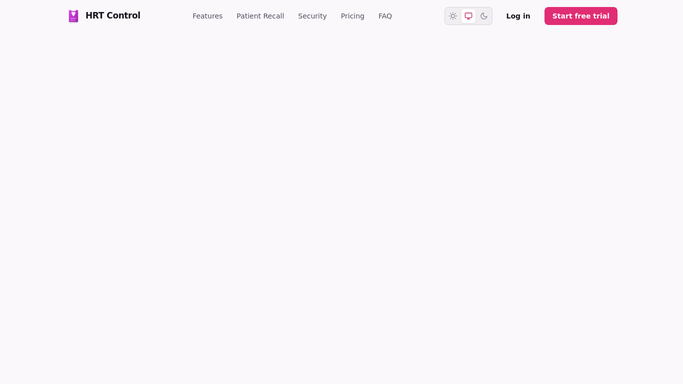
HRT Control automates the clinic's own chasing. Patient Recall watches each patient's last visit, pellet, lab or pharmacy activity and invites the overdue back on rules you set, with quiet hours and opt-outs respected. The lab portal and the compounding pharmacy's order page are read by staff, which is the part WebRun takes.
 Written by
Julian Adeniyi
Retail operations
Written by
Julian Adeniyi
Retail operations
 Reviewed by
Nikhil Bhatt
Automation strategist
Reviewed by
Nikhil Bhatt
Automation strategist
A hormone clinic is measured in cycles, not in visits
Hormone therapy is not a course of treatment that ends. A patient starts, gets a baseline panel, starts a protocol, comes back to have it checked, and keeps coming back for years. The clinic's real product is continuity, and the thing that kills it is a gap nobody noticed.
HRT Control is practice management built for exactly that shape of work, and its vocabulary shows it. A patient profile carries documents, notes and a full activity timeline. Lab orders move through a pipeline: requested, received, reviewed, picked up. Pharmacy orders carry payment, pickup and delivery status. Pellet insertions are scheduled as procedures and recorded with multi-dosage detail and a lot number per dosage. Test requests run their own ordered, received and reviewed track.
The staff are usually a nurse practitioner or a physician, one or two medical assistants, and a front desk holding the phone.
The pipeline knows only what the front desk told it
The pipelines are the honest part of the design. They tell you exactly where every order stands, and they tell you that because somebody set the status.
Which means the day starts with a round of other people's websites. A medical assistant signs in to the reference laboratory to see whether Thursday's panels have posted, downloads the ones that have, and marks them received. Somebody opens the compounding pharmacy's order page to find out which scripts are made up, which shipped, and which are stuck waiting on a payment. Somebody checks whether the pellet supply order landed.
Then the same person turns to the clinic's own list: who is overdue a draw, whose last insertion was five months ago, whose card declined on the monthly plan.
By the time all of that is in the system, the system is accurate and it is eleven o'clock.
Patient Recall does the chasing without being reminded
Inside its own walls the software is doing more of this than most clinics use.
Patient Recall is the centrepiece. Rules watch each patient's last visit, pellet, lab or pharmacy activity and invite the overdue ones back automatically, by SMS, email or both, with the audience, the timing window and the message set by you. It runs daily inside real guardrails: quiet hours, per-patient cooldowns and daily send caps, patients with an upcoming appointment skipped, STOP replies opting someone out, and every send and skip logged with a reason. You can preview the audience before a rule ever fires.
Around it sit automatic SMS and email alerts with wording and rules you control, work queues that show what needs attention today, a patient portal where people see their own labs, prescriptions and pellet history rather than phoning to ask, and secure messaging tied to the chart.
All of that acts on what the clinic already knows. The panel sitting on the laboratory's site, the script the pharmacy compounded yesterday, the card the processor declined on Tuesday: none of those have told HRT Control anything yet.
A result can be filed before the patient rings about it
A clinic that is not waiting on other people's websites finds things out several days sooner.
Panels collected from the laboratory's own site the morning they post, matched to the right patient and set beside their last two results, so a trend in a testosterone or an oestradiol level is visible when the clinician opens the chart rather than after the call. Anything outside range flagged to the front of the queue instead of sitting in a download folder.
The compounding pharmacy's order page read each morning, so a script that is ready, shipped or stalled on payment shows up in the clinic's own pipeline without a phone call. Pellet stock checked at the supplier against the insertions already booked for the fortnight. Monthly plans lined up against what the card processor actually took, so a decline is a conversation this week and not a discovery at the next visit.
The boundary in a prescribing clinic is not a matter of taste. Collecting a result, reading an order page and spotting a declined card can all run unattended. Interpreting a result, changing a dose, and anything at all that reaches a patient, wait for a qualified person.
The laboratory posts a result and waits to be visited
The pharmacy will not ring the clinic when an order is ready, and the laboratory will not ring either. Both of them just put it on a page and wait to be visited.
WebRun is an AI agent that works a real Chrome browser in a private environment of your own, signed in exactly as your medical assistant is. It opens the laboratory portal, the pharmacy's order page or the payment console, reads what is there, and puts it in front of the person who needs it. A workflow can be restricted to an explicit list of sites, and you can watch a run and stop it partway.
Nothing is written into a patient record, and nothing addressed to a patient leaves without a qualified person sending it. Each workflow below names what it opens.
Questions people ask
Would it mark a lab order as reviewed for us?
No. It collects the result and files it beside the patient's previous values, ready for a clinician. Marking something reviewed is a clinical act and stays with the person qualified to make it, which is the whole point of that pipeline.
Patient Recall already texts our lapsed patients. Why add anything?
Recall works from activity HRT Control can see, and it does that well. This covers what the clinic cannot see: results still sitting on the laboratory's site, orders stuck at the compounding pharmacy, plans that failed at the card processor.
Our laboratory and pharmacy logins are sensitive. Which sites does it reach?
It runs in a private environment of your own, signed in as your staff are, and a workflow can be locked to an explicit list of domains so it reaches only the sites you named. You can watch any run live and stop it partway.
12 ready-made HRT Control workflows
Each one names the apps it touches and the exact steps it takes. Open one to read what it will do, then turn it on.





Want one of these running on your own HRT Control?
Show WebRun the process once and it will run it on schedule, in your own private browser environment.