How to Automate GlampManager
GlampManager automates the booking it holds: instant confirmations, automated emails that chase a balance and ask for feedback, deposit policies, online balance payments, and a two-way iCal sync keeping Pitchup, Booking.com and Airbnb from selling the same pod twice. Extranets, forecasts and review sites are outside it, which is where an agent like WebRun works.
 Written by
Owen Hartley
Workflow engineer
Written by
Owen Hartley
Workflow engineer
 Reviewed by
Nikhil Bhatt
Automation strategist
Reviewed by
Nikhil Bhatt
Automation strategist
A glampsite is six units and one changeover day
GlampManager was written for glampsites and nothing else: pods, yurts, bell tents, safari tents, shepherd's huts, treehouses, geodomes and cabins, let by the night. It comes from the UK team behind CampManager.
A glampsite is not a hotel, and the difference is arithmetic. There are six units, or nine, or four, and each has a changeover day. Fill them through the school holidays and the year works. Lose a Saturday in August to a cancellation nobody re-sold and there is no second Saturday in August to make it back with. Plenty of those stays arrive through a channel that keeps its own inbox, its own review score and its own copy of your availability.
So GlampManager carries what the site runs on: the booking chart per unit, who arrives and departs today and this week, what deposit was taken and what balance is still owed, which channel sold the stay, and the confirmation and pre-arrival email each guest has already had.
The pod has to be ready by two, and everything else waits
Changeover day at a small site is one or two people and a van.
They are draining a hot tub, cutting grass and getting six units turned round before two o'clock, and the office work happens on a phone between them. Somebody checks whether the balance on the Friday arrival came in. Somebody opens the Booking.com extranet to see whether a guest messaged there instead of by email. Somebody reads the forecast, because a wind warning changes whether the bell tents stay up. Somebody notices the review from last week that nobody answered. Somebody works out whether the two nights left in the middle of August are priced like the two nights either side of them.
None of that is neglect. The pod has to be ready by two, and everything else stays negotiable right up until it is not.
The iCal sync stops the double booking, not the surprise
GlampManager covers the booking and the money around it well, and a site paying for it should be using all of this before adding anything.
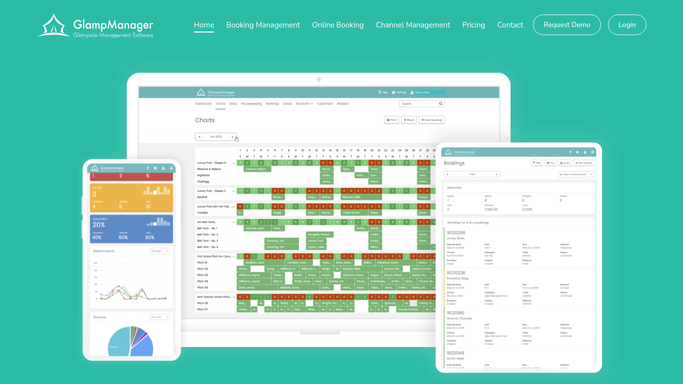
The dashboard shows arrivals, departures and bookings for today and the week ahead, with occupancy and performance broken down by accommodation type and by the booking sources that brought them in. Booking charts put every unit on one colour-coded calendar and let a booking be made straight from it, with real-time availability, alternative dates when a stay does not fit, and costs recalculated on amendment. Automated emails carry the confirmation, the payment chase, the pre-arrival note and the post-stay feedback request. Deposit policies, online balance payments, a virtual terminal, invoices, discounts and promo codes handle the money. Two-way iCal channel management syncs availability and allocation with Pitchup, Booking.com, Airbnb, Expedia, Tripadvisor, Canopy and Stars and Cool Camping, and reviews can be captured from guests directly.
All of that acts on a booking already in the system. The channel's own extranet is a different place, and so is the message a guest left there, the review score that channel displays, the forecast for your postcode, and the rate the site up the lane has put on for the same weekend.
Thursday is early enough to fix most of what Saturday brings
Two days is the difference between moving a guest and apologising to one.
Saturday's arrivals and departures listed with the balance still owed on each, the units needing a full turn against those staying on, and the party sizes that decide how many firepit bundles go out. The forecast and any weather warning for the site's own postcode set against who is under canvas, so the decision about the bell tents gets taken on Thursday.
Channel extranets opened in turn: unanswered guest messages sitting in Booking.com or Airbnb, the review score each channel is showing, and whether your rates and minimum stays for August match what your own booking page says. Comparable sites on the listing platforms read for the same dates, so a gap in your own August is priced against what is genuinely selling. New reviews collected with the stay and the unit they came from. Guests whose balance falls due in the next fortnight, listed by arrival date.
Nothing there answers a guest. A reply to a review or a message in an extranet is written by a person, because on a six-unit site the owner's voice is the product.
The owner keeps the last word with guests
Turning six pods round by two is the job. Opening four other websites while doing it is not, and that is the half nobody gets to.
WebRun is an AI agent that works a real Chrome browser, signed in as you. It opens GlampManager, the channel extranets, the forecast and the review sites, reads what is on each screen, and leaves one page with the weekend already on it.
It runs on your schedule in your own private environment, and you can watch a run and stop it. Anything addressed to a guest is drafted and waits for you. The workflows below are already built, and each one names what it opens.
Questions people ask
Will it reply to a guest message in an extranet?
No. It finds the message, matches it to the booking and drafts an answer with the dates and the unit already in it, then leaves it for you. On a six-unit site the owner's voice is most of what guests are paying for.
Can it take a payment or refund a deposit?
No. It lists who owes what and when they arrive, and a balance chase is drafted for you to send. Taking or returning money is left to you inside GlampManager or your payment provider, where the audit trail belongs.
We run one site with six units. Is this worth setting up?
Usually yes, because small sites feel it most. There is nobody whose job is opening the extranets, so the checks land on whoever is turning the pods. A run that takes ten minutes gives that person the weekend on one page instead.
10 ready-made GlampManager workflows
Each one names the apps it touches and the exact steps it takes. Open one to read what it will do, then turn it on.



Want one of these running on your own GlampManager?
Show WebRun the process once and it will run it on schedule, in your own private browser environment.