How to Automate TazWorks
TazWorks automates the agency's own floor. TazWorkload Manager auto-assigns searches by jurisdiction, SLA or round robin, the Employee Leaderboard tracks turnaround, and mobile engagement puts consent on the applicant's phone. County portals, employer verifications and collection sites still need a browser, which an agent like WebRun opens.
 Written by
Marcus Deleon
Support operations
Written by
Marcus Deleon
Support operations
 Reviewed by
Nikhil Bhatt
Automation strategist
Reviewed by
Nikhil Bhatt
Automation strategist
A screening agency sells turnaround and gets judged on it
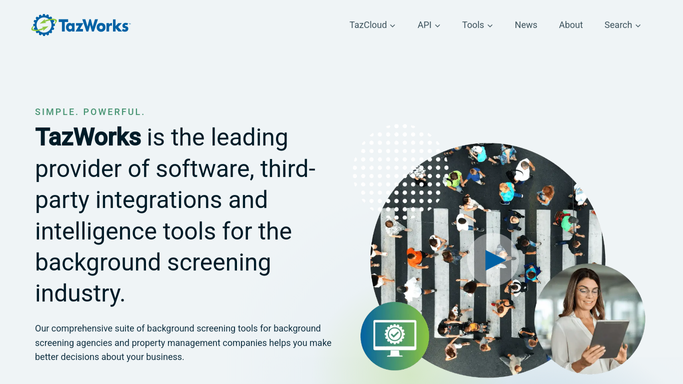
TazWorks is the platform a background screening agency runs on. It was founded as an independent company and is now part of MeridianLink, which acquired it, though the products keep their original names: TazCloud, TazWorks Software and TazInsights.
The customer is a consumer reporting agency: the company an employer, a landlord, a bank or a staffing firm hires to find out whether an applicant is who they said they were. The unit of work is an order, and an order is a bundle of searches with a different source behind each one. A county criminal record here, a former employer's HR line there, a school registrar, a driving record, a drug test at a collection site.
What the client is buying is a report that arrives quickly and is right, because somebody uses it to make a decision about a person. Both halves of that sentence are regulated.
A stalled county search is invisible until the client calls
The screening business runs on a clock the agency does not control.
A county's public access site goes down for maintenance, and the search sitting behind it stops without announcing anything to anybody. A court runner in a rural jurisdiction files a result three days after pulling it. An employer's HR department verifies dates on Tuesdays and only by fax. An applicant started the consent form on their phone, got interrupted, never came back, and the order has been open ever since with nobody responsible for it.
Meanwhile the client is a recruiter with a start date. They want to know why one order has been amber since Thursday, and answering that means opening it, finding which search is missing, then opening the vendor's site to see what happened. Multiply that by a busy Monday, and add the compliance layer nobody can shortcut: disputes on a statutory clock, adverse action in the right order.
The Employee Leaderboard measures the queue, not the courthouse
TazWorks automates a great deal of the agency's own floor, and a shop still handing out work across the room is losing hours a day to it.
TazWorkload Manager auto-assigns searches rather than leaving a supervisor to allocate them, and it can distribute by round robin, order by the SLA set for that client, work oldest first, or route to whoever covers that jurisdiction and search type. Its Employee Leaderboard shows assignment counts, completions by day or week, turnaround times and anything overdue or urgent, as it happens. Mobile engagement puts the application, the disclosures and the messaging on the applicant's own phone, which is where the consent bottleneck usually sits. Integrated drug screening covers scheduling and results with the collection providers, and TazInsights reports across all of it.
The shape of that is internal. It routes, measures and reports on work the platform can already see, and it reaches the vendors somebody has already integrated.
A county clerk's public access portal, an employer's own verification page, a school registrar and a licensing board's register all sit outside that boundary. They are also where the delay usually is.
Every stalled search has a page that would explain it
The delay has a cause, and the cause is written on a page somebody can open.
Every open search checked against the source that owes it, so an order behind a county portal that has been down since Tuesday is flagged with the reason rather than the colour. The jurisdictions running a known backlog listed by name, so a recruiter hears on day two instead of day six.
The applicant side works the same way. Consent forms started and then abandoned, listed with what is missing and how long they have been sitting, so the reminder goes to one person rather than the whole batch. Collection appointments booked but not attended, read from the provider's own site.
Then the client-facing work. Turnaround, completion rates and anything past the agreed service level assembled per client into the report they ask for. Rescreen dates falling due on the accounts that require them, gathered before the renewal conversation. Dispute intake sorted and routed to a named person with its statutory clock already showing.
Gathering can run unattended. Anything that changes a report, sends a consumer an adverse action notice or delivers a finished file to a client waits for somebody qualified to sign it off, because those are the steps a regulator asks about.
The queue moves faster when nobody is refreshing it
Nothing about opening a county's public access site every morning calls for a trained researcher, and that is exactly who does it, with three other files waiting.
WebRun is an AI agent that works a real Chrome browser, signed in as you. It opens TazWorks the way your team does, opens a court's public access portal or an employer's verification page beside it, and writes what it found against the order it belongs to.
It runs in your own private environment, and a run carries an allowlist, so it reaches the sites a workflow named and nothing else. Report delivery, adverse action and anything reaching a consumer are drafted and held.
The workflows below are already built, and each one names what it opens.
Questions people ask
Could it change a report or send an adverse action notice?
No. Adverse action, report delivery and any edit to a consumer's file are drafted and held for somebody qualified to release them. Those steps are governed by law and an examiner will ask who authorised each one, so the answer has to be a person.
Our researchers already have court portal logins. What does this add?
The checking, not the access. It signs in with those same logins on a schedule and reads the status of every open search, so a jurisdiction that stopped moving is flagged the morning it happens rather than when a recruiter chases. Research judgement stays with your team.
Many county sites offer no interface at all. Is that a blocker?
No, and it is the ordinary case. That is the reason for reading screens rather than calling interfaces. It opens the public access site the way a researcher would, reads what is on the page, and writes the result against the order in TazWorks.
12 ready-made TazWorks workflows
Each one names the apps it touches and the exact steps it takes. Open one to read what it will do, then turn it on.
Want one of these running on your own TazWorks?
Show WebRun the process once and it will run it on schedule, in your own private browser environment.