How to Automate RightCapital
RightCapital automates the plan itself. Account aggregation refreshes linked balances, Smart Import reads uploaded statements and meeting notes into plan inputs, RightFlows runs a review as a repeatable workflow, and RightIntel reports across the whole book. Gathering the accounts and estimates no feed reaches is what still fills the week.
 Written by
Priya Raghavan
Solutions lead
Written by
Priya Raghavan
Solutions lead
 Reviewed by
Sofia Marchetti
Marketing operations
Reviewed by
Sofia Marchetti
Marketing operations
The plan is what a client is actually paying for
RightCapital is financial planning software for advisors, and what it produces is the deliverable a planning relationship is built on: a picture of a household's whole financial life, and what becomes of it under a set of assumptions.
Everything a client lies awake about is in there. Whether they can retire at sixty-two. Whether to clear the mortgage. What a Roth conversion costs this year and saves later. Whether there is enough insurance if one income stops.
Advisors reach for it because clients follow it. Blueprint, Snapshot and the cash flow maps are the views people actually read, the tax modules put a conversion or a withdrawal order in figures rather than in theory, and the client portal lets a household look between meetings.
Which sets the standard the software has to hold. A plan that is out of date is not a stale report. It is a conversation held on the wrong numbers, with a decision at the end of it.
Most of a plan is typed in once and left
The planning is the skilled part and it is not what takes the time.
The week before a review goes on collecting. The client's old 401(k) is at a former employer's recordkeeper with its own login and no connection to anything. The pension estimate is behind a state or company portal. The Social Security figure was keyed in three years ago from a statement nobody has downloaded since. The equity comp sits in a stock plan portal. The annuity's contract value is on the carrier's site. The mortgage balance belongs to a servicer.
So an associate emails the client for documents. The client forgets. A second email goes out. Some comes back as a PDF, some as a photograph of a screen, and somebody retypes all of it.
The meeting happens either way. It happens on numbers that are somewhere between three months and three years old, and everyone in the room quietly knows it.
Smart Import reads what somebody already uploaded
RightCapital automates more of this than most firms use, and the built-in tools deserve to be exhausted first.
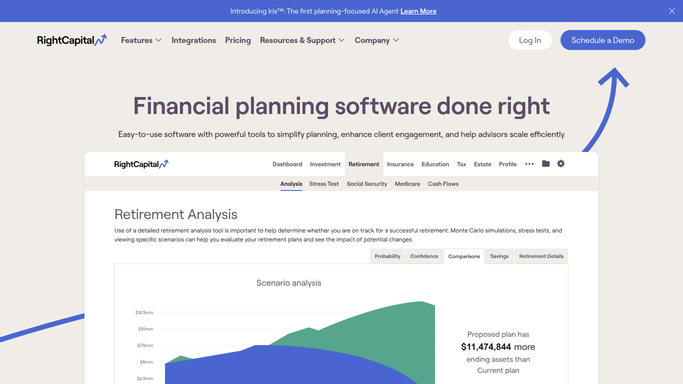
Account aggregation keeps linked accounts refreshed, so anything with a supported connection updates without being asked. Smart Import reads documents uploaded into a plan, including investment statements and meeting transcripts, pulls out income, savings, expenses, goals, net worth and holdings, and turns them into plan inputs instead of typing. RightFlows makes a review a repeatable workflow, with templates broken into steps and tasks, assignments handed out and a board showing where each client's plan has reached. RightIntel reports across the whole book at once: net worth, invested assets, outstanding tasks, when a report was last generated, when a client last logged in.
The pattern is worth stating plainly. Aggregation reaches the institutions a connection already exists for. Smart Import reads a document once it is inside the plan.
Neither of them goes and gets anything. The recordkeeper with no feed, the pension portal, the carrier's website and the Social Security statement all sit behind a login, holding a number the plan is wrong without, and the only route in is a person typing a password.
A plan can be true on the morning of the meeting
An associate spends the week before a review signing into recordkeepers, carriers and servicers so the meeting can start from real numbers. A password and a page, repeated until the list is done, is work a browser can do.
The held-away 401(k) balance read off the recordkeeper's own site each quarter and set beside what the plan currently assumes, so the gap is visible rather than theoretical. Vesting schedules and exercise windows pulled from the stock plan portal, so the equity in the plan matches the equity that exists. Annuity contract values from each carrier. The mortgage balance and rate from the servicer, which every debt conversation turns on and which nobody updates.
Then the housekeeping that never gets done. Clients whose outstanding tasks have sat untouched for a month, listed before an associate goes looking. Clients who have not opened the portal since the last review, which is usually the first sign of a relationship going quiet. Households whose linked accounts stopped updating because a connection broke, found the day it broke instead of the morning of the meeting.
None of that is advice. It is the fetching that has to happen before advice is possible, and it is the part that gets worse with every household added.
Recommending is regulated, retyping is not
A recordkeeper balance moves into a plan one login and one number at a time, and the hours go where the households are. That is why the two hundredth is harder to serve than the twentieth.
WebRun is an AI agent that works a real Chrome browser, signed in as you. It opens RightCapital the way your team does, opens the recordkeeper, the carrier or the servicer beside it, and brings the figures back with the client's name against them.
What it will not do is advise. It gathers and it prepares. Anything that changes a recommendation, or that leaves the firm under your name, waits for the person whose licence it is.
The workflows below are already built, and each one names what it opens.
Questions people ask
Will it change numbers inside a client's plan?
Only if you allow it, and the default is that it does not. Figures are gathered and set beside what the plan currently assumes, so an advisor sees the difference and decides. Anything a client will act on stays a person's call.
Can it reach a 401(k) that has no data feed?
Yes, and that is the common case. It signs into the recordkeeper's website the way your client service team does and reads the balance off the screen, which is why it works where aggregation has no connection to offer.
Is client financial data safe in this?
It runs in your own private environment, signed in as your own user, and sessions are not shared between tools. A workflow can be locked to a named list of sites, so it reaches RightCapital and the institutions you listed and nothing else.
13 ready-made RightCapital workflows
Each one names the apps it touches and the exact steps it takes. Open one to read what it will do, then turn it on.

Want one of these running on your own RightCapital?
Show WebRun the process once and it will run it on schedule, in your own private browser environment.