How to Automate Prism.fm
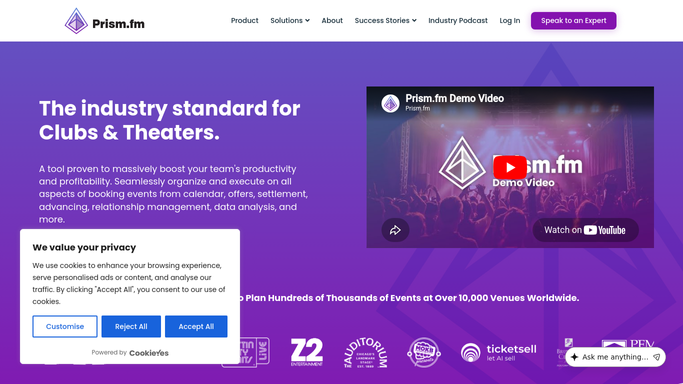
Prism.fm handles the deal itself: a calendar carrying holds, offers and confirmed shows, contracts generated from the deal rather than retyped, payment tracking against each event, settlements and the financial reporting that follows. Ticket counts, signature services, listings sites and rival on-sales sit outside it, so gathering those is what an agent like WebRun does.
 Written by
Elliot Nakamura
Platform writer
Written by
Elliot Nakamura
Platform writer
 Reviewed by
Owen Hartley
Workflow engineer
Reviewed by
Owen Hartley
Workflow engineer
A show is a deal long before it is a night out
Prism.fm is booking and business management software for live music. Venues and clubs run on it, and so do promoters, talent agencies, performing arts centres, amphitheatres and arenas.
A show begins as a conversation with an agent, months out. It becomes a hold on a date, then an offer with a guarantee and a split, then a signed contract, then a run of show, then a settlement in a back room at one in the morning while the load-out happens outside. Prism is where that whole life sits: the calendar, the deal terms, the contract, the payments and the final numbers, all against the same event.
The stakes are unusual for software this size. A guarantee is committed before a single ticket sells. A hold nobody chases blocks a Friday another promoter would have paid for. A sold-out room can still settle badly if the deal was written wrong in March.
The week before a show is a hundred small confirmations
Advancing a show is the job nobody outside the industry knows exists.
Somebody is chasing the signed contract, the tax form and the certificate of insurance, and none of the three people who owe them work for the venue. Somebody is reading the ticket count off the ticketing platform's back end each morning and deciding whether to buy another week of radio. Somebody is confirming the backline, the hotel rooms, the catering and the local crew call. Somebody is putting the day sheet in front of production, box office and bar before doors open.
Around all of that, offers sit out with agents for a week and go cold. Holds age quietly until the date is worth nothing. Multiply it by a room playing most nights and by a promoter working several rooms at once, and the follow-up becomes a full-time job that nobody was hired to do.
Prism automates the deal it already holds
Prism does the difficult part of this well, and a venue paying for it should be using all of it.
The calendar is the spine, carrying confirmed shows, holds and offers on one view, so a date's real status is visible instead of living in somebody's inbox. Offers and contracts are generated from the deal rather than retyped into a document each time. Deal and payment tracking follows what is owed and what has been paid against each event without a spreadsheet beside it. Settlement is built in, the piece that usually takes longest and produces the most arguments, and the financial reporting runs off settled numbers rather than an export. Prism Insights pools box office data across the venues on the platform, so an artist can be judged on what they have actually drawn in your market. Permissions decide who sees which deal.
The thing all of it shares is that it acts on the event record Prism is holding.
The ticketing system is somebody else's. The agent's own reports are somebody else's. The signature service, the listings pages and the other rooms in town are all somebody else's, and not one of them is going to build a venue an integration.
A hold can be decided with the whole city's calendar in view
A hold is confirmed or dropped in a short phone call, and the facts that should decide it sit on somebody else's website: the ticket counts, the agent's report, the listings for every other room in town.
This morning's count for every show on sale, read off each ticketing platform's own reporting screen and set against the guarantee and the break-even in the deal, so a show tracking badly gets a marketing decision three weeks out instead of a hard settlement on the night. On-sales announced at the other rooms within driving distance, gathered before a hold is confirmed, because a Thursday is worth much less opposite a bigger show.
Outstanding paperwork checked where it lives. Whether the signature service says the contract came back. Whether the artist's routing went public while your offer is still out, which usually means the date went somewhere else.
Then the quieter signals. What an artist you are considering has been doing on streaming and social since the offer was written. Whether the local listings pages carry your dates, times and prices correctly.
Anything addressed to an agent, an artist or a mailing list is drafted and read by a person first. A wrong number in an offer is not a typo, it is an obligation.
Nobody books a room by refreshing a ticket count
Choosing the artist and shaping the deal is what a talent buyer is for. Opening seven ticketing back ends and a signature service every morning to find out where things stand is not, and it is what eats the day.
WebRun is an AI agent that works a real Chrome browser, signed in as you. It opens Prism.fm the way your team does, opens the ticketing platform, the signature service or a rival room's listings beside it, and puts the answer next to the right show.
It runs on your schedule in your own private environment, and a workflow can be limited to a named list of domains. You can watch a run and stop it.
Each workflow below names the sites it opens.
Questions people ask
Will it send an offer or message an agent for us?
No. Offers, advance emails and agent follow-ups are drafted with the show details already in them and wait for a person to send. An offer is a financial commitment and an agent relationship is the business, so both stay with the buyer who owns them.
Can it read ticket counts from our ticketing platform?
Yes. It signs into the platform's own reporting screen as your team does and reads the numbers off it, then sets them against the guarantee and break-even held in Prism.fm. No integration or data feed has to be agreed with the ticketing company first.
We work several rooms and several promoters. Can one run cover them?
Yes. A run can work through each room or promoter in turn and return one comparison, which is useful precisely because the ticket counts live in different systems depending on who is selling that show.
12 ready-made Prism.fm workflows
Each one names the apps it touches and the exact steps it takes. Open one to read what it will do, then turn it on.


Want one of these running on your own Prism.fm?
Show WebRun the process once and it will run it on schedule, in your own private browser environment.