How to Automate Panda Perio
Panda Perio holds the clinical side of a periodontal practice and connects to the practice management system beside it. Comparison charting shows how a pocket has changed, and instant letters write the report to the referring dentist. Benefits, consents and physician clearances live on other people's sites, which is where WebRun works.
 Written by
Grace Okafor
Healthcare operations
Written by
Grace Okafor
Healthcare operations
 Reviewed by
Nora Whitfield
Editorial lead
Reviewed by
Nora Whitfield
Editorial lead
A periodontal chart is a comparison, not a snapshot
Panda Perio, written PANDA by the people who make it, is clinical record software for periodontal practices. It is used by periodontists and their hygienists, and it is deliberately not a whole practice system: it holds the clinical record and connects to whatever practice management software the office already runs, a list that includes Open Dental, Eaglesoft, Soft Dent, Practice Works and Clear Dent.
The reason a specialty needs its own record is the charting. A periodontal exam is six measurements per tooth, plus recession, bleeding, furcation and mobility, and none of those numbers mean anything on their own. A five millimetre pocket is either stable or it is active disease, and the only thing that decides which is what the same site measured six months ago.
So the file is a time series, and the practice is built around reading it. Which is also why almost everything else in the office ends up somewhere other than Panda.
Surgery day has a checklist nobody owns
Two systems means two places to look, and the gap between them is where the front desk lives.
Take a graft booked for next Tuesday. Somebody needs to know what the patient's dental plan will actually pay, which means their remaining annual maximum, which exists only on the insurer's own website. Somebody needs the signed consent back, which is sitting in a signature service. If the patient is on an anticoagulant or has a cardiac history, somebody needs written clearance from their physician, which means a letter out and a reply chased for a fortnight. Somebody needs the right implant size on the shelf, a count nobody has made.
Then there is the part with no date on it at all. A maintenance patient on a ninety day recare who has not been seen in five months. A course of scaling and root planing finished in March whose four to six week re-evaluation was never booked. A referring dentist who sent three patients last quarter and has heard back about one.
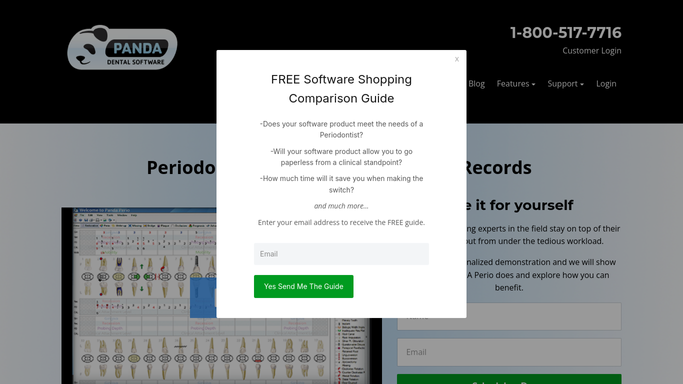
Panda compares the pockets and writes the letter
Where Panda is strong it is very strong, and at the two things a periodontist would pick first.
Comparison charting sets the current exam against previous ones, so a change in probing depth is visible rather than calculated, and charting can be done wirelessly at the chair. Instant letters have been in the product since 2001: the report and thank-you note to the referring dentist are produced from the exam and treatment plan instead of dictated, which for a referral-fed specialty is the difference between correspondence going out and correspondence being intended. The Clinical Workflow Manager tracks records through the office, treatment planning and paperless progress notes sit on the same record, and patient education comes off the patient's own chart.
Every one of those reads the clinical record and writes something out of it. None of them opens a website. The insurer's benefits page, the physician's office, the signature service, the implant supplier's site and the ledger in the practice management system are all outside, and each is a login with somebody on the other end waiting to be chased.
Next Tuesday's list can be cleared by Friday
The surgical week stops being assembled from memory on a Monday.
Next week's schedule taken from the chart and each patient's benefits and remaining maximum checked on their own plan's site, so a case that will not be covered becomes a conversation this week rather than a write-off next month. Graft and soft tissue consents reconciled against what is actually signed, with the missing packets drafted and the outstanding list handed over. Clearance requests to each patient's physician written from the chart, logged, and followed up when no reply comes back.
Implant and surgical stock counted against real usage, so the size about to run out is ordered before the case that needs it. Maintenance patients past their ninety day interval, listed with the date they were last seen. Re-evaluations owed after scaling and root planing, with a slot already held. Sites where probing depths have deepened since the last exam, put in front of a clinician as a watch list and not as a diagnosis.
That distinction holds throughout. Reading, comparing and listing run on their own. Anything that changes a clinical record, or reaches a patient, a physician or a referring dentist, is drafted and waits for the person whose judgement it represents.
The record already shows who stopped coming
Nothing on that list is difficult, and that is precisely why it loses to a full schedule.
WebRun is an AI agent that works a real Chrome browser, signed in the way your office is. It reads Panda Perio, opens the insurer, the signature service or the supplier when a run needs them, and hands back a list with the exceptions and the names on top.
It runs on your schedule in a private environment of your own, sessions are not shared between tools, and a workflow can be held to an explicit list of domains. You can watch it work and stop it at any point.
The list below shows what each workflow opens and what it leaves unsent.
Questions people ask
Will it write anything into the periodontal chart?
No. It reads the chart and reports what it finds, such as sites where probing depths have deepened since the last exam, and that goes to a clinician as a watch list. Changing a clinical record is not something a workflow does by default.
We run Panda alongside our practice management software. Does that break it?
No, that is the normal case here and part of why a browser is the right route. Two systems are simply two screens in the same run, and neither has to expose an API for their figures to end up on one list.
Does a referring dentist ever receive a letter nobody read?
No. Report letters, clearance requests and recall notes are prepared with the patient's own findings filled in and held for the periodontist or the office manager to approve. Nothing addressed to a dentist, a physician or a patient sends itself.
11 ready-made Panda Perio workflows
Each one names the apps it touches and the exact steps it takes. Open one to read what it will do, then turn it on.


Want one of these running on your own Panda Perio?
Show WebRun the process once and it will run it on schedule, in your own private browser environment.