How to Automate Highway
Highway settles the carrier. Carriers onboard themselves through the Carrier Identity Engine, insurance and authority are monitored continuously against rules you set, and Load Lock re-checks identity at load level. Your TMS, your accounting system and the federal record still have to agree with it, which is where WebRun works.
 Written by
Rosa Lindqvist
Operations editor
Written by
Rosa Lindqvist
Operations editor
 Reviewed by
Nora Whitfield
Editorial lead
Reviewed by
Nora Whitfield
Editorial lead
Booking a truck means trusting a company you have never met
Covering a load means handing a trailer worth more than the truck pulling it to a company somebody found an hour ago. Highway exists because that sentence is uncomfortable.
It is a carrier identity platform for freight brokers and 3PLs, and it is where a carrier proves who it is before it gets near your freight. Carriers onboard themselves through the Carrier Identity Engine: a person shows a government ID with a live photo match and proves they are authorized to represent the carrier. Insurance status and DOT authority are watched against rules you set, and a carrier that falls out of compliance is flagged and deactivated rather than quietly left on the list.
It is written GoHighway about as often as Highway, and the site now answers at highway.com. Motor carriers and insurance agencies work in it from their own side, which is why the checks reach people rather than only paperwork.
Onboarding a carrier is document chasing with a deadline
The load goes out tomorrow and the carrier you want has a certificate that expired on Friday.
That is the shape of most of it. A packet that is nearly complete. A certificate emailed to a rep instead of uploaded. An authority showing revoked on the federal record and active in your accounting system, because accounting was updated once, in March. A carrier your Chicago desk stopped using for a reason written in an email nobody else can find.
Then the churn. Authorities get revoked and reinstated. Insurance lapses and comes back on a different policy number. A carrier changes its name, or its address, or the person who answers the phone. Each of those is a different screen on a different site, and they all answer the same question: is this outfit still the outfit we approved.
Whoever owns onboarding spends the day being interrupted about it, because behind each one is somebody else's load standing still.
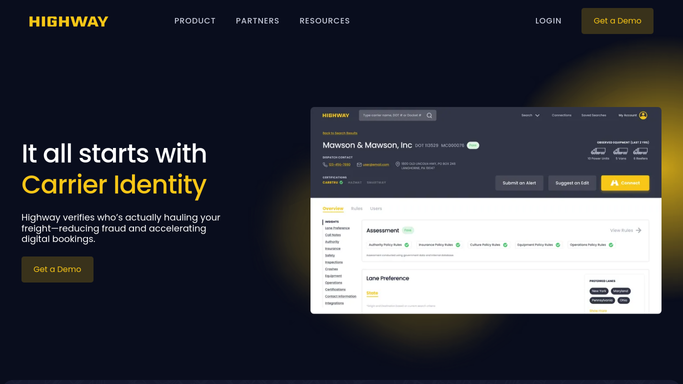
The Carrier Identity Engine watches every carrier between loads
This product already does the hard part, and the extent of that is worth spelling out.
Monitoring does not stop when onboarding ends: the rules run against carriers continuously, so a lapse between loads is caught rather than discovered at pickup. Compliance is classified differently for base, high-value and hazmat freight, and the result shows as a pass, partial pass, incomplete or fail on the Highway Badge. When a carrier fails, deactivation reaches your TMS. Load Lock works at load level, re-verifying identity, checking the load against your requirements and raising risk before the freight moves. Know Your Driver carries the same standard down to the driver at the dock, with a live face and ID check and a flag when one driver is somehow assigned to two loads at once.
What Highway settles is the carrier.
What it does not settle is what the rest of your company does with the answer. The payee record in accounting. The approved-carrier list your largest shipper keeps and audits you against. The reason a rep in Chicago will not use somebody. Those are your screens, and none of them update themselves.
A carrier file that keeps pace with the federal record
The carrier list Highway holds is the trustworthy one. The work is checking it against everywhere else that name appears.
Carriers marked non-compliant read against your TMS and your accounting system, so an outfit that cannot be tendered a load is not also sitting in the payee file waiting on a check. Insurance certificates counted down by expiry and matched to the loads already tendered to that carrier this week, so the lapse turns up before the pickup, not at the claim. Authorities that were revoked and have since been reinstated on the federal record, listed for a person to decide whether the relationship restarts.
The queue side follows. Packets stalled part way through onboarding, named with the document that is actually missing. New carriers gathered into a short daily list for the desk using them. Carriers whose authority is younger than your policy threshold flagged before a rep books one. High-risk flags collected across the week and routed to whoever owns that lane.
Freight and money sit on the other side of these decisions, so the boundary is firm. Reading, comparing and listing run unattended. Deactivating a carrier or telling an operator they are no longer approved waits for a person.
The call on a carrier belongs to your compliance desk
Taking one back is the same kind of call. What needs nobody is the opening of four systems to find out whether they still agree with each other.
WebRun is an AI agent that drives a real Chrome browser, signed in as your carrier compliance team. It opens Highway, reads the carrier list and the badge status, then opens your TMS, your accounting system or the federal record and compares what it finds there.
It runs on your schedule in a private environment of your own, and a workflow can be held to a named list of sites. You can watch a run while it happens and stop it part way.
Below, each workflow names the systems it compares and the call it leaves to you.
Questions people ask
Can it deactivate a carrier in our TMS?
It prepares the change and leaves it. Switching a carrier off stops loads being tendered and stops payments, so a compliance manager makes that call. What it removes is the search: the mismatches arrive as a list with the badge status and the system that disagrees.
Is this not just re-reading what Highway already monitors?
No. Highway answers the question about the carrier well. This is about the systems that have to act on that answer: your TMS, your payee file, a shipper's approved list. Those disagree with each other quietly, and nothing reconciles them on its own.
Will it hold up a carrier we need to book today?
No. It runs on your schedule and produces lists, it does not gate anybody. A rep booking a truck this afternoon works exactly as before. The difference is that the certificate expiring on Friday was already on somebody's desk on Tuesday.
10 ready-made Highway workflows
Each one names the apps it touches and the exact steps it takes. Open one to read what it will do, then turn it on.



Want one of these running on your own Highway?
Show WebRun the process once and it will run it on schedule, in your own private browser environment.