How to Automate FrameworkLTC
FrameworkLTC automates the long-term care pharmacy itself. Cycle fills, Medicare Part A split billing and batch claim work happen inside the platform, with FrameworkFlow driving barcode workflow, FrameworkECM handling documents and FrameworkPOD tracking delivery. What the facilities and the wholesaler know is still fetched by hand.
 Written by
Aiko Tanabe
Product researcher
Written by
Aiko Tanabe
Product researcher
 Reviewed by
Dimitri Vasilev
Logistics analyst
Reviewed by
Dimitri Vasilev
Logistics analyst
FrameworkLTC runs the pharmacy the residents never see
FrameworkLTC, from SoftWriters, is the pharmacy management platform behind a large share of the long-term care pharmacies in the United States, serving roughly eight hundred of them and the care of over two million patients.
A long-term care pharmacy is not a drugstore. It has no counter and almost no walk-in traffic. It serves nursing homes, assisted living communities and group homes, packaging medication into cycles, delivering it on routes, and billing across a mixture of Medicare Part D, Medicare Part A per diem, Medicaid and facility accounts, often for the same resident in the same month.
So the software has to handle things retail pharmacy software never meets: cycle fills for hundreds of residents at once, split billing when a stay changes payer mid-month, multi-facility reimbursement, and an accounts receivable cycle owed by buildings rather than people.
The census changes overnight and nobody calls the pharmacy
The pharmacy's whole month is driven by facts that happen in somebody else's building.
A resident goes to hospital on Tuesday evening. Another is admitted Wednesday and needs a first fill ready before the next delivery. A third changes payer because a Part A stay ended, which changes how everything they take is billed. None of that is announced. It appears in a facility's own resident record, and the pharmacy finds out when a nurse calls, or when a claim rejects.
So somebody at the pharmacy spends the morning logging into facility systems and reading census reports. Somebody else works the phones at prescriber offices, chasing refill authorizations that have been sitting unsigned. Somebody checks the wholesaler for whether a drug in this cycle is on backorder, which is a fact worth knowing before a technician reaches an empty shelf and not after. Somebody rings a nursing station about an order taken at two in the morning.
Each of those is a deadline with a delivery van attached.
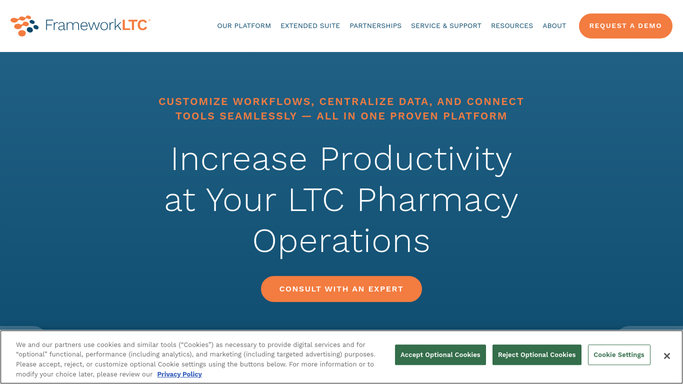
Cycle fill and split billing are already solved in Framework
SoftWriters has spent three decades on exactly this problem, and it is worth being clear about how much of it is handled.
Cycle fill automation processes recurring orders without a person retyping them. Split billing and batch claim processing let a team work rejection codes in batches rather than reconciling orders one at a time. FrameworkFlow drives a barcode-based workflow from a mobile device, so the physical path of a fill is tracked rather than assumed. FrameworkECM turns the document pile into a routed workflow, and FrameworkPOD closes the loop on delivery with proof that the route actually arrived. FrameworkInsight reads across all of it for forecasting.
The platform also connects to hundreds of partner systems, and where an interface to a facility exists, it does the job well.
Where one does not, and for most pharmacies that is a meaningful share of the buildings they serve, the census is a report on a site with its own login. So is the wholesaler's availability page, the prescriber portal holding an unsigned authorization, and the state board that renews a license.
The answers live in the facility's system and the wholesaler's
The census is the document the morning turns on, and nothing about it requires a pharmacist to be the one who reads it.
Last night's admissions, discharges and hospital transfers read from each facility's own system before the cycle fill run, so nobody packs and delivers for a resident who left on Tuesday, and a new admission has a first fill on the right van. Payer changes caught the same way, before a claim rejects rather than after.
The wholesaler checked for backorders and allocation on the drugs in this cycle, early enough that an alternative can be sourced before the van loads. Refill authorizations still unsigned at prescriber offices, gathered into one worklist rather than held in somebody's head. Pharmacist and technician licenses, plus registrations in every state the pharmacy ships into, checked on the boards that issue them.
The pharmacy line is absolute and worth stating outright. All of that gathering happens unattended. No fill is dispensed, no order verified and no therapeutic decision made without a pharmacist. What arrives is a prepared, checked worklist, and a licensed person still makes every call on it.
A pharmacist's hour is the scarcest thing in the building
A pharmacist reading a census report on a nursing home's website is doing work that requires none of their training, on a morning when verifications are stacking up behind them.
WebRun is an AI agent that works a real Chrome browser, signed in the way your staff sign in. It opens the facility system, the wholesaler, the prescriber portal or the state board, reads what is there, and brings back a worklist with the resident, the drug and the date attached.
It runs on your schedule in your own private environment, sessions are not shared between tools, and a workflow can be restricted to a named list of sites. You can watch a run and stop it.
The workflows below are already built, and each one names what it opens.
Questions people ask
Will it dispense or verify anything on its own?
No. It gathers and flags, and a pharmacist does the rest. Nothing is dispensed, verified or substituted without a licensed person, and no clinical or dispensing decision is made by an unattended process.
Can it read a facility census when there is no interface?
Yes, and that is the main reason to use it. It signs into the facility's system the way your staff do and reads the census report, which is often the only access the pharmacy is given.
Is it safe with controlled substance records?
It sees what the person signing in can see, sessions stay inside your own private environment, and a workflow can be locked to a named list of domains. Reading a record and acting on one are deliberately separate.
12 ready-made FrameworkLTC workflows
Each one names the apps it touches and the exact steps it takes. Open one to read what it will do, then turn it on.
Want one of these running on your own FrameworkLTC?
Show WebRun the process once and it will run it on schedule, in your own private browser environment.