How to Automate FieldGroove
FieldGroove prices the job and then runs it. Estimates calculate their own math once measurements go in, digital signatures close them on the spot, and job scheduling puts crews and trucks against work orders. Builder portals, rebate programs and supplier branches sit outside it, so an agent like WebRun opens those and reports back.
 Written by
Priya Raghavan
Solutions lead
Written by
Priya Raghavan
Solutions lead
 Reviewed by
Nora Whitfield
Editorial lead
Reviewed by
Nora Whitfield
Editorial lead
A builder's schedule decides when the insulation crew works
Insulation is a trade paid by the measurement and scheduled by somebody else. FieldGroove is the software built for that shape of business: field service software for contractors who price work by measurement and then send crews to install it, used across insulation, drywall and roofing, including by some of the largest contractors in the country.
The whole job cycle sits inside it. A lead arrives, an estimate is built by picking products and entering measurements while the arithmetic happens for you, the customer signs it on the screen, and the same record becomes a work order with installers, a truck and a date against it. Later it becomes an invoice, and at the end a margin number. For a contractor working new construction, that record is the only place the lot, the material count, the crew and the price ever meet. A production builder running forty houses is forty of those records moving on the builder's calendar.
The bags are ordered against a date somebody else keeps moving
Almost everything that decides whether a crew has a good week happens where FieldGroove cannot see it. The builder publishes a production schedule on their own portal and then changes it: drywall went in early on lot 42, so insulation is wanted Thursday rather than the week after, and nobody rings to say so.
The utility or state rebate that made the spray foam upgrade worth selling has a document list and an approval status on a program website, and the customer's money waits behind it. The distributor's site says whether the batts and the low-GWP foam are actually at the branch your driver pulls from. A warranty registration has its own portal. A final inspection has a county date, and the trade after you cannot start until it clears. Every one of those is a login somebody in the office opens between phone calls, which in practice means Friday, if Friday is quiet.
The estimate does its own arithmetic, then stops at the door
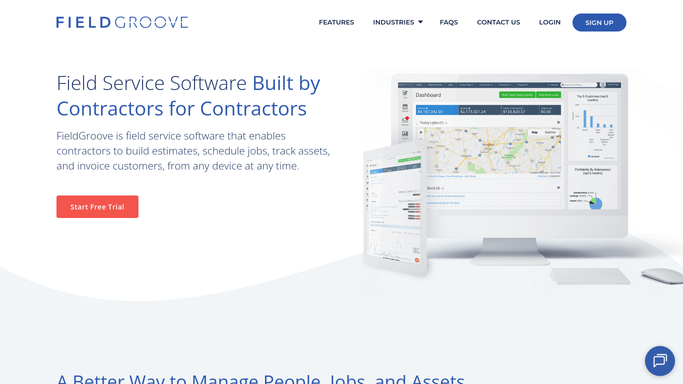
FieldGroove earns its place on the pricing and the running of the job, and a contractor using half of it is leaving the easy part on the table. Estimates calculate automatically once line items, products and measurements go in, which is what lets a salesperson quote in a driveway instead of back at a desk. Digital Signatures let the customer accept and add upgrades on the spot. Job Scheduling books work orders, installers, crews and trucks together and retires the whiteboard the dispatcher used to guard. Asset Tracking watches the fleet and the inventory in real time. Around them sit Tasks and Reminders, Roles and Permissions, Document Storage for the site photos, SMS and Emails for sending estimates and invoices out, and Reports and Trends for margin and win-loss. It pushes to QuickBooks or Sage so nothing is entered twice.
Each of those works on what is already in FieldGroove. The builder's schedule, the rebate status and the branch stock level live behind other companies' logins, and none of them will ever type themselves in.
The production schedule can read itself every morning
Picture the job list going out to look instead of waiting to be told. The builder's production schedule read each morning against the lots you are booked on, so a date that slipped on Monday reaches the crew leader on Monday and not at the gate on Thursday. Rebate applications checked on the program's own site, so the one stuck on a missing invoice gets fixed while the customer still remembers signing it.
Branch stock confirmed before a truck is loaded for a house that needs eighty bags. Estimates unsigned past a week surfaced with the builder, the lot and the value attached, so the call is about a specific address rather than a template reminder. Warranty registrations completed as jobs close instead of in a January catch-up. County inspection results read the day they post, because your crew cannot go back and the next trade cannot go in until they do. None of that is a new system. It is the same information, arriving on the day it is worth having.
A dispatcher should be loading trucks, not refreshing portals
An estimator's afternoon is worth more than a builder's portal is. WebRun is an AI agent that works a real Chrome browser, signed in as you, on whatever schedule suits the season. It opens the builder's portal, the rebate program, the distributor's branch page or the county site, reads what is on screen, and hands back the short list your day actually turns on: lots that moved, rebates stuck, estimates gone quiet.
Because it drives the browser rather than an API, a builder portal with no integration and no export is simply another page to read. Anything that sends a message, files an application or changes a record is drafted and left for a person to release. The cards below are where contractors usually start.
Questions people ask
Our estimates already calculate themselves in FieldGroove. What is missing?
The information that arrives from outside. FieldGroove does the math on what your estimator typed and schedules the crew you assigned. Whether the builder moved the lot, whether the rebate cleared and whether the branch has the material are all answers held on other companies' websites, and an agent is what goes and gets them.
Will it submit a rebate application for us?
Not on its own. Checking a program site for status runs unattended because nothing is changed by looking. A submission, an upload or a message to a homeowner is prepared with the details filled in and held for you to approve, so a person is always the one who presses send.
Our builders all use different portals. Does each one need setting up?
Each portal needs pointing at once, the way you would show a new coordinator where things are. After that the agent signs in and reads it like a person would. Because it works the browser, a portal with no API and no export is no harder than one that has both.
10 ready-made FieldGroove workflows
Each one names the apps it touches and the exact steps it takes. Open one to read what it will do, then turn it on.

Want one of these running on your own FieldGroove?
Show WebRun the process once and it will run it on schedule, in your own private browser environment.