How to Automate Chargebee
Chargebee automates the billing it owns. Billing runs plans and invoices, Smart Dunning retries failed cards, and Chargebee Retention offers a pause or a discount in the cancel flow. Reading the buyer's AP portal, the signed contract terms and the CRM is the part still done by hand, and what WebRun takes on.
 Written by
Owen Hartley
Workflow engineer
Written by
Owen Hartley
Workflow engineer
 Reviewed by
Rosa Lindqvist
Operations editor
Reviewed by
Rosa Lindqvist
Operations editor
Chargebee is the contract, not just the charge
Chargebee is where a subscription business keeps the agreement rather than the transaction. A plan with its price and its billing cycle. A subscription with a start date, a term, the discount somebody negotiated and a renewal that will happen whether or not anyone remembers it. Invoices, credit notes, proration, the coupon applied in year one, the seat count that changed in March.
That is a different object from a payment. A card charge either worked or it did not. A subscription is a relationship with a history and a date in the future, and finance, sales and support all read it for different reasons. The controller wants recognised revenue. The account manager wants to know what this customer is paying now. Support wants to know whether the person on the phone is still entitled to the thing they are asking for.
So Chargebee becomes the record everybody quotes from, because it is the one place the terms are written down.
Every failed card ends in a conversation somebody has to have
The billing runs itself. The exceptions are what fills the week.
Monday is a list. Four cards failed over the weekend, and two of those customers are on annual plans worth a phone call rather than another email. Three subscriptions renew in six weeks, and one has a notice period running out on Friday, which nobody will spot because it lives in a signed order form and not in the billing system.
An invoice from March is still open, not because the customer refuses to pay but because it needs a purchase order number and a submission into their accounts payable portal, and the colleague with that login has left.
Then the reconciling. What the processor paid out against what was invoiced. Which of last month's cancellations were customers choosing to go and which were cards that expired. The recurring revenue figure in the board pack against the one in the CRM, which never agree.
Smart Dunning retries the card and stops there
Chargebee automates the money side thoroughly, and most of it deserves configuring before anything else.
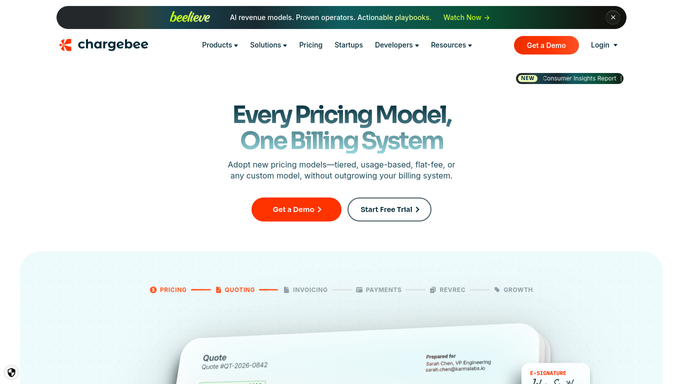
Billing runs the plans, the proration and the invoices, on usage-based or tiered pricing. Smart Dunning retries a failed payment on the schedule you set, sends the dunning emails you wrote, and carries out the final dunning action you chose once the attempts run out. Chargebee Retention turns the cancel flow into a set of offers, so somebody clicking cancel is shown a pause, a discount or a smaller plan first. RevRec builds revenue schedules for ASC 606 without a spreadsheet.
Every one of those acts on something Chargebee already holds: the subscription, the invoice, the card on file.
The wall is that a recurring business is mostly decided somewhere else. A business-to-business invoice is rarely late because the customer forgot. It is sitting unapproved in their accounts payable portal, waiting on a purchase order number. The renewal that matters has a notice period buried in an order form in a shared drive. The churn coming in November shows up first as an account that stopped logging in, which is a fact about your product, not your billing. Chargebee cannot open any of that, and was never meant to.
A renewal can arrive with the account already checked
Once the subscription list can be checked against the other systems, the exceptions turn up already explained.
The renewals falling in the next quarter, each with its notice date read off the signed order form, so the ones needing a conversation reach an account manager long before the auto-renew fires. The cards expiring next month, listed before they fail rather than after. Failed payments set against whether that account still has the access it stopped paying for.
The open invoices matched against the buyer's own accounts payable portal, which splits a chase list in two: genuinely late, and stuck three approvals deep for want of a purchase order number. The processor's payouts lined up beside the invoices Chargebee raised, with the gap named while it is still one week wide. Last month's cancellations sorted into people who chose to go and people whose card expired, because those are two different problems.
The line matters more here than almost anywhere, because this is recurring money with a customer on the end of every action. Assembling lists, reading portals and comparing figures can run unattended. Cancelling a subscription, issuing a refund, applying a credit or firing the next dunning escalation is a decision, and it belongs to a person.
The decisions about money stay with a person
Gathering all of that is the slow part, and none of it is a decision.
WebRun is an AI agent that works a real Chrome browser, signed in as you. It opens Chargebee, the customer's accounts payable portal, the payment processor, the CRM and the folder where the order forms live, reads what each one says, and hands back the week's exceptions with the account, the number and the reason attached.
It runs on your schedule in your own private environment, and you can watch a run and stop it. Nothing is cancelled, refunded, credited or escalated on its own.
The workflows below are already built, and each one names what it opens.
Questions people ask
Can it cancel a subscription or issue a refund?
No. Anything that moves recurring money or ends a customer's service is prepared and left for you. It will build the list, check the account and draft the note, but the decision stays with a person who knows the relationship.
How is this different from Chargebee's own dunning?
Chargebee's dunning retries the card and emails the customer. This covers what surrounds it: whether the account still has access, whether the invoice is stuck in the buyer's accounts payable portal, and which accounts need a call rather than another reminder.
Do we need the Chargebee API or a developer?
No. It signs in and reads the screens the way your team does, which is also why it can open a customer's accounts payable portal or a contract folder that offers no API at all.
12 ready-made Chargebee workflows
Each one names the apps it touches and the exact steps it takes. Open one to read what it will do, then turn it on.


Want one of these running on your own Chargebee?
Show WebRun the process once and it will run it on schedule, in your own private browser environment.