How to Automate Auditdata Manage
Auditdata Manage automates the clinic's own side: patient management, scheduling and online booking, inventory, stock and repair management, billing, claims and enterprise reporting across every location. Manufacturer repair portals, insurer benefit detail and distributor stock live elsewhere, and an agent such as WebRun reads those each morning.
 Written by
Nora Whitfield
Editorial lead
 Reviewed by
Hannah Vogel
Finance operations
A hearing aid fitting starts a relationship measured in years
Auditdata Manage is what a hearing care business with more than one clinic runs its days on.
Hearing care is not a transaction. A patient comes in for a test, is fitted with devices that cost more than most people expect, and then comes back: for a follow-up, for a recheck, for a repair, for domes and wax guards, for a replacement as the warranty runs out, and for a new pair some years later. The clinic that keeps up with that keeps the patient. The one that does not, does not.
Manage holds that whole arc for a network of clinics rather than for one. Patients, appointments and online booking, the devices dispensed and their serial numbers, stock across locations, repairs, billing and payments, claims and reimbursement, and reporting that reads across the group rather than site by site. Auditdata sells it alongside Measure for audiometry and Auditbase for hospital departments.
Somebody is on hold to the manufacturer about a repair
The part of the week nobody planned for is the chasing, and almost all of it happens on somebody else's system.
A patient's aid went back to the manufacturer for repair three weeks ago. The clinic does not know where it is, so somebody signs into the manufacturer's portal to find out. A trial return period is running out and nobody has spoken to the patient. A device's warranty lapses next month and nobody has told that patient either. A fitting is booked for Thursday and the benefit still has to be verified with an insurer or a third-party administrator, on their site rather than yours.
Underneath sit the smaller things. Receivers and wax guards below par at one clinic and overstocked at another. Demo units that have sat long enough to have quietly become old stock. A cancellation at ten past nine that leaves a chair empty, because nobody had time to work the waitlist.
Every one of them is a short task on a different website. Together they are most of a front desk's day.
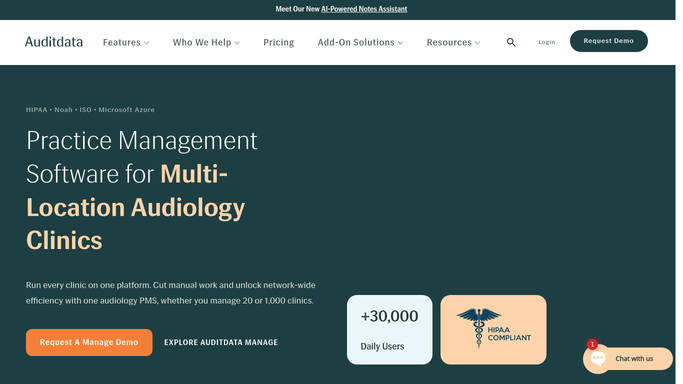
Manage keeps every clinic on the same protocol
Auditdata covers the inside of this properly, and a group not using what it licenses is making its own work.
Patient management and scheduling run the clinical day, with online booking and patient notifications taking routine contact off the phone. Inventory, stock and repair management follow devices and consumables across locations rather than per site. Billing and payments, and claims and reimbursement, handle the money. Standardised workflows and protocols push the same guided steps into every clinic, which is most of the point of buying enterprise software, and enterprise reporting and KPIs put the group's numbers in one place.
What none of it does is open an account on a site the business does not own.
The manufacturer's repair tracking is on the manufacturer's portal. The insurer's authorisation and the third-party administrator's benefit detail are on theirs. The distributor's live stock and lead times are on a third. Each of those decides something the clinic has to tell a patient, and each answers only to a person with a password and a spare few minutes.
The repair, the trial and the warranty speak for themselves
A clinic where those checks are already made before the doors open is a different clinic to work in.
Every open repair looked up on the manufacturer's own portal overnight, so the patient whose aid came back yesterday is called today, and the one stuck for a month is escalated rather than forgotten. Benefits verified on the insurer or administrator site for every fitting on the week's schedule.
Trials counted down to the end of their return period, with a check-in drafted for each patient early in the window, so a fit problem gets solved rather than returned. Warranty expiry read across everything dispensed, so the conversation happens before the cover ends rather than after a repair bill. Consumable stock compared across clinics and against the distributor's own availability before a purchase order is drafted.
And the cancellation at ten past nine: the waitlist searched for the patient who fits that slot, with the offer written and waiting for a receptionist to send.
The clinical line stays where it is. Reading, matching and comparing run unattended. Anything that reaches a patient, changes a record or commits an order is prepared and held for a person.
An agent makes the rounds nobody has time for
Four minutes a check, sixty checks, and they belong to whoever is least busy, which is nobody.
WebRun is an AI agent that drives a real Chrome browser, signed in the way your staff sign in. It opens Auditdata Manage, the manufacturer's repair portal and the insurer's site, reads what each says, and hands back the repair list, the verification sheet or the recall queue already prepared.
It runs to your schedule inside your own private environment, a workflow can be held to a named list of sites, and sessions are not shared between them. A run can be watched and stopped while it happens.
The workflows below are already built, and each names what it opens and what it leaves for you.
Questions people ask
Will it text a patient about a repair before we have seen it?
No. Every message to a patient is drafted and held for staff to send. What runs on its own is the looking up: where a repair has got to, whose trial ends this week, which warranty lapses next month.
Manufacturer portals are all laid out differently. How does it cope?
No. It reads each site the way your front desk does, so a portal with no export, no API and an unusual layout is worked like any other. A site that changes is a change to one workflow, not to an integration.
Does patient information leave our clinics?
Runs happen inside your own private environment, and sessions are not shared between the sites in a workflow. It sees what the staff member signing in can see, on the sites you have named, and nothing beyond that.
11 ready-made Auditdata Manage workflows
Each one names the apps it touches and the exact steps it takes. Open one to read what it will do, then turn it on.

Want one of these running on your own Auditdata Manage?
Show WebRun the process once and it will run it on schedule, in your own private browser environment.