How to Automate Acumen
Acumen automates nephrology on the Epic platform. Care Everywhere exchanges records across the network, Acumen Rounder tracks which patients need seeing across hospitals and dialysis centres, and consolidated MCP billing handles the monthly cycle. Transplant portals, access centres and payer sites sit past that edge, which is where WebRun works.
 Written by
Owen Hartley
Workflow engineer
Written by
Owen Hartley
Workflow engineer
 Reviewed by
Devon Ruiz
Workflow engineer
Reviewed by
Devon Ruiz
Workflow engineer
A nephrologist's day happens in buildings the practice does not own
Acumen is the EHR a large share of American nephrologists work in, built by Interwell Health and delivered on the Epic platform as Acumen Epic Connect. The practices using it are kidney care groups, and their day looks unlike almost any other specialty's.
A nephrologist is rarely in one building. The morning is rounds at a hospital, the afternoon might be two dialysis centres, and the office clinic sees the chronic kidney disease patients not yet on dialysis. The dialysis units are usually run by a large dialysis organisation the practice has no ownership of, and the hospital is a third party again. Three venues, three sets of systems, one patient.
Payment follows the same shape. A dialysis patient is billed monthly rather than per visit, and what the practice can bill turns on how many face-to-face visits actually happened, which is a counting problem before it is a billing one.
Half the patient's month happens where the chart cannot see it
A patient on haemodialysis spends three sessions a week somewhere the practice does not control, and most of what matters clinically is recorded there.
Monthly lab panels are drawn and run by the dialysis organisation, in its own system. So are the treatment records: how much fluid came off, what the blood pressure did, whether a session was cut short, whether a patient simply did not come. A missed treatment is one of the strongest signals in the specialty, and it does not reach the practice's chart on its own.
The rest fragments the same way. Vascular access is managed at an access centre with its own reporting. A patient's place on a transplant waitlist lives in the transplant centre's system, and a status change there rarely reaches the nephrologist quickly. Hospital admissions and discharges arrive late or not at all. Authorisations for injectables sit on payer portals, and value-based quality measures are attested somewhere else again.
So the practice reconstructs the month afterwards, by hand, off other people's screens.
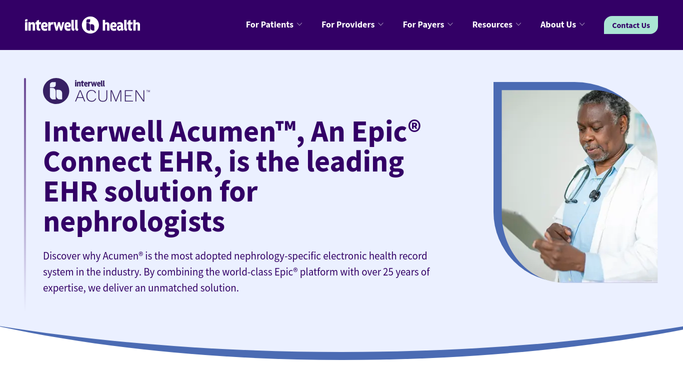
Acumen Rounder and Care Everywhere cover the ground Epic can reach
For everything it can see, Acumen is strong, and its choice of foundation is a large part of why.
Being Epic means Care Everywhere, so records exchange with the many hospitals and practices already on that network without anyone building an interface. The nephrology-specific work sits on top. Acumen Rounder is the rounding application, web and mobile, which replaced the older Acumen Mobile Charge Capture, and its patient tracking tells a nephrologist which patients need to be seen and where each one is. Dialysis documentation, charge capture and consolidated MCP billing handle the monthly cycle. MyChart gives patients the portal many of them know from their hospital. There are population health tools, CKD and ESKD care coordination, transitional care management after a discharge, and specialised workflows for CKCC and value-based quality measures.
That is a great deal of reach, and Rounder itself connects to the clinical networks of major dialysis providers.
It is still the reach of a network, and every network has an edge. The transplant centre's portal is past it. So is the vascular access centre's reporting, the payer's authorisation queue, and any unit not on the list.
Transplant status and missed treatments can be on the list by seven
By seven in the morning, the month can be something watched rather than something reconstructed after it closes.
Transplant waitlist status checked at each centre for every listed patient, so an inactivation for a missing test is found in days rather than at the next clinic visit. Missed and shortened treatments collected from the units the practice covers, so the patient who skipped twice this fortnight is a conversation on Tuesday instead of an admission on Friday. Monthly lab panels retrieved and set against the previous two, so a rising potassium reads as a trend rather than a single number.
Face-to-face visit counts totalled mid-month against who is still due, so somebody nobody has seen yet gets seen while the month is open. Authorisation expiry dates listed by which closes first. Hospital admissions and discharges checked each morning, because transitional care only works if the practice knows the patient came home.
A dialysis unit gets no say in where this stops. Gathering runs unattended. Anything that writes to a chart, drops a charge or reaches a patient waits for a clinician or a coder to approve. Nephrology is the judgement, not the fetching.
The list can be waiting when rounds start
Somebody assembles that picture today, in the gaps between hospitals, and the gaps are not big enough for it.
WebRun is an AI agent that works a real Chrome browser, signed in as your staff are. It opens the transplant centre's portal, a dialysis unit's system, a payer site or the hospital's own, reads what is on each screen, and returns one list with the exceptions on top.
It runs on your schedule in your own private environment, sessions are not shared between tools, and a workflow can be restricted to a named list of domains. You can watch a run and stop it at any point.
The workflows below are already built, and each one names what it opens.
Questions people ask
Will it drop a charge or change a chart on its own?
No. Charges, chart entries and anything reaching a patient are prepared and wait for a clinician or a coder. Reading the transplant portal, the dialysis records and the payer site is the part that runs unattended.
Acumen runs on Epic. Is this not just duplicating Care Everywhere?
No. Care Everywhere is the reason to automate only what sits beyond it. This is for the transplant centre portal, the vascular access reporting and the payer authorisation queue, none of which are on that network.
Is protected health information safe on those outside portals?
Sessions run in your own private environment and are not shared between tools, and a workflow can be limited to a named list of domains. It sees what the staff member whose login is used can see, and nothing more.
12 ready-made Acumen workflows
Each one names the apps it touches and the exact steps it takes. Open one to read what it will do, then turn it on.


Want one of these running on your own Acumen?
Show WebRun the process once and it will run it on schedule, in your own private browser environment.