How to Automate Trym
Trym automates the cultivation record for licensed growers: plants tagged from clone to harvest, a bi-directional Metrc sync, a compliance tab that files a full day of events at once, wireless sensors and crop steering. Lab portals, licence renewals and buyer sites sit outside it, and an agent like WebRun reads those.
 Written by
Julian Adeniyi
Retail operations
Written by
Julian Adeniyi
Retail operations
 Reviewed by
Devon Ruiz
Workflow engineer
Reviewed by
Devon Ruiz
Workflow engineer
Every plant in the room is a numbered legal object
In a licensed cannabis grow, a plant is not just a plant. It carries a tag, that tag carries a number, and the state expects that number accounted for from the moment a clone is taken until the day the flower is sold or destroyed. Trym is the software growers run so that account stays straight.
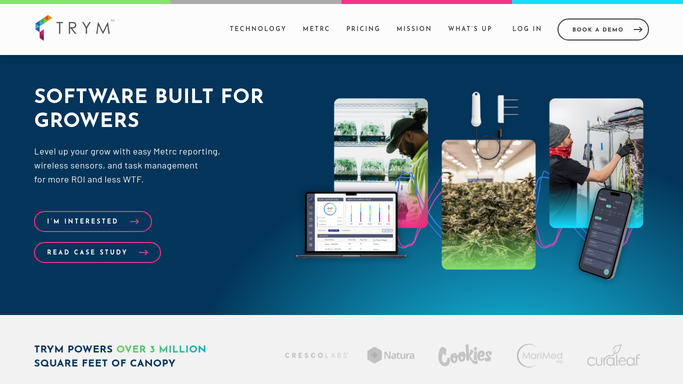
It was built in Novato, California, in 2018, by founders who wanted cultivation software a head grower would actually use rather than a compliance database with a grow module bolted on. What sits inside is the working record of the facility: plantings and tags from clone through harvest, inventory by growth stage, active harvests, wireless sensors in the rooms, crop steering, tasks assigned to whoever is on shift, and the analytics that come out the far end.
Commercial operators use it because those two things, the legal record and the daily work, are the same record. Getting them to agree is the entire job.
The clipboard work lands on a cultivation lead
The person who is best at growing usually ends up doing the paperwork, because they are the only one who knows which plant is which.
So a cultivation lead's week fills up with things that are not cultivation. Samples went to the lab eight days ago and the certificate of analysis still has not appeared, so somebody signs into the lab's portal to look, then does it again tomorrow. The state licensing site has a renewal window that opens at some point, and the only way to know is to go and check. Wholesale orders arrive on a marketplace the sales side watches, while the harvest that has to cover them lives here.
Then there is destruction. Waste gets logged in the room, and eventually somebody sits down with the physical log and the system and works out whether the two agree. When they do not agree, it is not a data problem. It is an inspection finding waiting to happen.
Trym closes the loop with Metrc and stops there
Inside the facility this is largely solved, and any grower still keying weights twice should hear how solved.
The Metrc sync runs both ways, so the plants, packages and events in Trym and the ones in the state system stay one set rather than two lists that drift apart. The compliance tab gathers the day's events in one place and files them together, and an action can be reverted before it goes, which matters far more than it sounds. Touchless harvesting is the part people demonstrate: hang a cut plant on the connected scale, scan the tag, and the next screen loads itself, so a harvest day becomes a rhythm instead of a queue at a laptop. Tasks, automated workflows and room sensors carry the rest of the shift.
The limit is the shape of it. Trym talks to Metrc, thoroughly, and Metrc is one website out of several the licence depends on. The testing lab publishes on its own portal. The licensing authority runs its own site. The buyer orders somewhere else again. None of those are Metrc, so none of them are in the sync.
Lab results that reach the sales desk on their own
The record starts here, in the rooms, which makes the useful direction outward, toward everyone waiting on it.
Picture the testing lab's portal checked twice a day for every batch you have out, so a certificate posted at four in the afternoon reaches the sales desk and the compliance file that same afternoon, with the potency and the pass or fail already matched to the harvest batch it belongs to. Picture the licence watched all year on the state's own site: renewal windows, status changes, anything filed against it, so a deadline is a calendar entry weeks out rather than a discovery.
Picture the destruction log reconciled every week, the waste recorded in the rooms set against what the state system holds, with the differences listed by date and room while somebody can still remember the day in question. Or the wholesale orders read off the marketplace each morning and set against what is genuinely cured, packaged and available, so the sales team stops selling flower that has not finished drying and nobody has to walk the rooms to find out.
Compliance evidence that gathers itself overnight
Every one of those is a login and a table. The lab portal, the state site, the marketplace: none of them offer an export, and none of them are going to build an integration for a grower.
WebRun opens them. A real browser, signed in as you, on a schedule you set, reading the same screens your compliance manager reads and reporting back what changed.
What it does not do is act alone. Collecting runs unattended, and it stops there. Anything that files an event to Metrc, submits something to the licensing authority, or sends a message to a buyer is drafted and waits for a licensed person to release it. In this industry a filing made by mistake is not an inconvenience, it is a finding that follows the business. The cards below are the jobs cultivation teams pick up first.
Questions people ask
Will it report events to Metrc for us?
No. It reads Metrc and the sites around it, and where a filing is needed it prepares the entry and stops. A licensed person presses send. An event filed in error becomes part of your compliance record, so nothing reaches the state on its own.
Our testing lab has a portal but no API. Can it still pull COAs?
Yes, and that is the common case. It signs in to the lab's portal the way your compliance manager does, reads the result off the page and matches it to the harvest batch. The lab does not have to build anything, or even know about it.
Does this replace the Metrc sync we already have in Trym?
No. That sync is the right tool for Metrc and it stays exactly where it is. This covers the sites Trym has no reason to connect to: the testing lab, the licensing authority, the wholesale marketplace, the county. Different systems, same obligation.
12 ready-made Trym workflows
Each one names the apps it touches and the exact steps it takes. Open one to read what it will do, then turn it on.


Want one of these running on your own Trym?
Show WebRun the process once and it will run it on schedule, in your own private browser environment.