How to Automate Sonio
Sonio automates the fetal ultrasound report. Report fields populate from image analysis, images sort themselves by view, an AI visual checklist tracks exam completeness live, and finished reports go out to referring providers by eFax or integration. Genetics labs, referral centres and payer sites never answer back, and that is where WebRun reads.
 Written by
Hannah Vogel
Finance operations
Written by
Hannah Vogel
Finance operations
 Reviewed by
Clara Bennett
Revenue operations
Reviewed by
Clara Bennett
Revenue operations
An anatomy scan is a checklist with pictures attached
Fetal ultrasound runs on protocols rather than impressions. Sonio is the cloud platform built around that: reporting, image management and quality review for the units that scan pregnancies. It is a French company based in Paris, and Samsung Medison completed its acquisition in 2024, after which Sonio carried on as an independent business, its products still compatible with any manufacturer's ultrasound machine. Sonographers, obstetricians and maternal-fetal medicine specialists work in it, with department leads and IT staff behind them.
An obstetric scan is not a picture somebody describes afterwards. The mid-pregnancy anatomy survey has a defined list of views that must be obtained and documented, each with its own quality criteria, and the report is complete only when the list is. Growth scans repeat at ordered intervals and are read against the previous one and against a curve.
So what the department actually produces is a document: a structured report, sent back to the obstetrician who asked for the scan, early enough for somebody to act on it.
A gestational week cannot be moved
Nearly every other deadline in medicine can be rescheduled. This one advances on its own.
A growth scan ordered at four-week intervals is a different examination at thirty-two weeks than at thirty-six, and a repeat that slips past its window is not a late appointment, it is a missing one. An anomaly found on a Tuesday needs a specialist appointment within days rather than within the usual referral time. An amniocentesis has a window. NIPT has a turnaround, and then a result that somebody has to actually read.
Almost all of that follow-up lives in other people's software. The genetics laboratory keeps results on its own portal. The centre accepting a referral runs a different system. The diary holding next month's slots is not the reporting platform. The payer that denied a detailed obstetric ultrasound posted the reason on its own site.
So a coordinator spends the week working out which of last week's reports produced the thing it was supposed to produce.
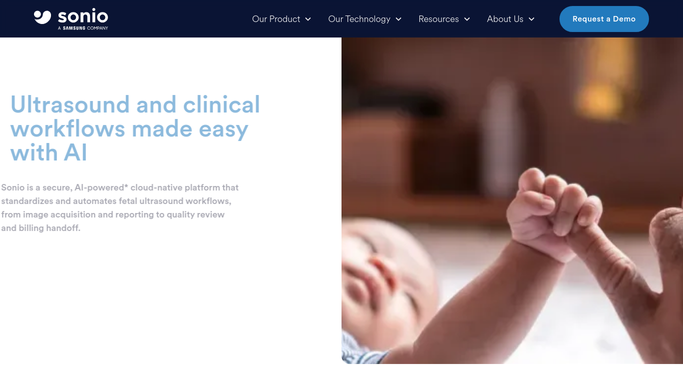
Sonio fills the report while the images are still arriving
On the examination itself Sonio does an unusual amount, and a unit should lean on all of it.
Report fields including fetal anatomy and placental location populate automatically from image analysis, on fully customisable templates and protocols, with graphs and tables tracking development across the pregnancy. Images sort themselves by view type into a consistent order however they were acquired, and the best frame can be extracted automatically from a cine clip. An AI-powered visual checklist gives real-time oversight of exam completeness as images arrive from the machine, recording quality criteria assessments as it goes. Sonio Detect, cleared by the FDA, detects views and anatomical structures and verifies their quality criteria. Practice analytics reports commonly missed views by protocol and unverified quality criteria. Finished reports reach referring providers by eFax, print or integration, and patients by secure QR code or protected link.
Look at the direction of every one of those. Sonio is very good at getting a complete, correct report out of the room and out of the building. Finding out what happened next was never its job. The report leaves, and nothing comes back.
The answers can come back to the unit that asked
Turn that arrow around, and the unit stops finding things out by accident.
NIPT and genetics orders matched against the laboratory's own portal each morning, so a result back on Thursday is read on Thursday rather than discovered at the next visit. Ordered growth-scan intervals checked against the booking diary, the pregnancies with nothing in it named while their window is still open, which in obstetrics is the only point at which naming them helps.
Referrals for an abnormal finding confirmed as accepted at the receiving centre instead of assumed because a fax went out. Denied obstetric ultrasound claims collected from the payer's site with the codes and the report behind them, sorted by appeal deadline. Consent paperwork for an amniocentesis or CVS confirmed as signed before the day, not on it. Tomorrow's list checked for the women who have confirmed nothing.
The boundary here is absolute. Reading, matching and flagging run unattended overnight. Nothing is written into a report, no image or result is interpreted, and nothing reaches a pregnant patient until a qualified clinician has read it and sent it themselves.
A sonographer should be scanning, not phoning laboratories
It needs somebody who will log in, read a date and write it down every morning, without being pulled away by the list of scans waiting in the room.
WebRun is an AI agent that drives a real Chrome browser, signed in the way your staff sign in. It opens the genetics laboratory's portal, a referral centre's system, the payer's site or the booking diary, reads the screen, and brings the answers back attached to the right pregnancy.
It runs on your schedule inside your own private environment, sessions are not shared between tools, and a workflow can be locked to an explicit list of domains. You can watch a run and stop it at any point. Anything irreversible drafts and waits.
Each card below states which sites its run touches, and when.
Questions people ask
Does it look at ultrasound images or change a report?
No. Image analysis is what Sonio Detect does, and interpretation belongs to your clinicians. This reads outside websites, matches what it finds to the right patient and hands back a list. Any edit to a report, and anything sent to a woman or her obstetrician, waits for a qualified person.
Genetics results only exist behind a laboratory login. How does it reach them?
Yes, and it is the usual case. The run opens that portal in a browser with your own credentials and reads the screen the way a coordinator does, so a laboratory site offering no export and no integration is as reachable as one offering both. Nothing has to be built first.
Will it contact pregnant patients about a finding?
Never on its own. It can find that a woman has no follow-up booked and draft the outreach, but the message waits for a clinician to read, approve and send. News about a pregnancy should come from the person who can answer the question that follows it.
11 ready-made Sonio workflows
Each one names the apps it touches and the exact steps it takes. Open one to read what it will do, then turn it on.


Want one of these running on your own Sonio?
Show WebRun the process once and it will run it on schedule, in your own private browser environment.