How to Automate Markt POS
Markt POS already covers the shop floor: weight-based and perishable inventory, vendor management with purchase orders, batch price and label updates by margin, spoilage reporting, and scanned invoices. Purveyor price lists, wholesaler stock and state product registers sit on other companies' logins, which is the round an agent like WebRun makes.
 Written by
Owen Hartley
Workflow engineer
Written by
Owen Hartley
Workflow engineer
 Reviewed by
Rosa Lindqvist
Operations editor
Reviewed by
Rosa Lindqvist
Operations editor
A specialty market sells by the pound and buys by the box
Markt POS is a point of sale built for specialty grocery, and its customer list reads like a good high street: butcher shops, fish and seafood markets, produce markets, natural and organic food stores, international markets, co-ops, and the neighbourhood shop with a kitchen at the back that Markt's own site calls a grocerant.
What makes a grocery different is that most of what it sells has no fixed unit. Scanner scales at the checkout and the deli counter ring meat, produce and bulk goods by exact weight, out to four decimal places, because a shop selling by the pound cannot afford to round. The deli scales stay in step with the system, so a price changed once is not walked round the store on a clipboard.
Somebody's homemade sausage has an item record next to a case of imported olives, the PIN pad takes SNAP, EBT and eWIC, and the owner is usually the person behind the counter.
The cost of a case moves faster than the label on it
A grocery's margin is not decided at the register. It is decided on the buying side, on a Monday, in five or six places that have nothing to do with the till.
The purveyor sends a price list as an emailed PDF, and the primal that was one number last week is another this week. The wholesaler's ordering portal shows what is genuinely on the warehouse floor, which is how you learn that a third of the order will be substituted by somebody who has never stood in your shop. Somebody logs in to see whether Thursday's pallet shipped.
Then the other end of the day. The pickup and delivery marketplaces hold their own version of the takings, with the refunds and missing items that never crossed the register.
None of it is difficult. All of it is somebody's evening.
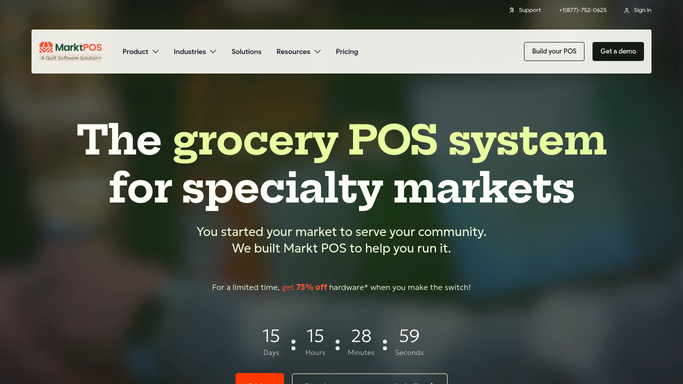
Markt keeps the case counted and the labels current
A shop using Markt as a till alone leaves most of it switched off, and the back office is the part worth switching on.
Inventory Management is built for the awkward stock a grocery actually carries: perishables, weight-based items, goods with no UPC, and whatever the kitchen made that morning. Vendor Management ties each item to its supplier, holds the wholesale cost against it, and turns a low-stock report into a purchase order. Batch Price and Label Updates reprice by the margin you want, then print the shelf labels in the same pass. Reporting covers daily sales, profit margin by category, department performance and spoilage, which in a fresh shop decides the month.
Invoices can be scanned rather than keyed, two stores run from one back office login, and loyalty points and gift cards sit on the same record. Markt connects out to QuickBooks, and to Instacart and Mercato for pickup and delivery.
Every one of those works from what the shop already recorded, or from a partner Markt has wired in. The purveyor quoting by PDF is not a partner. Neither is the regional wholesaler's ordering portal, the packer's dealer site, or the state register saying which products a WIC card may be used on.
The buying side can be read before the order goes in
Put somebody on those sites each morning and the case gets priced on this week's numbers, not last week's.
This morning's cost on the purveyor's ordering site, set beside what the same cut is ringing at over the counter, so a primal that went up can be challenged or swapped before Monday's order goes out. The wholesaler's portal read for what is actually in the warehouse, so substitutions get chosen in the shop instead of on the loading dock.
A carcass reconciled the way a butcher already thinks about it: what the whole animal cost against what the cuts sold for, pound by pound, rather than as a feeling that the last one was a bad buy.
The state's approved product register checked against the shop's own item file, so a delisted line leaves the shelf before it fails at the PIN pad with a queue behind it. The marketplace back ends read for refunds and missing items, money taken out of the day that never appears on the register.
Building that list can run overnight. Deciding what to buy stays with the owner, and should.
The order still gets decided by the person who cuts
This morning's number is on the purveyor's site, and it does not travel to the shop on its own. In a shop with four staff the fetching is the owner's, and the hour comes straight off the counter.
WebRun is an AI agent that works a real Chrome browser, signed in as you. It opens a purveyor's ordering site, a wholesaler's portal or a state product register, reads what is on the screen, and sets the answer next to the cost and margin figures out of Markt POS.
Runs happen on a schedule you set, in your own private environment, and you can watch one and stop it part-way. Placing an order, moving a shelf price or messaging a customer is drafted and left for you.
The workflows underneath name the sites each one opens.
Questions people ask
Does a run ever move a price in the back office?
No. It collects the costs, sets them beside what each item is currently ringing at, and flags the lines where the margin has gone. Repricing is a decision with your name on it, so the change is prepared and a person applies it in the back office.
Our main purveyor emails a PDF price list. Is that any use?
Yes. A price list is readable whether it sits behind a login or arrives as an attachment, and the useful part is not the list itself. It is this week's number set against last week's and against your own shelf price, which is where the line that moved becomes obvious.
Could a run put wrong figures into our inventory?
It reads Markt POS rather than rewriting it. Costs and stock figures gathered outside come back as a list you look at, and anything that would change an item record is drafted first. Your back office stays the record, and nothing is written into it without somebody agreeing.
12 ready-made Markt POS workflows
Each one names the apps it touches and the exact steps it takes. Open one to read what it will do, then turn it on.



Want one of these running on your own Markt POS?
Show WebRun the process once and it will run it on schedule, in your own private browser environment.