How to Automate Copyt
Copyt handles the mechanical half of resale: catalogue autofill from a style code, one-click listing to eBay, StockX, Whatnot, alias and Shopify, Smart Auto-Delist when an item sells, a consignment portal and UPS labels. Verification status, fee statements, payout dates and live asks stay on each marketplace's seller screens, which an agent like WebRun reads.
 Written by
Nikhil Bhatt
Automation strategist
Written by
Nikhil Bhatt
Automation strategist
 Reviewed by
Samuel Adeyemi
Integrations writer
Reviewed by
Samuel Adeyemi
Integrations writer
A resale shop's inventory is one pair at a time
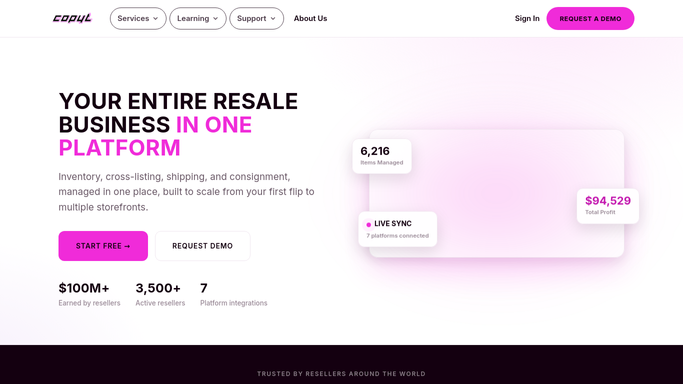
Copyt is an inventory and cross-listing platform for resellers, built around sneakers and streetwear. It runs for one person selling out of a spare room, for a storefront with staff, for bulk wholesalers, and for sellers who move stock on Whatnot live streams.
Resale inventory does not behave like retail inventory. There is no reorder point, because there is no reorder. Each item is a single pair in a single size with its own cost basis, bought in a different place on a different day, and worth whatever the market says this week. A shop with eight hundred pairs on the wall is holding eight hundred separate small bets.
Every pair gets entered once, given an internal SKU, and pushed out to wherever it might sell. When one of them sells it has to vanish from everywhere else before somebody buys it twice. What is on hand, what is listed, and what is owed to a consignor: that list is the business.
Checking on a sale is its own part-time job
A pair sells and the work starts. It ships to a verification centre, and then everybody waits.
Somebody signs into the marketplace seller dashboard to see whether it passed. Somebody else looks up when the payout for last week is actually scheduled and what came off it in fees, because the number that lands in the bank never matches the number on the listing. A consignor messages asking where their money is, and answering means two screens and some arithmetic.
Then the buying side. A model restocks and the shop wants it before the group chat does. A release date shifts. The ask on a size ten drops forty dollars overnight and three pairs on the shelf are suddenly priced above the market. Anything sitting since spring has to be looked up one at a time against recent sold comps before anyone can decide what to mark it down to.
Cross-listing reaches the listing, not the money behind it
Copyt does the hardest mechanical part of resale properly, and it is worth being precise about how much ground that covers.
Keyword Search Autofill takes a sneaker name, style code or SKU and fills the product details out of its own catalogue, and UPC Barcode Scanning does the same from a phone. One-click listing pushes an item to eBay, StockX, Whatnot, alias and Shopify at once, and Smart Auto-Delist pulls it from the others the moment it sells somewhere, which is the double-sale problem solved. The Unified Consignment Portal follows a submission from intake through to payout with real-time status, and larger accounts add Unique Item Serialization, Multi-Location Tracking and Scan-to-Accept at the counter. Shipping runs on contracted UPS rates with tracking attached.
All of that acts on items in the account and listings it created.
What it does not reach is the rest of each marketplace's own seller screens, and that is exactly where the money and the waiting live. Whether a specific pair cleared verification. When a payout is scheduled and what was deducted from it. What the current ask is for the size sitting on your shelf. Whether a model has restocked. Those are pages behind a seller login, read by a person, one tab at a time.
Verification holds and fee statements that report themselves
Give something the run of those dashboards on a schedule and the waiting stops being a person refreshing a tab.
Every pair currently at a verification centre checked each morning, so a hold or a failed authentication is known the day it happens rather than the week a buyer complains. Payout schedules and fee statements read off each marketplace and set against what the item cost, so the flip margin is the real one after fees instead of the one on the listing. Consignor balances assembled from those same figures, so the message asking where the money is gets answered before it is sent.
The buying side reads the same way. Current asks for the exact size on the shelf, gathered daily, so a pair priced above the market is obvious while it can still move. Restock and release dates from the brand's own pages. Recent sold comps for anything aged, lined up beside the cost basis, so a markdown decision takes a minute rather than an evening.
None of that needs an API key, a developer, or a marketplace to build an integration it has no reason to build.
An agent reads the seller dashboards
Signing into each marketplace and reading the screen has never been the skill in resale. Buying well is.
WebRun is an AI agent that works a real Chrome browser, signed in as you. It opens a marketplace seller dashboard, a brand's release page or a consignment portal, reads what is there, and brings it back next to the inventory and cost figures in Copyt.
Dropping a price, delisting a pair, paying a consignor and messaging a buyer are decisions with money on them. Those are drafted and wait for you.
The workflows below are already built, and each one names exactly what it opens.
Questions people ask
Will it drop prices on my listings by itself?
No. It reads the current asks and recent comps, sets them against your cost basis, and proposes the change. Repricing is money out of your margin, so the new price is drafted and waits for you to accept it.
Can it check a marketplace Copyt does not cross-list to?
Yes. It signs into any seller dashboard the way you do, so a marketplace, a brand release page or a consignment site outside the cross-listing set is still readable on a schedule. No integration has to exist first.
Could it get my seller account flagged?
It works in your own browser session at a human pace, on a schedule you set, and a workflow can be locked to an explicit list of sites. It reads pages rather than hammering an endpoint, and you can watch a run and stop it.
12 ready-made Copyt workflows
Each one names the apps it touches and the exact steps it takes. Open one to read what it will do, then turn it on.



 Shopify›

Want one of these running on your own Copyt?
Show WebRun the process once and it will run it on schedule, in your own private browser environment.