How to Automate Athennian
Athennian automates the record and the calendar. Entity and people records, structure charts, tasks and compliance calendars track filing events across jurisdictions, with automated reminders and recurring workflows for annual returns. Reading what the registries actually say back, and catching a rejected filing, is the outside half an agent like WebRun handles.
 Written by
Priya Raghavan
Solutions lead
Written by
Priya Raghavan
Solutions lead
 Reviewed by
Elliot Nakamura
Platform writer
Reviewed by
Elliot Nakamura
Platform writer
A subsidiary exists because a register says it does
Athennian is entity management and governance software for the legal, tax, finance and treasury teams that look after a group of companies. Its own term for the work is governance operations, and the people doing it are paralegals, company secretaries and corporate counsel, either in-house or at a firm acting for clients.
A group is rarely one company. It is a parent, a holding company, a financing entity, an operating company in each state or province it trades in, a few dormant shells nobody wants to strike off, and a joint venture or two. Every one of them has directors and officers, a registered address, share classes, a minute book and a filing calendar of its own.
Athennian holds that as records rather than folders: entity and people records, equity and debt structures, structure charts drawn from the ownership as it is actually recorded, and the documents attached to each. If a register somewhere says one of those companies is not in good standing, a deal stops.
Compliance is a calendar kept in other people's jurisdictions
The work is not complicated. It is relentless, and it is spread across authorities that share nothing with each other.
Annual reports fall due on different dates in every jurisdiction. Franchise tax is worked out one way in Delaware and another way elsewhere. A foreign qualification needs a certificate of good standing that goes stale faster than the process it is filed with. A registered agent forwards a service of process notice and somebody has to route it that day. A business licence lapses quietly. A director resigns and four filings follow.
So a paralegal spends the week logging in: to a state portal to see whether last month's filing posted, to the agent's site to download what arrived, to a payment page to settle a fee, then back into the entity record to note that all of it happened. Every one of those logins produces a fact that already existed somewhere else.
Athennian reminds you from the dates it was given
The platform does far more than store the record, and a team not using the task side is doing avoidable work.
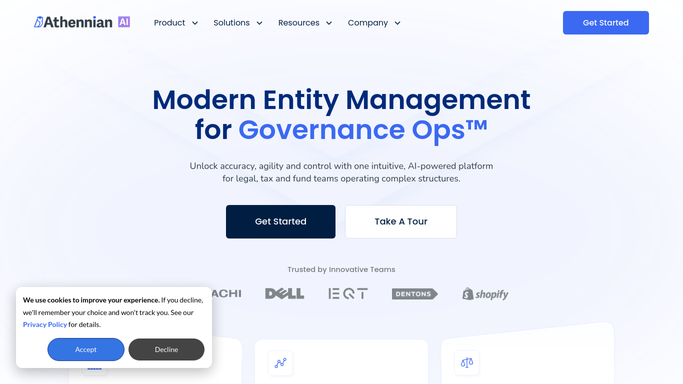
Compliance calendars track filing and compliance events across entities and jurisdictions, with automated reminders and email notifications ahead of the dates. Recurring workflows can be built for the events that come round every year, annual returns and reappointments among them, generating tasks without anyone rebuilding the list. Tasks connect back to the entity, the person and the document they belong to. Document management stores and automates templates with electronic signature, and controls and governance keep permissions and an audit trail over who changed what.
The reminders are good and they are inward-facing. They fire on the dates Athennian holds, about the entities Athennian holds, to the people who log into Athennian.
The confirmation that a filing was accepted is on a state website. The rejection notice is in an email from the agent. A good standing certificate has to be ordered and downloaded. The franchise tax figure is calculated on the authority's own page. Until a person goes and looks, the record says exactly what it said yesterday.
The registers can be checked without anyone logging in
A compliance calendar describes what is true only if somebody has been to the registers, and that visit does not have to be made by a paralegal.
Each entity's status read on the register that publishes it, so a company that slipped out of good standing surfaces in days. Filings submitted last week checked for acceptance, with the rejected ones named and the reason attached, because a rejection nobody opens for a month is how a late fee becomes a reinstatement.
Good standing certificates ordered ahead of the qualification that needs them. Franchise tax amounts read per entity as the authority publishes them. Business licence expiries watched on the issuing authority's own site, which is often the only place that date lives at all.
Service of process forwarded by the agent picked up the morning it lands, matched to the entity it belongs to and routed with the document attached. And the whole portfolio reconciled: what each register says today about directors, addresses and status, put beside what the entity record says, with every difference listed for a person to look at.
Every filing still leaves with a human name on it
Checking twelve registers for a status that has probably not changed is not a use of a qualified person's morning. Working out what the one exception means is.
WebRun is an AI agent that works a real Chrome browser, signed in as you. It opens Athennian, the state and provincial registers, the registered agent's portal and the tax authority's own pages, reads what each of them says today, and brings back the entities that no longer agree.
It runs on your schedule in your own private environment, and you can watch a run and stop it. It does not submit a filing, pay a fee, sign a document or respond to a service of process notice. Those are legal acts, and they wait for the person who is accountable for them.
The workflows below are already built, and each one names what it opens.
Questions people ask
Will it file an annual report or pay a franchise tax bill?
No. It reads the registers, checks whether a submitted filing was accepted and prepares what is needed, then stops. Submitting to an authority and paying a fee are legal acts that stay with the paralegal or counsel who is accountable for the entity.
Can it keep entity records in Athennian up to date on its own?
It reads first and writes only where you allow it to. Most teams start with it reporting the differences between the registers and the entity record, then let it update fields once they have watched a few runs and trust what comes back.
Does it work across jurisdictions that have no filing API?
Yes, and that is the usual case. It works the registry websites the way a paralegal does, in a real browser, so a state portal with nothing but a search box and a results page is read the same way as one with a modern interface.
12 ready-made Athennian workflows
Each one names the apps it touches and the exact steps it takes. Open one to read what it will do, then turn it on.

Want one of these running on your own Athennian?
Show WebRun the process once and it will run it on schedule, in your own private browser environment.