How to Automate MedHub
MedHub automates the training record. Work Hours Reporting alerts on late hours and violations, the assessment module scores trainees against ACGME Milestones and EPAs, and Credentials Monitoring watches expiry dates. Confirming that a licence, a clearance or a badge actually came through still means opening somebody else's site, which is what WebRun does.
 Written by
Nora Whitfield
Editorial lead
Written by
Nora Whitfield
Editorial lead
 Reviewed by
Priya Raghavan
Solutions lead
Reviewed by
Priya Raghavan
Solutions lead
MedHub is the evidence that a doctor was trained
MedHub is the software a teaching hospital runs its training programmes on. Residency and fellowship programmes use it for graduate medical education, medical schools use its student side for undergraduate medical education, and a consulting arm sits alongside for the people who run those programmes.
A residency is three to seven years of supervised work, and almost none of what makes it count is the work itself. It is the record: the evaluations faculty write, the hours a resident logged, the procedures they performed and how many, the rotations they sat, the milestone ratings a committee agreed on. That record is what an accreditor reads, and it follows a physician into every credentialing file for the rest of their career.
So the programme coordinator, the programme director and the designated institutional official all live inside it, along with several hundred residents and faculty who would rather be somewhere else.
The coordinator's week goes on chasing other people's forms
A coordinator's job description says programme administration. The week is mostly pursuit.
Evaluations faculty have not completed, and the same eight names every month. Hours logged three weeks late, or not at all, by a resident on nights. Procedure logs quietly behind, which nobody notices until somebody counts them against a minimum. Each of those is a reminder written by a person who has already sent four.
Then the part that was never inside MedHub at all. Incoming interns start on the first of July, and before any of them can touch a patient each one needs a training licence issued by a state board, a registration where the programme requires it, current life support certification, occupational health clearance, a background check, a hospital badge and access to an electronic record they have never seen. Every one of those is a different organisation with its own website and its own queue.
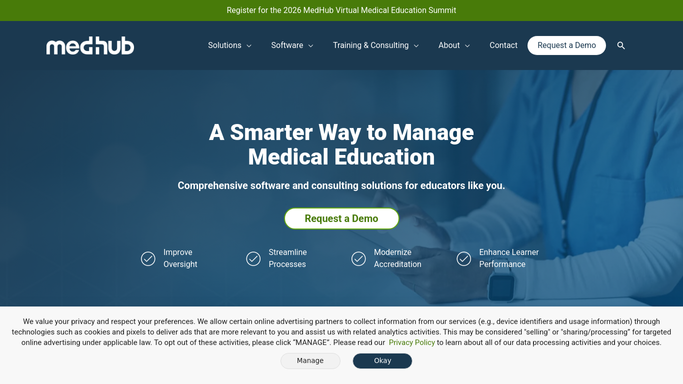
Evaluations, work hours and milestones are MedHub's home ground
MedHub does the internal half of this thoroughly, and a programme should have all of it switched on first.
Work Hours Reporting gives residents a time sheet and the programme automatic alerts on late or incomplete hours and on violations, one of the first things an accreditor asks about. The competency-based assessment module scores trainees against ACGME Milestones and Entrustable Professional Activities with procedure logging attached, and Annual Program Evaluation pulls evaluations, procedures, hours and curriculum goals into the yearly review. Dynamic Forms collects onboarding, reappointment and offboarding documents, PLA Manager runs Program Letters of Agreement through their approvals, and Credentials Monitoring tracks state, DEA and controlled substances licences with automatic expiry alerts. Rotation, call and clinic schedules sit alongside, and the mobile app lets an evaluation get finished on a phone.
All of that works from what the programme puts in, or from a system MedHub integrates with.
Credentials Monitoring will tell you a licence expires in April. Whether the board has issued the new one is a fact on the board's website, and the same goes for the badge, the clearance and the certification card.
The intern who cannot start in July is knowable in May
A programme able to read the boards, the hospital portals and the certification sites gets its bad news in spring rather than on the first of July.
Every incoming intern's training licence looked up on the issuing state board each week from March, so an application that stalled is a phone call in May instead of a hole in the rota. Registrations checked the same way.
Onboarding chased where it actually happens: the affiliate hospital's own portal, read against your incoming roster, so the interns with no badge, no record access and no health clearance are named with weeks left to clear them. Life support cards confirmed on the training provider's site rather than trusted to a forwarded email.
Procedure counts set against the minimums a specialty board publishes, so a fourth year finds a shortfall with a year to close it. Away rotation paperwork followed on the host institution's system, and fellowship application statuses collected from the sites that hold them.
None of that decides anything, and it should not. Reading a board's page and reporting what it says is clerical. Changing a trainee's record, telling somebody they are out of compliance, or submitting anything to an accreditor waits for the coordinator or programme director whose responsibility it is.
Judging a resident is the faculty's job; collecting the evidence is not
Somebody in the GME office is going to open the state board's lookup and the affiliate hospital's portal before July. Doing it in March is the difference between an inconvenience and a rota nobody can staff.
WebRun is an AI agent that drives a real Chrome browser, signed in the way your office signs in. It works state board lookups, hospital onboarding portals, certification sites and specialty board pages, reads what is on them, and brings back a list against your roster with the gaps marked.
Runs happen on your schedule in your own environment, and a workflow can be restricted to an explicit list of domains. You can watch one and stop it.
The workflows below each list the sites they open.
Questions people ask
Will it complete an evaluation or sign off on a resident?
No. Assessment is a faculty judgement and stays one. An agent gathers and reports: what a board's site shows, which onboarding items are outstanding, who is behind on hours. Anything written into a trainee's record, or sent to a resident or faculty member, is drafted and waits for approval.
Does anything get submitted to the ACGME on our behalf?
No, and it should not. Submissions to an accreditor or a licensing body carry a name and a signature behind them, so those stay with the coordinator or programme director. Reading a published status, a deadline or a case log requirement is the part worth handing over.
We work with four affiliate hospitals, each with its own portal. Can it cope?
No. Because it works a browser rather than an integration, a portal only has to be something a person can sign into. Several hospitals with different systems is the normal case, and each one can be a separate workflow reporting into the same roster view.
12 ready-made MedHub workflows
Each one names the apps it touches and the exact steps it takes. Open one to read what it will do, then turn it on.

Want one of these running on your own MedHub?
Show WebRun the process once and it will run it on schedule, in your own private browser environment.