How to Automate Klaviyo
Klaviyo automates the sending. Flows trigger on events its integrations supply, segmentation slices the audience on almost any condition, and data science predicts a next order date and a churn risk. Working out who should get an email when the reason sits in a system Klaviyo cannot see is the gap WebRun fills.
 Written by
Rosa Lindqvist
Operations editor
Written by
Rosa Lindqvist
Operations editor
 Reviewed by
Aiko Tanabe
Product researcher
Reviewed by
Aiko Tanabe
Product researcher
Klaviyo knows what each customer did, not just who they are
Klaviyo is a marketing platform built for businesses that sell things, and what separates it from a mailing list is memory. A profile in Klaviyo is not a name and an email address. It is a record of what that person viewed, what they left in a basket, what they bought, when they last opened anything, and what the data science reckons they will do next.
That is what makes the automated flows worth having. A welcome series greets somebody who has just signed up. An abandoned cart reminder goes to the person who got as far as checkout. A back in stock reminder waits for the product to return and then tells the people who asked for it.
The businesses running it are rarely large. A chocolatier, a supplement shop, a cigar lounge, a laser hair removal studio. One person handles marketing alongside three other jobs, and Klaviyo is the tool that lets them behave like a much bigger company on a Tuesday afternoon.
Every send starts with a list somebody exported
The flows run themselves. The campaigns do not.
Every promotion begins with somebody deciding who should get it and why, and that decision is made by going and looking. Opening the booking software to see which clients have a package expiring this month. Reading the point of sale to find who bought the thing that is now on offer. Scrolling a membership list for the people who lapsed in the spring. Checking the spreadsheet somebody keeps of last season's customers who have not rebooked.
Then it gets copied across. A file exported, tidied up, uploaded as a list, and out of date by the following week. Or worse, retyped, with two or three addresses fat-fingered on the way.
The email itself takes twenty minutes. Working out who it should go to took the morning, and it will take the morning again next month, because the answer has changed.
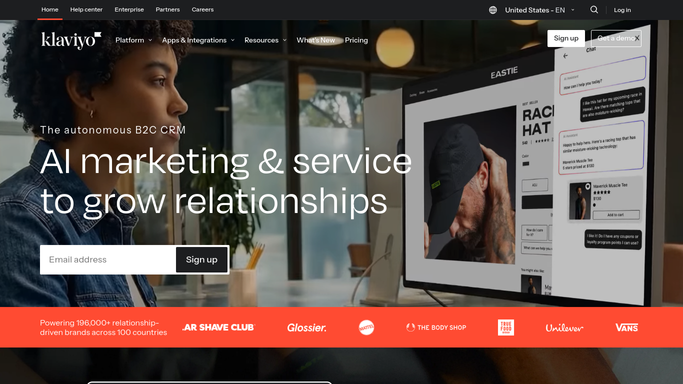
The integration list decides what a flow can know
Klaviyo is genuinely good at the part it owns, and it owns quite a lot.
Segmentation slices an audience on almost any condition you can express. Data science predicts a next order date, a lifetime value and a churn risk for each profile. Web forms capture signups from a popup or an embedded block. Benchmarks compare your numbers against similar brands. A/B tests settle arguments about subject lines. There are ready-made flows for the standard sequences, and the drag-and-drop builder handles conditional splits without anyone writing code.
All of that runs on events Klaviyo receives. It integrates with hundreds of platforms, and if you sell on one of them the events arrive on their own: viewed a product, started checkout, placed an order, price dropped.
If you do not, Klaviyo hears nothing. The salon software, the class booking system, the specialist point of sale, the membership platform written for one trade: those hold the fact that would justify the email, and they never built a Klaviyo integration and probably never will. A flow cannot trigger on something nobody told it about.
The reason to send can come from the till, not the website
What justifies an email usually sits in the booking software or at the counter, behind a login.
Clients with a prepaid package expiring in the next thirty days, read out of the booking software each morning, with a personal reminder drafted for each one. Members whose loyalty points fall off at the end of the month, pulled from the point of sale before the points go. The regulars who buy a particular line and have not been in for forty-five days, matched against the fact that the line is back on the shelf.
Off-peak slots still empty in next week's diary, turned into an offer aimed at the people who usually book that hour. Last season's customers who have not rebooked, checked against this season's confirmed list so nobody gets a nudge they already answered. A new product added at the counter, matched to the customers who buy in that category anyway.
Each of those is a real reason to email somebody, sitting in a system Klaviyo cannot see. Writing the email was never the hard part. The list was, and the list is the part that can be assembled without anyone opening a tab.
Nothing goes out before a person reads it
The segment can be built for you. The sending should not be, and this is the one place worth being firm about.
WebRun is an AI agent that works a real Chrome browser, signed in as you. It opens the booking system, the point of sale or the membership platform, reads who qualifies, and prepares the campaign or the flow message in Klaviyo with the right people attached. Because it works the browser rather than an API, it reaches the systems that never built a Klaviyo integration.
Then it stops. A marketing email is irreversible in a way a spreadsheet is not: a wrong send cannot be recalled, and it costs unsubscribes and sometimes a reputation. Everything is left in draft for a person to read and send.
It runs on your schedule in your own private environment, and you can watch a run and stop it. The workflows below are already built, and each one names the systems it opens.
Questions people ask
Do we need a Klaviyo integration for our point of sale?
No, and that is usually the point. Where a system has no Klaviyo integration, WebRun signs into it in a browser the way you do, reads who qualifies, and builds the list in Klaviyo without anything being connected to anything.
Could it send a campaign to the wrong people?
It does not send. Campaigns and flow messages are prepared with the audience attached and left in draft, so the last look is always a person's. That is deliberate, because an email that has gone cannot be unsent.
How does it match a customer in another system to a Klaviyo profile?
On the details both systems already hold, normally the email address, with the phone number as a fallback. Anyone it cannot match confidently is listed separately instead of guessed at, so nobody receives somebody else's offer.
32 ready-made Klaviyo workflows
Each one names the apps it touches and the exact steps it takes. Open one to read what it will do, then turn it on.
 Shopify›Shopify›
Want one of these running on your own Klaviyo?
Show WebRun the process once and it will run it on schedule, in your own private browser environment.